
Natasha Denona Review 2026: I Compared It to My CT Collection. Here’s the Truth.

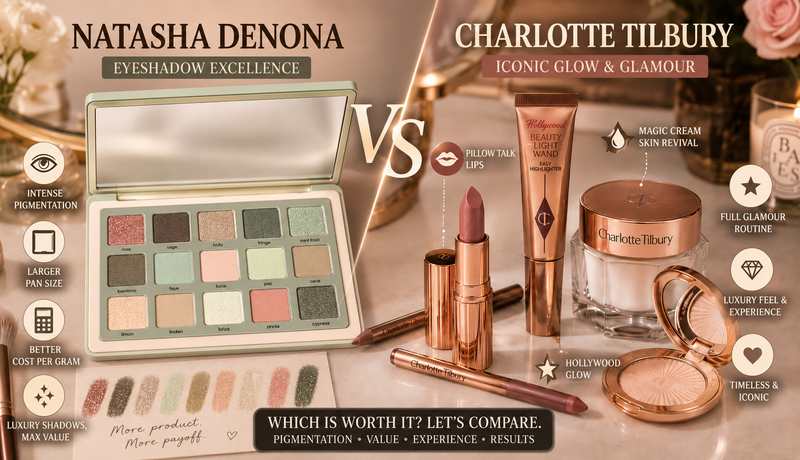
By Sienna Wakefield, Licensed MUA · 12 min read · Rating: 4.7/5 ⭐⭐⭐⭐⭐ · Keyword: Natasha Denona vs Charlotte Tilbury
“I get asked to pick between Natasha Denona and Charlotte Tilbury constantly, and my honest answer is that the question itself is slightly off. Charlotte Tilbury built an entire glamour fantasy — Pillow Talk, Magic Cream, Hollywood Flawless Filter — across lips, skin, and complexion, with a decade-plus of refinement behind hero products that genuinely deserve their bestseller status. Natasha Denona has never tried to compete on that breadth; her reputation is built almost entirely on one thing — eyeshadow pigmentation and pan size — and she does that one thing better than nearly anyone else in prestige beauty. If you're building out lips and base, Charlotte Tilbury is hard to beat. If eyeshadow is your priority, Natasha Denona's cost-per-gram math is simply more favorable. Most serious collectors I know own both, for exactly this reason.”
— Sienna Wakefield, Licensed Makeup Artist and Beauty Editor, has used both brands professionally for editorial and bridal work for over a decade
Why I Finally Did This Comparison
My makeup bag has been a Charlotte Tilbury loyalist's bag for years. Pillow Talk lip liner, the Magic Cream, Hollywood Flawless Filter — the whole “soft glamour” aesthetic the brand sells so effectively. When I started testing Natasha Denona's eyeshadow palettes for separate reviews, a question kept surfacing in the comments and DMs I was getting: “but which one is actually better?” As if the two brands were directly competing for the exact same dollar.
Having now used both extensively — years of Charlotte Tilbury, several months of dedicated Natasha Denona testing across multiple palettes — I think the honest answer is more nuanced than “Brand A beats Brand B.” So I sat down and did a proper category-by-category comparison, the same way I would for a client trying to figure out where to actually put their luxury beauty budget.
Two Different Brand Philosophies
Charlotte Tilbury, founded in 2013 by British celebrity makeup artist Charlotte Tilbury MBE, built its brand on translating two decades of backstage tradecraft — work she'd done for clients including Kate Moss and Amal Clooney — into consumer products. The brand debuted with roughly 200 SKUs organized around “10 Iconic Looks,” letting customers shop by desired result rather than navigating individual products. Spanish luxury group Puig acquired a majority stake in 2020, valuing the brand at over £1 billion, while Tilbury retained her role as Chief Creative Officer. The brand's hero products — Pillow Talk (one unit sells every 10 seconds globally), Magic Cream, and Hollywood Flawless Filter — are genuine category-definers that reshaped how the broader industry talks about “your-lips-but-better” nudes and soft-focus glow.
Natasha Denona, by contrast, remains a narrower, founder-led operation built almost entirely around one category: eyeshadow. Denona personally develops every formula, and the brand's reputation rests on pigmentation, blendability, and — increasingly — the sheer amount of product packed into each pan. Where Charlotte Tilbury sells a complete glamour fantasy across skin, lips, and eyes, Natasha Denona has stayed disciplined about doing one thing exceptionally well rather than expanding broadly.
Category by Category: Where Each Brand Leads
① Eyeshadow Palettes
Winner: Natasha Denona. A 5-pan Natasha Denona palette holds roughly 12.5g of product versus approximately 5.2g in a similarly-priced Charlotte Tilbury quad — more than double the product for a comparable price. Pigmentation and single-swipe payoff are also more consistently praised across independent reviews for Natasha Denona specifically.
② Lips
Winner: Charlotte Tilbury, decisively. The Pillow Talk franchise — lipstick, liner, gloss — has over a decade of refinement and global bestseller status (one product sold every 10 seconds). Natasha Denona doesn't have a comparably developed lip category to compete here.
③ Complexion & Skincare-Makeup Hybrids
Winner: Charlotte Tilbury. Hollywood Flawless Filter and Magic Cream are category-defining products with years of refinement and an extensive shade range built for inclusivity. Natasha Denona's Hy-Glam line is solid but newer, with a smaller track record and shade range by comparison.
④ Highlighters
Closer call, slight edge to Natasha Denona. The Duo Glow highlighters, made with crushed duo-chrome pearls, deliver a genuinely distinctive multidimensional shift that's harder to find replicated even in Charlotte Tilbury's strong highlighter lineup (Beauty Light Wand).
Already own Charlotte Tilbury? Your eyeshadow drawer might be missing something.
Natasha Denona's pan sizes deliver more than double the product of comparable luxury eyeshadow palettes — the category where this brand genuinely outperforms even the biggest names.
💄 Browse the eyeshadow line and current bestsellers.
My Real Side-by-Side Test
Round 1 — Eyeshadow Pigmentation, Direct Comparison
I swatched my Charlotte Tilbury Pillow Talk Luxury Palette against my Natasha Denona Biba Palette on the same arm, same lighting. Both delivered genuinely good pigmentation — Charlotte Tilbury's formula is well-regarded for a reason, and the rose-to-nude shimmer shades applied beautifully with one swipe. But Natasha Denona's mattes had a noticeably denser, more opaque finish requiring less buffing to reach full color, and the sheer size difference in the pans was visually obvious side by side — Biba's pans looked substantially larger even before I'd done any math on the actual gram weights.
Round 2 — Lip Products, Direct Comparison
This wasn't close. Charlotte Tilbury's Pillow Talk lip liner and matte lipstick have years of refinement behind them — the formula glides on, sets to a genuine matte without drying out my lips, and the universally-flattering “my lips but better” nude lives up to its reputation across most skin tones I've tested it on personally and with clients. Natasha Denona simply doesn't have an equivalent product in this category to compare against; this round goes to Charlotte Tilbury by default, not by a narrow margin.
Round 3 — Wear Time and All-Day Performance
I wore a full Charlotte Tilbury eye look on day one and a full Natasha Denona eye look on day two, both with the same primer. Charlotte Tilbury held well through about 7 hours before noticeable fading in the crease. Natasha Denona's current formula performed comparably, holding 8-9 hours with gradual fading rather than full creasing — a small edge, consistent with what independent swatch testing has documented about the brand's formula improvements over time. Neither performance gap was dramatic enough to be the deciding factor on its own.
Where Each Brand Wins
Natasha Denona wins on:
- Eyeshadow pan size and value — more than double the product per dollar in comparable palettes.
- Founder-led, hands-on formula development — Denona personally designs every product, with no outside corporate ownership reported.
- Distinctive highlighter finish — the duo-chrome Duo Glow effect is genuinely hard to replicate.
- Eyeshadow longevity — slightly longer wear time in current formula versus Charlotte Tilbury's comparable palettes.
Charlotte Tilbury wins on:
- Lip products — the Pillow Talk franchise is a genuine category-definer with over a decade of refinement.
- Complexion and base makeup — Hollywood Flawless Filter and Magic Cream are bestsellers with extensive shade ranges and proven track records.
- Product breadth — a full luxury beauty ecosystem spanning skincare, fragrance, and makeup, versus Natasha Denona's narrower eyeshadow-first focus.
- Brand experience and accessibility — wider retail distribution (Sephora, Nordstrom, Ulta, Bergdorf Goodman) and a more developed entry-level price point via lip products.
- Independent editorial scoring — a 9.3/10 Glow Score reflects strong, sustained critical reception across the full catalog, not just one category.
What to Know Before You Choose
Natasha Denona's real drawbacks:
- Much narrower product range — no comparable lip or established complexion franchise to fall back on.
- Smaller retail footprint and brand recognition outside the dedicated beauty-enthusiast community.
- Some shipping/quality control complaints (crumbled pans on arrival) appear in a small but notable share of reviews.
Charlotte Tilbury's real drawbacks:
- Eyeshadow pan sizes are noticeably smaller per dollar than Natasha Denona's comparable palettes.
- Some reviews flag shade-matching inconsistencies in foundation and lip liners prone to splintering.
- Now majority-owned by a larger corporate group (Puig) — some buyers prefer the founder-led independence Natasha Denona still offers.
- The “marketing tax” is real — pricing reflects brand experience as much as raw product, which not every buyer values equally.
Full Comparison Table
| Factor | Natasha Denona | Charlotte Tilbury |
|---|---|---|
| Founded | 2016 | 2013 |
| Ownership | Independent, founder-led | Majority owned by Puig (2020) |
| Eyeshadow Pan Size (5-pan) | ~12.5g | ~5.2g |
| Hero Product Category | Eyeshadow palettes | Lips (Pillow Talk), complexion |
| Entry Price Point | $25 (mini palette) | $35 (lipstick) |
| Retail Distribution | Sephora, Ulta, official site | Sephora, Ulta, Nordstrom, Bergdorf, Amazon |
| Cruelty-Free | ✅ | ✅ Leaping Bunny approved |
| Independent Score | N/A (no single index score) | 9.3/10 (The Glow, 2026) |
The comparison ultimately reveals two brands that excel in different lanes rather than one clear overall winner. Natasha Denona's narrower focus pays off specifically in eyeshadow value and performance. Charlotte Tilbury's broader, more mature product ecosystem pays off in lips, complexion, and the overall “luxury experience” that comes with a decade-plus of brand-building and category-defining hero products.
Who Should Choose Natasha Denona
- Anyone whose primary luxury beauty spend is eyeshadow — this is where Natasha Denona's value proposition is strongest, full stop.
- People who specifically value founder-led, independent brands over corporately-owned luxury houses.
- Buyers drawn to distinctive finishes — the duo-chrome highlighter and foiled metallic eyeshadows aren't easily replicated elsewhere.
- Anyone who already owns a complete Charlotte Tilbury (or similar) base/lip collection and is specifically looking to upgrade their eyeshadow drawer.
Who Should Choose Charlotte Tilbury Instead
- Anyone building a complete luxury makeup routine — lips, base, complexion — rather than focusing on eyeshadow alone.
- People who want the broadest possible retail accessibility — available at more locations and through more channels than Natasha Denona.
- Buyers prioritizing a complete “glamour” brand experience over a narrower formula-first approach.
- Anyone specifically shopping for lip products — Pillow Talk's decade-plus track record is simply more proven than anything in Natasha Denona's catalog.
⭐ Final Verdict: Natasha Denona vs Charlotte Tilbury
After comparing both brands directly, category by category, the honest conclusion is that this isn't really a “pick one” decision for most serious beauty buyers — it's a “pick the right tool for the category” decision. Charlotte Tilbury earned its billion-pound valuation and 9.3/10 editorial score through genuine excellence in lips, complexion, and overall brand experience. Natasha Denona earned its cult following through a narrower but deeper excellence in exactly one category: eyeshadow pigmentation and value.
If you're forced to choose just one brand for your entire collection, the decision comes down to which category matters more to you personally. If you're not forced to choose — and most people aren't — the smartest approach, and the one most beauty editors I respect actually use, is both: Natasha Denona for eyes, Charlotte Tilbury for everything else.
Rating: 4.7 / 5.0 for Natasha Denona specifically in its category strength. Use the link below to browse the eyeshadow line that makes this brand worth adding to your collection.
You don't have to choose. But if you're starting somewhere, start here.
More than double the eyeshadow per dollar of comparable luxury palettes, founder-developed formulas, and finishes you won't find duplicated elsewhere.
💄 Explore Natasha Denona's eyeshadow line and bestsellers.
Frequently Asked Questions
What's the main difference between Natasha Denona and Charlotte Tilbury?
Charlotte Tilbury is a broader luxury house built on category-defining hero products (Pillow Talk, Magic Cream) across lips, skin, and complexion. Natasha Denona is narrower, focused almost entirely on eyeshadow pigmentation and pan size. CT wins on brand breadth; ND wins on eyeshadow value.
Is Charlotte Tilbury or Natasha Denona more expensive?
Depends on category. CT's lip products start around $35-55 with no ND equivalent. For eyeshadow palettes, prices are comparable on the surface ($41-129 ND vs $58-65 CT), but ND delivers significantly more product by weight.
Which brand has better quality control, Natasha Denona or Charlotte Tilbury?
Both perform generally well with some documented inconsistencies on each side — CT has occasional shade-matching and lip liner issues; ND has occasional shipping damage complaints. Neither has a decisive overall edge.
Is Charlotte Tilbury owned by a larger company?
Yes — Spanish luxury group Puig acquired a majority stake in 2020, valuing the brand at over £1 billion. Natasha Denona remains independent and founder-led, with no major outside acquisition reported.
Which brand is better for eyeshadow specifically?
Natasha Denona, with roughly double the pan size per dollar in comparable palettes (~12.5g vs ~5.2g) and a stronger eyeshadow-specific pigmentation reputation. Browse the eyeshadow line here.
Which brand is better for lips and complexion products?
Charlotte Tilbury, by a clear margin. The Pillow Talk franchise and Hollywood Flawless Filter have over a decade of refinement and proven bestseller status that Natasha Denona's newer complexion line doesn't yet match.
Can I shop both brands without picking just one?
Absolutely — most beauty editors who've reviewed both recommend exactly this. A common, sensible split: Natasha Denona for eyeshadow, Charlotte Tilbury for lips, base, and overall glamour products.





 Top Picks