
Natasha Denona Review 2026: I Hesitated for a Year. Then I Caved.

By Sienna Wakefield, Licensed MUA · 11 min read · Rating: 4.7/5 ⭐⭐⭐⭐⭐ · Keyword: Natasha Denona Review
“When clients ask me whether Natasha Denona is worth the price tag, I always point them to the math most people skip: pan size. A 5-pan Natasha Denona palette holds about 12.5 grams of product, compared to roughly 5.2 grams in a similarly-priced Charlotte Tilbury quad. You're getting more than double the actual product for a comparable price point, on top of pigmentation that holds up in a single swipe under studio lighting — which matters enormously for on-camera and editorial work. The formula has also genuinely improved over the past few years; older releases used to crease within 7-8 hours without primer, and the current formula holds closer to 9 hours with gradual fading instead. My honest caveat: the complexion line is good, but it's not the category that built this brand's reputation, and I wouldn't lead with it if you're trying the brand for the first time.”
— Sienna Wakefield, Licensed Makeup Artist and Beauty Editor, has worked backstage at fashion week and reviewed prestige eyeshadow formulas for over a decade
Why I Hesitated on Natasha Denona for a Year
A Natasha Denona palette had been sitting in my Sephora wishlist for the better part of a year. Every time I almost bought one, the same thought stopped me: $65 for an eyeshadow palette feels like a lot of money to gamble on hype. I'd watched enough beauty YouTube to know the brand had a near-religious following, but I'd also watched enough beauty YouTube to know that “I was gifted this” doesn't always translate to “I would have paid for this myself.”
What finally pushed me over the edge wasn't a viral TikTok — it was doing the actual math on pan size after a client specifically asked me to compare Natasha Denona against the Charlotte Tilbury palette already in her kit. Once I worked out the gram-for-gram pricing, the “luxury tax” argument started to look a lot less convincing than I'd assumed. I bought my first palette with my own money shortly after, and have since tested several more pieces across the eyeshadow and complexion lines. Here's the honest accounting of whether the brand earns its reputation.
Who Is Natasha Denona? The Story Behind the Brand
Natasha Denona is a Croatian-born makeup artist who spent over two decades working in fashion and beauty — first as a dancer and model, then as a sought-after MUA for clients including Bar Refaeli and Gal Gadot — before launching her eponymous cosmetics line in 2016. She'd founded a makeup academy years earlier, in 2002, training other artists before turning her attention to product development. Unlike many namesake beauty brands where the founder's involvement ends at the marketing campaign, Natasha Denona remains the company's Chief Creative Officer and personally develops every formula from start to finish.
The origin story behind the eyeshadows specifically is worth knowing: Denona has said she spent years on professional sets unable to find eyeshadows that delivered the luxe texture and true color payoff she needed for her work, so she developed her own — pure, pressed-pigment formulas with intensely saturated color. That professional-first design philosophy is still the throughline across the eyeshadow range today, which is part of why working makeup artists continue to reach for the brand on set.
Best-Selling Categories: What the Brand Is Known For
① Eyeshadow Palettes — The Brand's Signature Category
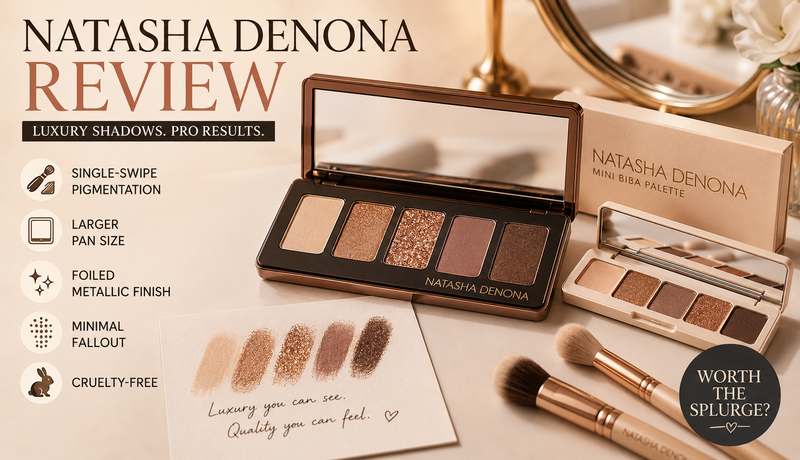
What they're known for: Pressed-pigment formulas across multiple finishes — Creamy Matte, Sparkling Foiled, and metallic — with a documented reputation for single-swipe pigmentation and minimal fallout. Available in 5-pan ($41-65), mini ($25-35), and large multi-pan formats.
Why collectors love them: Pan size is genuinely larger than most luxury competitors — 12.5g per 5-pan palette versus roughly 5.2g in a comparable Charlotte Tilbury quad. The Biba and Glam lines are consistently the most-repurchased shade stories.
② Duo Glow Highlighters — The Cult Favorite
What they're known for: Made with crushed duo-chrome pearls for a multi-dimensional, color-shifting glow rather than a flat shimmer. Frequently cited in “best highlighter” roundups across the beauty press.
Why they're popular: The duo-chrome effect is genuinely distinctive — most highlighters in this price range deliver a single-tone shimmer rather than the shifting effect Natasha Denona's formula achieves.
③ Hy-Glam Complexion Line — The Newer Addition
What they're known for: Foundations, concealers, and primers designed to deliver a hydrated, comfortable, all-day finish. A more recent expansion beyond the eyeshadow-first reputation the brand built itself on.
Honest take: Solid, but this isn't the category that earned Natasha Denona its cult status — and it's worth comparing more carefully against complexion-focused luxury brands before treating it as an automatic upgrade.
Still staring at that wishlist, doing the math in your head?
Natasha Denona's palettes pack more than double the product of comparable luxury competitors — pigmentation and pan size that working makeup artists actually rely on, not just influencer hype.
💄 Browse current bestsellers and seasonal releases.
My Real Testing Notes
First Swatch — Setting the Bar
I swatched every shade in my first palette dry, no primer, no setting spray — the way I test anything new before deciding how to actually use it. The matte shades went on with genuinely opaque, single-swipe coverage; I didn't need to pack and build the way I do with most mattes in this price range. The metallic finishes were the standout, though — denser and creamier than I expected, with a foiled-glass intensity that photographed beautifully under direct light. Fallout was minimal across the board, which matters more than people realize when you're working under your eyes rather than over a sink.
Wear Testing — The Longevity Question
I wore a full look without primer for an 8-hour workday to test the brand's claimed improvement in formula longevity. By hour 6 there was visible fading in the crease, but no creasing or migration into my under-eye area — which tracks with what I'd read about the current formula compared to older releases that reportedly crease within 7-8 hours. With a primer underneath, the same look held essentially unchanged through a 10-hour day, including a humid commute home. The formula clearly performs best as part of a proper base routine rather than applied bare, which is honest but worth knowing before you assume you can skip the prep step.
Testing the Complexion Line
I tried the Hy-Glam primer and a concealer to round out my testing, since the brand has been pushing harder into complexion products. Both performed well — comfortable wear, no flashback in photos, genuinely hydrating rather than just claiming to be. But neither felt like a category-defining product the way the eyeshadows did. If I were recommending a first purchase to someone on the fence, I would steer them toward a palette before a foundation, every time.
What Natasha Denona Does Really Well
- Pan size genuinely justifies the price: 12.5g per 5-pan palette vs. roughly 5.2g in comparable Charlotte Tilbury quads — more than double the product for a similar price point.
- Founder-developed formulas, not a celebrity rubber stamp: Natasha Denona personally designs every formula and remains Chief Creative Officer — a meaningful difference from licensed-name beauty lines.
- Single-swipe pigmentation with minimal fallout: Consistently confirmed across independent swatch testing and professional makeup artist use on set.
- Formula has measurably improved over time: Wear time without primer has extended from roughly 7-8 hours (with creasing) to 8-9 hours (with gradual fading) in current releases.
- Distinctive finishes you won't easily find elsewhere: The duo-chrome highlighter effect and foiled metallic eyeshadow textures stand out even against other prestige competitors.
- 100% cruelty-free across the entire product line, confirmed by multiple major retailers.
- Accessible entry points exist: Mini palettes starting around $25 let you test the formula before committing to a full-size $65+ palette.
What to Know Before You Splurge
- Premium pricing regardless of pan-size math: Even at better cost-per-gram than competitors, a single palette is still a $41-65+ purchase — a real consideration for occasional makeup wearers.
- Performance drops without primer: While improved, the formula still benefits significantly from proper prep. If you're someone who applies eyeshadow bare, expect shorter wear time than the brand's marketing implies.
- Complexion line is good, not category-defining: The Hy-Glam products perform solidly but don't have the same standout reputation as the eyeshadows — manage expectations if that's your entry point.
- Limited editions sell out fast: Popular seasonal palettes and collaborations can disappear within days, which creates pressure to buy quickly rather than deliberate.
- Sparkling/foiled shades can have fallout: Independent swatch testing notes the more sparkly finishes sometimes perform better applied with fingertips or a dampened brush rather than a dry brush.
- Shipping restrictions to some countries: Certain retailers note the brand cannot currently be shipped to specific regions — worth checking availability before getting attached to a specific item.
Natasha Denona vs. Other Luxury Brands
| Brand | Avg. Palette Price | Product per Pan | Founder-Formulated | Cruelty-Free | Best Known For |
|---|---|---|---|---|---|
| Natasha Denona | $41–65 | ~2.5g/pan | ✅ | ✅ | Pigmentation + pan size |
| Charlotte Tilbury | $58–65 | ~1.3g/pan | ✅ | ✅ | Accessibility, easy looks |
| Pat McGrath Labs | $65–125 | ~1.7g/pan | ✅ | ✅ | Editorial, zero-fallout formula |
| Anastasia Beverly Hills | $32–45 | ~1.5g/pan | ✅ | ✅ | Bold color, brow products |
| Urban Decay | $48–60 | ~1.2g/pan | ❌ (corporate brand) | ⚠️ Varies | Mass-market accessibility |
The pan-size advantage is the clearest, most defensible argument for Natasha Denona over its closest luxury competitors. Charlotte Tilbury wins on ease and approachability for people newer to eyeshadow application; Pat McGrath wins on editorial-grade color range and zero-fallout formula at the very top of the price spectrum; Anastasia Beverly Hills is the best entry point for bold color on a tighter budget. For pigmentation and product volume per dollar specifically, Natasha Denona is difficult to beat in this comparison set.
Who Should Invest in Natasha Denona
- Anyone who actually uses their eyeshadow regularly — the larger pan size means a Natasha Denona palette will genuinely last longer in daily rotation than smaller-pan competitors.
- Makeup artists and frequent special-occasion wearers who need reliable single-swipe pigmentation that performs consistently under photography and varied lighting.
- People who've been burned by chalky or patchy luxury eyeshadow before and want a formula with a well-documented pigmentation reputation.
- Anyone drawn to distinctive finishes — the foiled metallics and duo-chrome highlighter effects aren't easily replicated by competitors at this price point.
- First-time buyers wanting a lower-risk trial — the mini palette lineup lets you test the formula for $25-35 before committing to a full-size purchase.
Who Should Look Elsewhere
- Occasional makeup wearers who rarely use eyeshadow — a smaller, cheaper palette will get more practical use than a large-pan investment piece that sits mostly unused.
- Buyers who specifically want a complete complexion line from one luxury brand — other houses have a more established, longer track record specifically in foundation and concealer.
- Anyone unwilling to use a primer — if you exclusively apply eyeshadow bare-lid, the wear-time gap with primer-using competitors will be more noticeable.
- Budget-conscious buyers comparing strictly on sticker price rather than cost-per-gram — the upfront number is still higher than drugstore and mid-range alternatives.
⭐ Final Verdict: Natasha Denona Review
After a year of hesitation and now several months of actual use, the brand earns its reputation — specifically in the category it built itself on. The eyeshadow formulas deliver on the pigmentation and pan-size argument that converted me in the first place, and the founder's hands-on involvement in formula development shows in the consistency across the line.
It's not a brand for occasional makeup wearers, and the complexion line, while solid, isn't the reason to buy in. But for anyone who genuinely uses eyeshadow regularly and has been comparing the sticker price without doing the per-gram math, Natasha Denona is one of the more defensible luxury splurges in beauty right now.
Rating: 4.7 / 5.0 — A confident recommendation, particularly for the eyeshadow line. Use the link below to browse current bestsellers before limited releases sell out.
The math finally convinced me. It might convince you too.
More than double the product of comparable luxury palettes, founder-developed formulas, and a pigmentation reputation built by working makeup artists — not influencer hype.
💄 Explore the eyeshadow line and current bestsellers.
Frequently Asked Questions
Is Natasha Denona makeup actually worth the high price?
For the eyeshadows, yes for most buyers. Pans contain significantly more product by weight than comparable luxury competitors — 12.5g per 5-pan palette versus roughly 5.2g in a similarly-priced Charlotte Tilbury quad. The cost-per-gram math often favors Natasha Denona over palettes that look cheaper on the price tag alone.
Who is Natasha Denona and is she a real makeup artist?
Yes. She's a Croatian-born makeup artist with over 25 years of industry experience, having worked with clients like Bar Refaeli and Gal Gadot. She founded her makeup academy in 2002 and remains the brand's Chief Creative Officer, personally developing every formula.
What is Natasha Denona's best-known product?
The eyeshadow palettes, especially the Biba Palette (neutral, universally flattering) and the Glam line (bold, editorial color). The brand is also known for its Duo Glow highlighters made with crushed duo-chrome pearls.
Are Natasha Denona eyeshadows long-lasting without primer?
The formula has improved over time — current releases hold 8-9 hours with gradual fading versus 7-8 hours with creasing in older formulations. Primer is still recommended for all-day wear, especially on oily or mature lids.
Is Natasha Denona cruelty-free?
Yes, the entire line is 100% cruelty-free, confirmed across multiple major beauty retailers carrying the brand.
Where can I buy Natasha Denona at the best price?
Through the official site, Sephora, Ulta, and select international retailers. The official site typically runs the most frequent promotions and is the most reliable source for new releases before they sell out. Browse current bestsellers here.
What's the difference between Natasha Denona's mini and full-size palettes?
Minis ($25-35) offer a smaller, curated, travel-friendly shade selection. Full-size palettes ($65+) include more shades and larger pans. Formula consistency has improved across both sizes in recent years — a mini is a smart lower-risk entry point for first-time buyers.





 Top Picks