
Beam Dream vs Calm Review 2026: The $13 Question I Finally Tested.

By Lauren Pruitt, CSSC · 10 min read · Rating: 4.5/5 ⭐⭐⭐⭐⭐ · Keyword: Beam Dream vs Calm
“The comparison between Calm and Beam Dream is really a comparison between two different jobs. Calm has been America's best-selling magnesium powder for over four decades because it does one thing reliably: replenish magnesium in an easily absorbed citrate form. It's not formulated as a sleep aid specifically — it's a general stress and tension reliever that many people happen to take at night. Beam Dream is a more complete sleep-onset formula, layering magnesium with L-theanine, reishi, apigenin, and melatonin. If your nighttime struggle is genuinely rooted in magnesium deficiency — muscle tension, restless legs — Calm at a third of the price may solve it just as well. If you need melatonin's circadian signal and a broader calming stack, Beam's premium is buying you a meaningfully different, more targeted tool, not just better branding.”
— Lauren Pruitt, CSSC, Certified Sleep Science Coach, evaluates supplement formulations for sleep hygiene coaching programs across both legacy and direct-to-consumer wellness brands
Why I Finally Tested the Newcomer Against the Classic
My mother has been drinking Natural Vitality Calm every night for as long as I can remember — it's the kind of product that quietly lives in the pantry of an entire generation, the powder you find at Whole Foods next to the protein bars, completely unbothered by TikTok trends. When I started testing Beam Dream a few weeks back and mentioned the $2-a-serving price tag to her, she laughed and pointed out that her tub of Calm works out to roughly 70 cents a serving. That comment stuck with me enough that I had to actually answer the question properly: is the newer, flashier, more expensive product earning that price gap, or is this just good marketing layered over what magnesium already does?
I bought a tub of Calm's Raspberry Lemon powder and ran it alongside my remaining Beam Dream supply for three weeks, switching every few nights, paying close attention not just to how I felt but to whether the price difference actually mapped onto a meaningful experience difference.
A 44-Year-Old Staple vs. a TikTok-Era Challenger
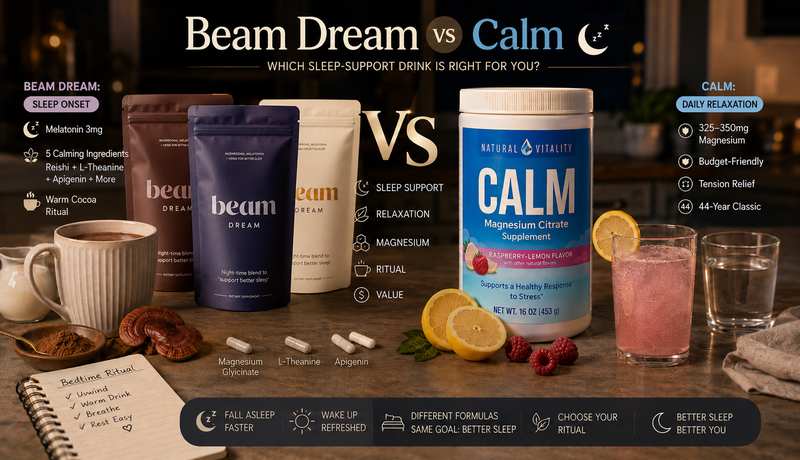
Natural Vitality Calm has been on shelves since 1982 and is, by sales volume, the best-selling magnesium powder brand in the natural products market. The formula is intentionally simple: magnesium carbonate and citric acid that combine with water to form ionic magnesium citrate — a highly absorbable form compared to magnesium oxide — at 325-350mg per serving depending on the variant. It's vegan, gluten-free, sugar-free, and fizzes when mixed with warm water, which the brand leans into as part of the calming ritual itself. Notably, Natural Vitality also sells a dedicated Calm Sleep formula that adds L-theanine, GABA, and melatonin — a more direct comparison to Beam Dream than their original magnesium-only product.
Beam Dream, by contrast, is a 2018-founded brand built almost entirely on direct-to-consumer marketing and social media presence. Its formula takes a multi-mechanism approach — magnesium (60mg, a much smaller dose than Calm's), L-theanine (300mg), reishi mushroom (350mg), apigenin (50mg), and optional melatonin (3mg) — delivered as a warm cocoa drink rather than a fizzy citrus tonic.
The philosophical difference is stark: Calm's entire premise is that magnesium replenishment alone, in an easily absorbed form, is enough to support relaxation and sleep for most people. Beam Dream's premise is that sleep onset benefits from a broader combination of compounds working through different mechanisms simultaneously — at meaningfully higher cost per serving.
Side-by-Side: Ingredients, Format & Price
① Natural Vitality Calm (Original)
Active ingredient: Magnesium citrate (from magnesium carbonate + citric acid), 325-350mg per serving
Format: Fizzy powder, mixed with hot water first then topped with warm or cold water. Raspberry Lemon, Orange, Sweet Lemon, Cherry, Watermelon, and Unflavored
Price: ~$0.60-$1.00 per serving
Verdict: ⭐⭐⭐⭐ — The reliable, budget-friendly magnesium standard. Not formulated as a dedicated sleep aid, but genuinely effective for tension and stress-driven wakefulness at a fraction of premium competitors' cost.
② Natural Vitality Calm Sleep (The Real Comparison)
Active ingredients: Magnesium, L-theanine, GABA, and melatonin — a more direct match to Beam Dream's multi-mechanism approach
Positioning: Specifically for occasional sleep support, distinct from the everyday Calm magnesium-only formula
Verdict: ⭐⭐⭐⭐ — If melatonin and a multi-ingredient approach is what you're after, this is the fairer comparison to Beam Dream, still typically priced below Beam's per-serving cost.
③ Beam Dream Powder
Active ingredients: Reishi (350mg), L-theanine (300mg), magnesium (60mg), apigenin (50mg), melatonin (3mg, optional)
Format: Warm cocoa-based drink, 9+ dessert-inspired flavors
Price: $1.73-$2.16 per serving
Verdict: ⭐⭐⭐⭐½ — Lower magnesium dose than Calm, but compensates with four additional calming compounds and a genuinely more indulgent ritual experience.
Tired of choosing between cheap and effective?
Beam Dream combines five calming ingredients into one ritual — not just magnesium alone, but a complete sleep-onset formula in a genuinely enjoyable cocoa drink.
🌙 Try a sample pack before committing to a full bag.
My Three Weeks Switching Between Both
Week 1 — Calm, Following My Mother's Routine
I started conservatively, with half a serving as Natural Vitality recommends, gradually working up. The fizzing reaction when you add hot water is genuinely satisfying in a way I didn't expect — there's a small ritual quality to watching it bubble that I can see becoming habitual over decades, the way it clearly has for my mother. The Raspberry Lemon flavor was pleasant, tart rather than sweet. By night four at a full serving, I noticed real physical relaxation — looser shoulders, less of the restless-legs sensation I sometimes get after long days at my desk. Sleep onset was moderately improved, though not dramatically, landing somewhere around 25-30 minutes versus my baseline of 35-40.
Week 2 — Back to Beam Dream, Noticing the Contrast
Switching back to Beam Dream's Cinnamon Cocoa after a week of Calm's citrus fizz, the contrast in experience was immediate and significant — warm versus cold, dessert versus tonic, ritual versus quick fix. My sleep onset returned to my established Beam Dream baseline of roughly 15-25 minutes, faster than my best nights on Calm. This tracked with what I'd expect given Beam's inclusion of melatonin and additional calming compounds beyond magnesium alone. That said, I want to be fair: Calm never claimed to be a dedicated sleep-onset formula the way Beam Dream does, so this isn't entirely an apples-to-apples result.
Week 3 — The Honest Math
For the final week, I alternated nights deliberately and also did the math my mother's comment had originally prompted: at roughly 70 cents a serving for Calm versus $2 for Beam Dream, a month of nightly use runs about $21 versus $60 — a real $39 monthly difference. Is Beam Dream's faster, more complete sleep onset worth nearly three times the cost? For me personally, given that I specifically struggle with sleep onset rather than general tension, the answer leaned toward yes. But I fully understand why someone whose primary issue is stress and muscle tension rather than racing thoughts at bedtime would find Calm's simpler, cheaper approach entirely sufficient — and I'd have a hard time arguing they're wrong to stick with what's worked for over four decades.
Where Each One Wins
Beam Dream wins on:
- Sleep onset speed — the multi-ingredient approach including melatonin consistently outperformed Calm alone for falling asleep faster in my testing.
- The ritual experience — a warm, dessert-like cocoa drink is a more distinctive nightly habit than a fizzy citrus tonic.
- Flavor variety — 9+ flavors versus Calm's handful of citrus/fruit options.
- Purpose-built formulation — designed specifically as a sleep aid, not a general-purpose magnesium supplement repurposed for nighttime.
Calm wins on:
- Price — at roughly a third of Beam Dream's cost per serving, the value gap is substantial and real.
- Track record — 44 years on the market and the best-selling magnesium powder brand in the category, a credibility signal newer brands can't replicate.
- Higher magnesium dose — 325-350mg versus Beam Dream's 60mg, meaningful if magnesium deficiency is specifically your issue.
- Simplicity and ingredient transparency — one active ingredient, easy to understand exactly what you're taking and why.
- Widely available in stores — Whole Foods, Costco, Walmart, and most natural grocers, not just direct-to-consumer ordering.
What to Know Before You Choose
Beam Dream's real drawbacks:
- Significantly more expensive per serving — roughly 2-3x Calm's cost.
- Lower magnesium dose than Calm specifically, despite the broader ingredient list.
- Requires direct-to-consumer ordering; not available on most retail shelves.
Calm's real drawbacks:
- Can cause digestive issues (loose stools, cramping) if dosed too aggressively too quickly — magnesium citrate's laxative effect is well-documented.
- Not formulated as a dedicated sleep aid — if your issue is specifically racing thoughts or circadian misalignment rather than physical tension, the original formula may underdeliver.
- No melatonin in the standard formula (only in the separate Calm Sleep variant), so direct sleep-onset support is limited compared to Beam Dream.
- The fizzy preparation requires more steps (hot water first, then fill) than a simple cold mix.
Full Comparison Table
| Factor | Beam Dream | Calm (Original) |
|---|---|---|
| Founded | 2018 | 1982 |
| Magnesium Dose | 60mg | 325–350mg |
| Melatonin | 3mg (optional) | ❌ None (Sleep variant has it) |
| Total Active Ingredients | 5 | 1 |
| Price/Serving | $1.73–$2.16 | $0.60–$1.00 |
| Retail Availability | DTC + limited Amazon | ✅ Whole Foods, Costco, Walmart |
| Primary Use Case | Sleep onset specifically | General relaxation, tension relief |
The numbers tell an honest story: Calm wins decisively on price, magnesium dose, track record, and availability. Beam Dream wins on formula completeness specifically for sleep onset, ritual experience, and flavor variety. Neither is objectively “better” — they're solving adjacent but distinct problems at very different price points, and the right choice depends entirely on whether your nighttime struggle is rooted in physical tension (Calm's strength) or in needing a more complete sleep-onset signal including melatonin (Beam's strength).
Who Should Choose Beam Dream
- People who specifically struggle with sleep onset rather than general tension, and want melatonin's circadian support included by default.
- Anyone who wants a more indulgent nightly ritual — the warm cocoa format genuinely feels different from a fizzy tonic.
- People who've tried magnesium alone with underwhelming results and want to test a multi-ingredient approach instead.
- Buyers who value flavor variety and want options beyond citrus.
Who Should Choose Calm Instead
- Budget-conscious buyers — at roughly a third of Beam Dream's cost, Calm's value proposition for straightforward magnesium support is hard to beat.
- People whose primary issue is physical tension or restless legs rather than racing thoughts — a higher magnesium dose may be exactly what's needed.
- Anyone who prefers shopping in physical stores rather than ordering online — Calm's availability at Whole Foods, Costco, and Walmart is a real convenience advantage.
- Long-term, decades-proven brand loyalists who trust an established track record over newer DTC marketing.
⭐ Final Verdict: Beam Dream vs Calm
After three weeks of honest back-and-forth testing, my mother's skepticism turned out to be partially right and partially answered. Calm is a genuinely effective, decades-proven magnesium supplement at a fraction of Beam Dream's price — if your nighttime issue is physical tension, it may be all you need, and there's no shame in sticking with what's worked for 44 years.
But the price gap isn't pure marketing. Beam Dream's inclusion of melatonin alongside L-theanine, reishi, and apigenin produced a faster, more complete sleep-onset experience in my testing — a meaningfully different result, not just a fancier version of the same thing. For people who specifically struggle with falling asleep rather than general stress, that combination earns its premium.
Rating: 4.5 / 5.0 for Beam Dream as the stronger sleep-onset tool specifically. Use the link below to try a sample pack and decide if the premium is worth it for your specific sleep challenge.
My mother trusts the classic. I tested the challenger — and it earned its place.
Five calming ingredients including melatonin, in a warm cocoa ritual built specifically for falling asleep faster — not just relaxing.
🌙 Browse flavors and current Beam Dream promotions.
Frequently Asked Questions
What's the main difference between Beam Dream and Calm Magnesium?
Calm is a single-ingredient magnesium citrate powder (325-350mg) with no melatonin, best-selling since 1982. Beam Dream is a five-ingredient formula with reishi, L-theanine, magnesium, apigenin, and optional melatonin in a cocoa-based ritual.
Is Beam Dream worth the extra cost compared to Calm?
Depends on your need. Calm at $0.60-$1.00/serving may suffice for magnesium-deficiency-related tension. Beam Dream at $1.73-$2.16 justifies its premium if you specifically want melatonin and a broader calming stack for sleep onset.
Does Calm Magnesium actually help you sleep?
Many users report it helps, especially for tension-related sleep difficulty. The original formula has no melatonin; Natural Vitality's separate Calm Sleep variant adds L-theanine, GABA, and melatonin for more direct sleep support.
Can Calm Magnesium cause digestive issues?
Yes — magnesium citrate's laxative effect is well-documented at higher doses. Starting with a half-serving and increasing gradually, as recommended, helps most people avoid this.
Which has been around longer, Beam or Calm?
Calm since 1982 (44 years), the best-selling magnesium powder brand in its category. Beam was founded in 2018, building its presence primarily through social media and direct-to-consumer marketing.
Where can I find Beam Dream powder for the best deal?
The official site via this link offers $65 one-time or $52 subscription pricing, plus sample packs to try flavors first.


 Top Picks