

By Marcus Vega, Tech & Lifestyle Writer · 9 min read
On the Ditoo — The Desk Centerpiece:
“The Ditoo is totally adorable, fun, and useful — its retro look with backlit mechanical keyboard and the functional joystick just look so good on a desk. The DSP Bluetooth Speaker is surprisingly powerful for such a little unit, it comes with the unique DSP bass boost mode which can comfortably fill up a room with enjoyable sound. The display comes with 256 programmable LEDs that can display 16 million colours. You can make your own designs via the app — there is even a monthly pixel art contest.”
— The Review Smiths, independent tech publication — from their Divoom Ditoo feature (Issue 12)
On the Timebox Evo — The Portable Companion:
“The Timebox Evo was built for people who wanted the Divoom experience everywhere, not just at their desk. People were making Divoom devices part of their daily rituals — alarm clocks, mood lighting, gaming setups, travel companions. At 3.9 inches square and small enough for a jacket pocket, the Timebox Evo brings pixel art, smart features, and Bluetooth audio to every room you walk into.”
— Divoom, from “The Divoom Story” and product positioning (divoom.com)
I Own Both. Here's How I Decided Which One Goes Where.
The Divoom Ditoo sits on my desk. The Divoom Timebox Evo sits on my nightstand — and travels with me in my backpack. I didn't plan to buy both. I bought the Ditoo first because it looked incredible and I wanted it on my desk. Then I realized I wanted the Divoom experience in my bedroom and on trips too — but the Ditoo is too big to move around, and I didn't want to unplug it every night.
The Timebox Evo solved that. But if you're only buying one — which most people are — the choice between them is surprisingly meaningful. They share the same app, the same 700,000+ pixel art community, and the same 16×16 LED display. But the experience of using them is completely different. Here are the four differences that helped me decide — and that will help you decide which one belongs in your life.
🎮 Divoom Ditoo Pro
- Design: Retro all-in-one PC
- Speaker: 15W DSP, bass boost, 360°
- Display: 16×16 LED (256 px, 16M colors)
- Input: RGB mechanical keyboard + joystick
- Games: ✅ Snake, Tetris, Breakout +
- Size: 3.54″ × 4.48″ × 4.77″ (~350g)
- Battery: ~8 hours
- Charging: USB-C
- Price: ~$50–90
- Best for: Desk setup, gaming room, gifts
🔊 Divoom Timebox Evo
- Design: Minimalist portable cube
- Speaker: ~6W, Bluetooth 5.0
- Display: 16×16 LED (256 px, 16M colors)
- Input: Basic buttons only
- Games: ❌ No physical input for games
- Size: 3.9″ × 1.5″ × 3.9″ (~255g)
- Battery: 6–8 hours
- Charging: Micro-USB
- Price: ~$40–60
- Best for: Bedside, travel, portability
4 Differences That Helped Me Choose
① The Design Philosophy Is Opposite — Desk Statement vs Portable Companion
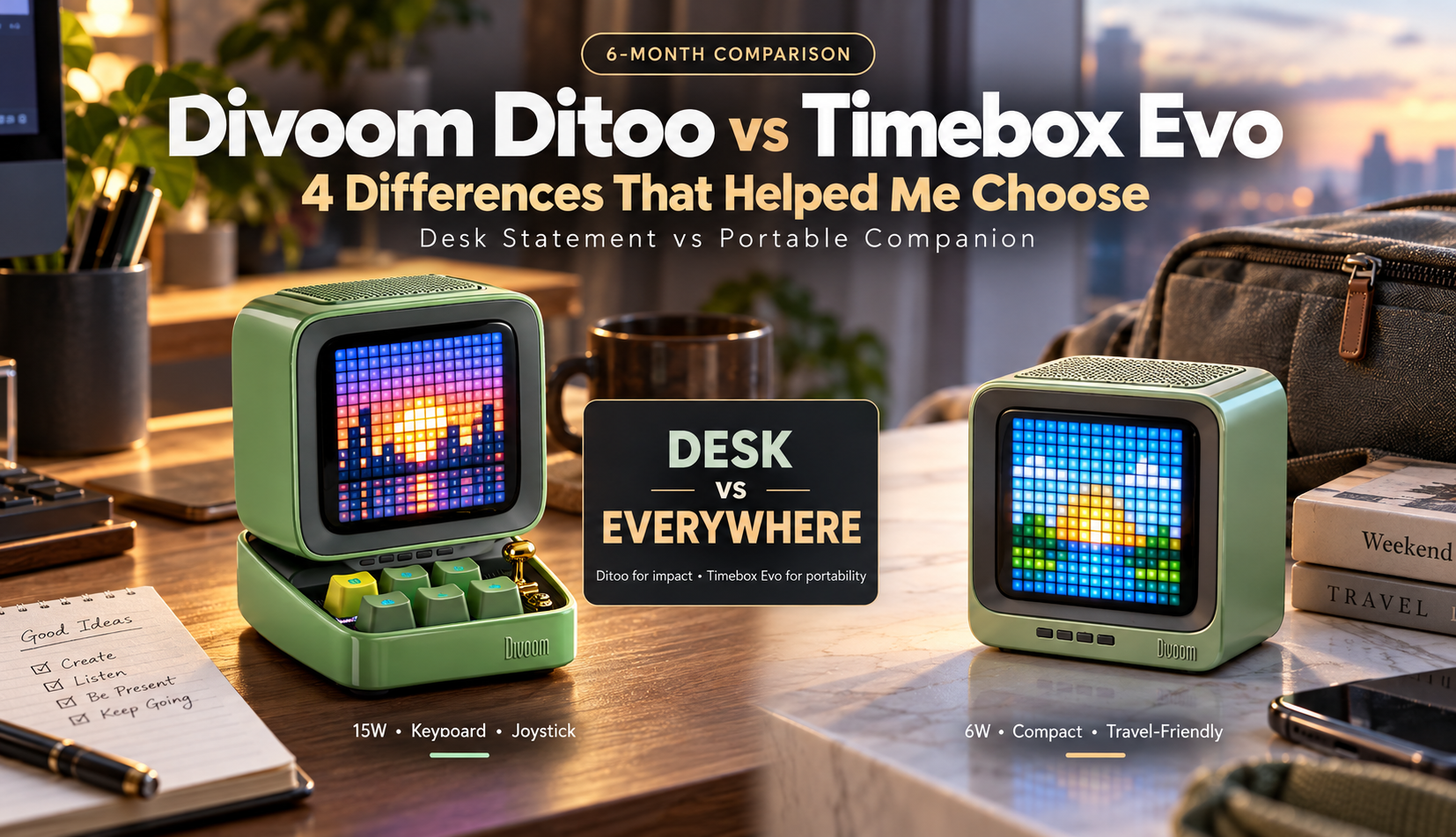
The Ditoo looks like a miniature retro computer. It has a clicky RGB mechanical keyboard (six keys), a functional joystick, a pixel art screen, and an overall aesthetic that says “I belong on a curated desk next to a gaming monitor.” It's designed to be seen, admired, and commented on. It's the kind of device that becomes the visual anchor of your workspace — the thing coworkers ask about during video calls.
The Timebox Evo is a minimalist cube. No keyboard, no joystick, no retro flourishes. Just a clean square face with a pixel art display and a few discreet buttons. It's designed to disappear into any room — your nightstand, kitchen counter, bathroom shelf, hotel desk — without demanding attention. It's the kind of device you carry in your bag without thinking about it, set down wherever you are, and use as naturally as checking the time. The Ditoo makes a statement: “I'm into cool tech.” The Timebox Evo makes no statement — it just works, wherever you put it. If you want your Divoom to be the centerpiece of a curated setup, buy the Ditoo. If you want it to be a quiet tool that follows your daily routine, buy the Timebox Evo.
⚖️ Ditoo for “look at this.” Timebox Evo for “use this everywhere.”
② The Audio Gap Is Significant — 15W Room-Filler vs 6W Personal Listener
This is the most objective, measurable difference between the two products. The Ditoo Pro packs a 15W DSP driver with bass boost mode and 360° sound projection. At 50% volume, it fills my 12 × 14 foot home office with clear, bass-present audio. At 80%, it handles a living room gathering. The bass has physical weight — you feel it vibrate the desk slightly. Podcasts are crisp. Music has depth. It's a legitimate desktop speaker that also happens to display pixel art.
The Timebox Evo's ~6W driver is a different experience. It fills a bedroom at comfortable listening volume. It handles podcasts and audiobooks beautifully — voice clarity is actually excellent for hands-free calls via the built-in microphone. But the bass is noticeably thinner, and at high volumes the speaker starts to strain in a way the Ditoo never does. It's audio for personal listening, not for filling a space. If your primary use is music at your desk, the Ditoo's 15W is a clear win. If your primary use is bedside audio, alarm sounds, white noise, and podcast listening — the Timebox Evo's 6W is genuinely sufficient and you won't miss the bass.
⚖️ Ditoo for desk music and room-filling audio. Timebox Evo for bedside, travel, and personal listening.
③ The Ditoo Has Retro Games — The Timebox Evo Has DJ Mixing (Both Are More Fun Than Expected)
The Ditoo's mechanical keyboard and joystick aren't just decorative — they enable built-in retro mini games. Snake, Tetris, Breakout, and several others run directly on the 16×16 LED display. The tactile satisfaction of clicky keys and a real joystick controlling pixel games is genuinely addictive — I play Snake during coffee breaks the way other people scroll their phones. It's a small, analog pleasure that creates a daily micro-ritual no other speaker can offer.
The Timebox Evo can't play games — no keyboard, no joystick, no physical input for gaming. But it has the DJ mixing feature through the Divoom app: virtual turntables, beat pads, and sound effects playing through the speaker in real time while the LED panel syncs as a visual equalizer. At dinner parties, the DJ mode has been my go-to party trick — handing someone my phone and letting them “mix” through the Timebox creates genuine entertainment. Different fun for different contexts: the Ditoo's games are solo entertainment during quiet moments. The Timebox Evo's DJ mode is social entertainment during gatherings. Neither is the reason you buy the product — but both become the reason you love it.
⚖️ Ditoo for solo retro gaming breaks. Timebox Evo for social DJ party tricks.
④ The Real Decision: Where Will You Use It Most?
After owning both for six months, the simplest decision framework is location-based. Ask yourself: where will this device spend most of its time?
If the answer is “my desk” → buy the Ditoo. It's designed to be a desk centerpiece. The retro computer design, the mechanical keyboard, the joystick, the 15W speaker — everything about it is optimized for a stationary desk setup where it can be plugged in, admired, and used as the visual and audio anchor of your workspace. Moving it between rooms is awkward and unnecessary.
If the answer is “my nightstand, my kitchen, my bag, multiple rooms” → buy the Timebox Evo. It's designed to travel with you. The pocket-sized cube, the 255g weight, the bedside alarm functionality, the built-in microphone for kitchen calls — everything about it is optimized for a device that moves through your day rather than sitting in one place. It sacrifices the Ditoo's desk drama for the portability that makes it useful in five rooms instead of one. Both are excellent. The difference is lifestyle, not quality. The Ditoo is for people who want their Divoom to be the star of their desk. The Timebox Evo is for people who want their Divoom to be a quiet companion throughout their entire day.
⚖️ One room, maximum impact → Ditoo. Every room, maximum flexibility → Timebox Evo.
Two Divooms. Two philosophies. Same 700K+ pixel art community. Both under $90.
Ditoo for your desk. Timebox Evo for your life. Or both — for less than a single premium speaker.
Full Comparison Table
| Category | Divoom Ditoo Pro | Divoom Timebox Evo | Winner |
|---|---|---|---|
| Design | Retro PC (keyboard + joystick) | Minimalist cube | Ditoo (desk aesthetic) |
| Speaker power | 15W DSP + bass boost | ~6W | Ditoo (2.5x louder) |
| Display | 16×16 LED (256 px) | 16×16 LED (256 px) | Tie (same resolution) |
| Retro games | ✅ Snake, Tetris, Breakout + | ❌ No physical input | Ditoo (exclusive) |
| Portability | Desk-first (~350g) | ⭐ Pocket-sized (255g) | Timebox Evo |
| Bedside alarm | ✅ (but stays on desk) | ⭐ Built for bedside (sunrise wake) | Timebox Evo |
| Built-in microphone | ❌ | ✅ Hands-free calls | Timebox Evo |
| DJ mixing | ✅ (via app) | ✅ (via app) | Tie (both via app) |
| Charging | USB-C | Micro-USB | Ditoo (modern port) |
| Color options | 6 colors | Black | Ditoo (more choice) |
| Gift “wow” factor | ⭐⭐⭐⭐⭐ | ⭐⭐⭐ | Ditoo |
| Price | ~$50–90 | ~$40–60 | Timebox Evo (cheaper) |
Score: Ditoo wins 6 categories. Timebox Evo wins 4. Two ties. But scores don't capture the real answer — these products aren't competing for the same use case. The Ditoo is the better desk product. The Timebox Evo is the better life product. The right choice depends entirely on where your Divoom will live.
Choose the Ditoo If…
- Your desk/gaming setup is where it'll live permanently — the retro PC design is the ultimate desk centerpiece. It stays plugged in, always on, always displaying.
- Audio quality matters to you — 15W with bass boost is 2.5x the Timebox Evo's power. Room-filling sound for music, podcasts, and background audio.
- You want retro games during breaks — Snake and Tetris on a 16×16 LED screen with a real joystick is a daily micro-pleasure the Timebox can't offer.
- You're buying it as a gift — the unboxing experience, retro design, and “what IS that?” factor make it the more impressive present. Available at divoom.com.
Choose the Timebox Evo If…
- You want a bedside alarm that isn't your phone — pixel art sunrise wake + white noise sleep timer = better mornings without the phone-scroll habit.
- Portability is essential — pocket-sized, 255g, moves between rooms and travels in your bag. The Divoom for every room, not just one.
- Budget is a factor — at $40–60, the Timebox Evo delivers the full Divoom ecosystem at the lowest price. Same app, same 700K+ designs, same smart features.
- You want hands-free calls — the built-in mic is great for kitchen cooking calls and desk speakerphone use. The Ditoo doesn't have a mic. Available at divoom.com.
⭐ Final Verdict: Divoom Ditoo vs Timebox Evo
Four differences, one simple framework: the Ditoo is the better product for a desk. The Timebox Evo is the better product for a life. The Ditoo wins on design drama, speaker power, retro gaming, and gift-worthiness. The Timebox Evo wins on portability, bedside functionality, hands-free calling, and price. Both share the same pixel art display, the same app, the same 700,000+ community, and the same “emotional technology” experience that makes Divoom unlike any other speaker brand.
My recommendation: if you can only buy one, decide by location. Desk → Ditoo. Everywhere else → Timebox Evo. If budget allows both ($90–150 combined), get both — the Ditoo stays on your desk, the Timebox Evo follows you through every other room. Together, they cover your entire day for less than a single AirPods Pro.
Ditoo: $50–90 · Timebox Evo: $40–60 — Both at divoom.com.
Desk or pocket. Statement or companion. One app. 700K+ designs. Both under $90.
Divoom Ditoo + Timebox Evo — the pixel art ecosystem that covers your desk, your nightstand, and your travels.
Frequently Asked Questions
Should I buy the Ditoo or Timebox Evo?
Desk/gaming setup → Ditoo (15W, retro design, games, $50–90). Bedside/travel/portability → Timebox Evo (pocket-sized, alarm, mic, $40–60). Both share the same app, display, and 700K+ community.
Which sounds better?
Ditoo — 15W DSP vs ~6W. Fills a room at 50% volume, has real bass. Timebox Evo is fine for personal listening but won't match the Ditoo for music.
Which is more portable?
Timebox Evo — 3.9″ cube, 255g, fits in a jacket pocket. Ditoo is 3.54 × 4.48 × 4.77″, ~350g, designed to stay on a desk.
Does the Timebox Evo have games?
No — no keyboard or joystick, so no built-in games. The Ditoo is the only Divoom with physical gaming controls. The Timebox Evo has DJ mixing instead (via app).
Do they have the same display?
Yes — both 16×16 LED (256 pixels, 16 million colors). Same Divoom app, same 700K+ community designs. The Ditoo's is slightly brighter due to higher power. Same visual experience in both.
Can I buy both?
Yes — many users do. Ditoo on desk + Timebox Evo on nightstand/travel. Combined $90–150 — less than a single premium speaker. Both share one app, one community, one ecosystem.
Which makes a better gift?
Ditoo — the retro PC design, mechanical keyboard, and joystick create a “wow” unboxing moment. More visually dramatic, 6 color options. Timebox Evo is the more practical/useful gift for travelers or people who want a bedside device.
Where can I buy Divoom products?
At divoom.com (official store, bundles, exclusive colors), Amazon, Walmart, Newegg. Ditoo: ~$50–90. Timebox Evo: ~$40–60.


 Top Picks