
UltraHEPA vs Standard HEPA 2026: 4 Key Differences You Must Know Before Buying

By Sandra Cho, CIAQP · 10 min read · Rating: 4.8/5 ⭐⭐⭐⭐⭐ · Keyword: UltraHEPA vs Standard HEPA
“The single thing I wish more consumers understood before buying an air purifier is that ‘HEPA' is an 80-year-old specification, and indoor air quality science has changed dramatically since 1943. The threats we now know matter most — viruses in the sub-0.1-micron range, ultra-fine combustion particles from traffic and cooking, and volatile organic compounds from modern building materials — simply weren't part of the design brief for the original HEPA standard. UltraHEPA® at 0.003 microns closes the particle-size gap meaningfully. But I want to be clear: the Carbon/VOC filter is equally critical. No HEPA filter — ultra or standard — can remove gases or VOCs. A purifier without a dedicated gas-phase filter is doing, at best, half the job in a modern home.”
— Sandra Cho, CIAQP, Certified Indoor Air Quality Professional with 12 years advising residential and commercial air quality systems
Why Your HEPA Purifier May Be Missing 30% of the Problem
Walk into any big-box store and you'll see dozens of air purifiers all advertising “True HEPA” filtration. On the surface, they appear to be doing the same job. The packaging says 99.97% particle capture. The price is reasonable. The reviews are good. So why are people with allergies, asthma, and chemical sensitivities still struggling even with a HEPA purifier running 24 hours a day?
The answer lies in what standard HEPA was designed to catch — and what it was never designed to address. Understanding the gap between standard HEPA and UltraHEPA® isn't just a technical footnote. It's the difference between a purifier that handles most of your indoor air threats and one that handles virtually all of them.
The HEPA Standard: What It Is and When It Was Created
HEPA — High Efficiency Particulate Air — was developed in 1943 during the Manhattan Project to filter radioactive particles from laboratory air. The specification requires that a filter capture at least 99.97% of particles at 0.3 microns in diameter. When HEPA filtration was applied to residential air purifiers decades later, it was a significant advancement over what had come before.
But 1943 science didn't know what 2026 science knows about indoor air threats. It didn't account for virus particles in the 0.01-0.1 micron range. It didn't anticipate ultra-fine combustion particles from gasoline engines, cooking, and wildfire smoke in the nanoscale. And it had no concept of the VOC off-gassing from synthetic building materials, furniture, and cleaning products that characterizes every modern home. The HEPA standard captures what it was designed to capture — it just wasn't designed for what we now know is in our air.
4 Key Differences Between UltraHEPA and Standard HEPA
① Particle Size — 0.003 Microns vs. 0.3 Microns
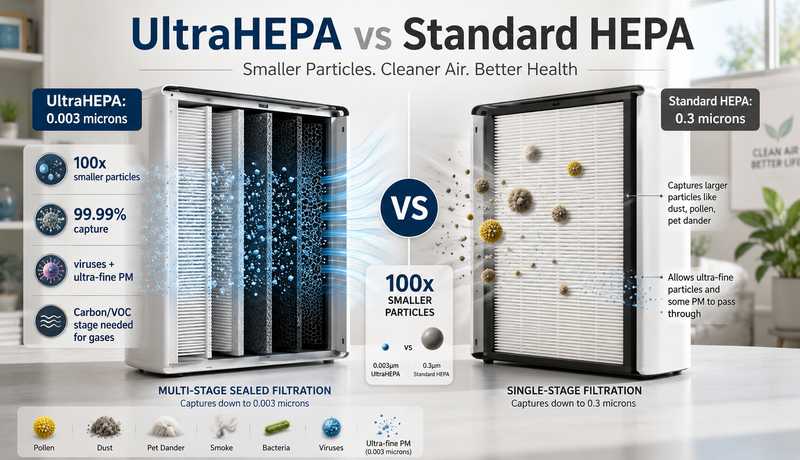
Standard HEPA captures particles ≥ 0.3 microns. AirDoctor's UltraHEPA® captures particles down to 0.003 microns — 100 times smaller. To put this in physical terms: a human hair is approximately 70 microns wide. The finest particles that UltraHEPA® captures are 23,000 times thinner than a human hair.
This size difference matters because many of the most harmful airborne particles — virus particles, ultra-fine combustion PM from traffic and cooking, and certain bacteria — are smaller than 0.3 microns and pass through standard HEPA filters without being captured at all.
② Capture Efficiency — 99.99% vs. 99.97%
Standard HEPA is rated at 99.97% capture efficiency at 0.3 microns. UltraHEPA® achieves 99.99% efficiency — but critically, at 0.003 microns. The efficiency improvement sounds marginal (0.02 percentage points) but the particle size difference it applies to is a 100x improvement in filtration depth.
This has been independently verified in MRIGlobal lab testing, which confirmed AirDoctor removed 99.97% of live SARS-CoV-2 and 99.99% of bacteria and viruses including H1N1 from a test chamber — data that standard HEPA-only brands typically don't publish because their filters weren't tested to perform at this particle size range.
③ Sealed System — All Air Through All Stages vs. Potential Bypass
The filter's rated efficiency only applies to air that passes through the filter media. A critical, overlooked difference is what happens to air that doesn't go through the filter. Many standard HEPA purifiers have imperfect seals or gaps in the housing where air can bypass the filter entirely — producing clean air delivery rates in the lab that don't match real-world performance.
AirDoctor uses a completely sealed filtration system — every cubic foot of air processed by the unit passes through all three filtration stages with no bypass. This is a hardware quality decision that affects real-world performance regardless of filter grade, and it's something most budget and mid-range HEPA purifiers don't offer.
④ Scope — Particles Only vs. Particles + Gases + VOCs
This is the most important difference that never appears on filter specification sheets. Both standard HEPA and UltraHEPA® are particle filters — they physically trap airborne particles in a fibrous matrix. Neither can remove gases or VOCs. Gases are molecular — they pass through any particle filter regardless of its rating.
AirDoctor addresses this with a dedicated Dual-Action Carbon/VOC filter using activated carbon and Potassium Permanganate to adsorb toxic gases (ozone, nitrogen dioxide) and VOCs (benzene, formaldehyde from furniture, flooring, cleaning products). Standard HEPA-only purifiers offer no equivalent. A home full of new furniture, fresh paint, or synthetic flooring is off-gassing continuously — and no HEPA filter, ultra or standard, touches any of it without a dedicated carbon stage.
Standard HEPA was designed in 1943. Your home's air wasn't.
AirDoctor's UltraHEPA® captures particles 100x smaller than standard HEPA — and adds a dedicated Carbon/VOC stage for the gases and chemicals that no HEPA filter can touch.
What This Means in Real-World Air Quality Terms
Consider what a typical modern home contains that a standard HEPA purifier is equipped to handle — and what it can't:
| Indoor Air Threat | Particle Size | Standard HEPA (0.3µm) | UltraHEPA® (0.003µm) | Carbon/VOC Filter Needed |
|---|---|---|---|---|
| Dust mites, pollen | 5–100 µm | ✅ Captured | ✅ Captured | ❌ Not needed |
| Pet dander, mold spores | 1–10 µm | ✅ Captured | ✅ Captured | ❌ Not needed |
| Bacteria | 0.3–10 µm | ⚠️ Partial | ✅ 99.99% captured | ❌ Not needed |
| Viruses (incl. SARS-CoV-2) | 0.01–0.3 µm | ❌ Many pass through | ✅ 99.97% captured | ❌ Not needed |
| Ultra-fine combustion PM | 0.001–0.1 µm | ❌ Most pass through | ✅ Captured | ❌ Not needed |
| Formaldehyde, benzene (VOCs) | Molecular | ❌ Passes through | ❌ Passes through | ✅ Required |
| Ozone, nitrogen dioxide | Molecular | ❌ Passes through | ❌ Passes through | ✅ Required |
The table makes clear what the marketing doesn't: standard HEPA handles the largest particles well, struggles with sub-0.3-micron threats like viruses, and is entirely unable to address any gas-phase pollutant. UltraHEPA® closes the particle-size gap — but neither filter type handles gases without a dedicated carbon stage.
Why UltraHEPA Matters for Your Home
- Virus protection where standard HEPA falls short: Viruses in the 0.01-0.1 micron range pass through standard HEPA filters. UltraHEPA® at 0.003 microns captures them — independently verified by MRIGlobal.
- Ultra-fine combustion particles from cooking, traffic, and wildfires: PM2.5 and sub-PM2.5 particles are now understood to be among the most harmful indoor air pollutants for cardiovascular and respiratory health. Standard HEPA captures larger PM2.5 but misses the finest fraction. UltraHEPA® captures it all.
- Every breath processed through every filter stage: AirDoctor's sealed system ensures no air bypasses the filter — eliminating the real-world performance gap between rated and actual filtration efficiency.
- The Carbon/VOC stage addresses what no HEPA filter can: VOCs and gases require a fundamentally different removal mechanism. AirDoctor's Dual-Action Carbon/VOC filter handles what both standard and UltraHEPA® filters cannot.
- Independently verified — not just a label claim: MRIGlobal testing published by AirDoctor provides specific, verifiable performance data on virus and bacteria removal that most standard HEPA brands don't offer because their filters weren't tested for this performance range.
Filter Standard Comparison Table
| Specification | Standard HEPA | True HEPA | UltraHEPA® (AirDoctor) |
|---|---|---|---|
| Year established | 1943 | 1943 (same standard) | Modern |
| Smallest particle captured | 0.3 microns | 0.3 microns | 0.003 microns |
| Capture efficiency | ≥99.97% at 0.3µm | 99.97% at 0.3µm | 99.99% at 0.003µm |
| Captures viruses | ⚠️ Partial | ⚠️ Partial | ✅ 99.97% (MRIGlobal) |
| Captures ultra-fine PM | ❌ Partial miss | ❌ Partial miss | ✅ Full capture |
| Removes gases/VOCs | ❌ No | ❌ No | ❌ Requires Carbon stage |
| AirDoctor system includes Carbon stage | — | — | ✅ Dual-Action Carbon/VOC |
Who Genuinely Needs UltraHEPA vs. Standard HEPA
UltraHEPA® (AirDoctor) makes the most sense for:
- Households where virus and bacterial protection is a priority — immunocompromised individuals, elderly family members, homes with infants
- Anyone concerned about ultra-fine combustion particles from traffic, cooking, or wildfire smoke in their area
- Homes with new furniture, flooring, renovation materials, or cleaning products off-gassing VOCs that standard HEPA cannot address
- Buyers who want independently published lab data on virus and bacteria removal — not just a filter classification
Standard HEPA is sufficient for:
- Basic dust, pollen, and pet dander removal in a healthy household without specific respiratory concerns
- Budget-constrained buyers who need particle filtration at the lowest possible cost and don't have specific virus, VOC, or ultra-fine PM concerns
- Supplementary purification in low-use spaces like guest rooms where the highest performance spec isn't required
⭐ Final Verdict: UltraHEPA vs Standard HEPA
Standard HEPA remains a useful, proven filtration standard — but it was designed for 1943-era air quality concerns, not the full spectrum of threats in a modern home. The gap between 0.3-micron standard HEPA and 0.003-micron UltraHEPA® is 100x in filtration depth — a difference that is clinically meaningful for virus capture, ultra-fine combustion PM, and certain bacterial threats.
Equally important: neither filter type addresses gases or VOCs without a dedicated carbon stage. The most comprehensive protection comes from UltraHEPA® combined with Dual-Action Carbon/VOC filtration in a sealed system — which is exactly what AirDoctor's 3-stage approach delivers.
For households where indoor air quality genuinely matters — allergies, asthma, children, pets, renovation, or proximity to traffic and wildfire risk — the upgrade from standard HEPA to UltraHEPA® with Carbon/VOC is the most meaningful investment in real indoor air protection available.
100x smaller filtration. 3-stage sealed system. Independently verified.
UltraHEPA® at 0.003 microns + Dual-Action Carbon/VOC — the complete answer to what standard HEPA-only purifiers miss. MRIGlobal tested. 30-day breathe-easy guarantee.
Frequently Asked Questions
What is the difference between UltraHEPA and standard HEPA filters?
Standard HEPA captures 99.97% of particles at 0.3 microns (1943 specification). UltraHEPA® captures 99.99% at 0.003 microns — 100x smaller — including viruses and ultra-fine combustion particles that pass through standard HEPA entirely.
Can standard HEPA filters capture viruses?
Partially — viruses on larger droplets may be captured, but free-floating virus particles in the 0.01-0.1 micron range can pass through standard HEPA. UltraHEPA® at 0.003 microns closes this gap, independently verified by MRIGlobal (99.97% SARS-CoV-2 removal).
Why can't standard HEPA filters capture VOCs and gases?
HEPA filters work by physically trapping particles. Gases are molecular — no particle filter, standard or UltraHEPA®, can capture them. A dedicated activated carbon stage is the only way to address gas-phase pollutants like formaldehyde and benzene.
Is the HEPA standard outdated?
Yes — it was designed in 1943 for radioactive particle filtration, not for modern viruses, ultra-fine combustion PM, or VOCs. The core standard hasn't changed in over 80 years despite significant advances in indoor air quality science.
What does ‘True HEPA' mean vs. UltraHEPA?
“True HEPA” differentiates genuine HEPA from “HEPA-style” fakes — both are 0.3-micron standards. UltraHEPA® goes 100x further to 0.003 microns with independently verified capture performance at that scale.
Does a sealed filter system matter as much as filter grade?
Yes — filter efficiency only applies to air that passes through the filter. Air bypassing through housing gaps negates the filter's rated performance. AirDoctor's sealed system ensures every processed breath goes through all 3 stages. Shop at this link.



 Top Picks