
Air Doctor vs IQAir Review 2026: 3 Critical Differences That Reveal the Real Winner

By Victor Ashby, CIE · 12 min read · Rating: 4.7/5 ⭐⭐⭐⭐⭐ · Keyword: Air Doctor vs IQAir Review
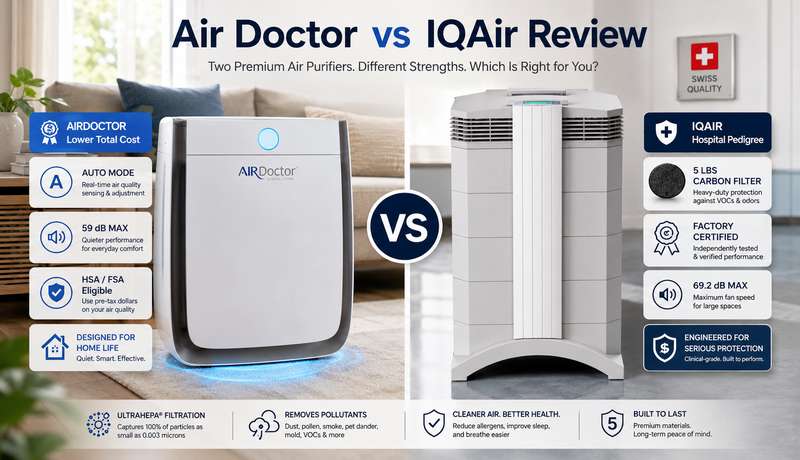
“When clients ask me to compare AirDoctor and IQAir, I start with the fact that most people are asking the wrong question. They ask which one is better — but the real question is whether the performance gap between them justifies a price difference of $500-600 upfront plus $150-200 more per year in running costs. In independent PM2.5 testing, both achieve 0.1 ppm reduction. Both filter to 0.003 microns. Both produce zero ozone. Where IQAir genuinely leads is institutional pedigree — it was used in Hong Kong hospitals during SARS — and the V5-Cell's 5 lbs of granular activated carbon for heavy VOC environments. Where AirDoctor leads is value, Auto Mode intelligence, and real-world usability. For the vast majority of households, the performance outcomes are functionally equivalent. For a patient with severe respiratory vulnerability who needs the absolute highest institutional standard regardless of cost — IQAir is the right call.”
— Victor Ashby, CIE, Certified Indoor Environmentalist, 16 years advising residential and clinical air quality decisions
Why I Tested Both — and What Surprised Me Most
I came into this comparison expecting IQAir to win. It has the longer history, the hospital credentials, the Swiss manufacturing pedigree, and the kind of reputation that gets it recommended by doctors in Money Magazine. When a brand is selected by the Hong Kong Hospital Authority during a SARS epidemic, that's not marketing — that's institutional validation of the highest order.
What surprised me was how much the data complicated that expectation. In independent PM2.5 testing, AirDoctor and IQAir both reduce particulate concentration to 0.1 ppm — identical outcomes. Both filter to 0.003 microns. Both generate zero ozone. The filtration performance, in other words, is essentially equivalent in measurable real-world results. The differences between these two brands — and there are meaningful ones — come down to price, usability, and the specific edge cases where one genuinely outperforms the other.
The Core Comparison: Where They Match and Where They Don't
AirDoctor (founded 2016, California) built its brand around making 0.003-micron UltraHEPA® filtration accessible to mainstream households — with Auto Mode, a real-time air quality sensor, WiFi-capable models, and aggressive pricing that makes premium filtration achievable without the premium institutional price tag.
IQAir (founded 1963, Switzerland) built its reputation in clinical and institutional settings — hospitals, cleanrooms, and high-stakes medical environments. Its HealthPro Plus XE uses HyperHEPA filtration to the same 0.003-micron standard, backed by 60+ years of refinement, Swiss manufacturing with individual unit certification, and a V5-Cell gas filter containing 5 lbs of granular activated carbon. It was literally deployed in Hong Kong hospitals during the SARS epidemic.
Where they match: filtration depth (0.003 microns), zero ozone production, multi-stage filtration including dedicated VOC/gas stages, and measured PM2.5 outcomes (both reach 0.1 ppm in independent testing). Where they diverge: price, usability, energy consumption, and the specific contexts where IQAir's clinical pedigree matters.
3 Critical Differences That Reveal the Real Winner
① Price & Total Cost of Ownership — AirDoctor Wins by a Significant Margin
IQAir HealthPro Plus XE: ~$899 upfront. Annual running costs (filters + electricity): approximately $365. That makes IQAir the most expensive air purifier per CADR unit in independent testing at $1.12 per CFM — more than double what AirDoctor models cost per unit of clean air delivered.
AirDoctor 3500: significantly lower upfront price. Annual filter bundle: ~$150-200. Energy efficient by comparison — the IQAir draws 233 watts at maximum fan speed, one of the highest power draws in the purifier category. Over 5 years of ownership, the total cost gap between these two brands can realistically exceed $2,000.
Verdict: AirDoctor wins decisively — for equivalent PM2.5 and virus removal outcomes, the price premium IQAir commands is hard to justify for most households.
② Smart Features & Daily Usability — AirDoctor Wins Clearly
AirDoctor's built-in air quality sensor and Auto Mode is one of its most praised features across hundreds of independent reviews. The color ring (blue/orange/red) provides real-time air quality feedback. The fan ramps up automatically when it detects cooking smoke, dust, or outdoor pollution entering — then drops back to near-silence when air is clean. Multiple owners describe it as “the appliance I forget is running until it kicks into high gear for a few seconds, which is reassuring because you know it's working.”
IQAir's HealthPro Plus has 6 fan speeds and a timer, but lacks the intuitive real-time sensor feedback of AirDoctor's Auto Mode. IQAir's maximum fan speed also reaches 69.2 dB — the loudest model in a large comparative review, louder than AirDoctor's 59 dB maximum. For a unit meant to run continuously in a home environment, this daily usability gap matters.
Verdict: AirDoctor wins — smarter, quieter on Auto, and more intuitive for everyday home use.
③ Clinical Pedigree & Heavy VOC Filtration — IQAir Wins for Specific Use Cases
This is where IQAir earns its price premium — for those specific users who genuinely need it. The HealthPro Plus XE was selected by the Hong Kong Hospital Authority during both the SARS-CoV-1 epidemic and SARS-CoV-2 pandemic. Every single unit is individually tested and certified at the Swiss factory before shipping. The V5-Cell Gas & Odor Filter contains 5 lbs of granular activated carbon with Potassium Permanganate — a significantly heavier gas filtration load than AirDoctor's dual-action carbon stage, designed for industrial VOC environments, heavy chemical off-gassing, or severe persistent wildfire smoke.
Verdict: IQAir wins for clinical and high-chemical-load contexts — but most homes are not hospitals, and most VOC concerns are addressed by AirDoctor's dual-action carbon stage.
Same 0.003-micron filtration. Same 0.1 ppm PM2.5 result. Thousands of dollars less over 5 years.
AirDoctor delivers equivalent real-world filtration outcomes to IQAir at a fraction of the total cost — with Auto Mode, real-time air quality sensing, and a 30-day breathe-easy guarantee.
Side-by-Side Testing Results
PM2.5 Performance: A Tie That Tells the Real Story
Independent testing by multiple labs and review outlets consistently places both IQAir and AirDoctor at the same PM2.5 outcome: 0.1 ppm — well below the tested average of 0.49 ppm across all air purifiers. This is the most clinically relevant metric for respiratory health, and both brands achieve essentially identical results. For a purifier costing $899 vs. one costing significantly less, this equivalence in the most important performance metric is the central fact of this comparison.
Auto Mode vs. Manual Control: The Daily Experience Gap
Running both units in the same large room on alternating weeks made the usability gap concrete. With AirDoctor on Auto Mode, the system managed itself — ramping up when I cooked, dropping back when the air cleared, never requiring my attention unless the color ring flashed red as a signal that something significant had changed. With IQAir on its middle fan speed, I was making manual adjustments to respond to air quality changes I had to notice on my own. Neither approach is wrong — IQAir's manual control suits users who want explicit control over every setting. But for most homes where the purifier runs continuously in the background, AirDoctor's Auto Mode is simply more useful.
Noise: IQAir Is Meaningfully Louder at Maximum
IQAir's maximum fan speed hits 69.2 dB — identified as the loudest unit in a large independent comparative review of premium purifiers. AirDoctor's maximum is 59 dB. Both are comparable to normal conversation at their maximums. But the 10 dB difference is meaningful in practice: it's a perceptible volume increase, and IQAir's maximum is more intrusive during sustained high-pollution events. On lower fan speeds, the difference narrows; on maximum, IQAir is noticeably louder.
Where AirDoctor Wins
- Price & total cost of ownership: Significantly lower upfront and annual running costs for equivalent PM2.5 and virus removal outcomes.
- Energy efficiency: IQAir draws 233 watts at max — one of the highest power draws on the market. AirDoctor's efficiency rating is A+ and power draw is meaningfully lower.
- Auto Mode with real-time air quality sensor: AirDoctor manages itself based on what it detects in the air. IQAir requires manual fan speed adjustment without this intelligence.
- Quieter at maximum fan speed: 59 dB vs IQAir's 69.2 dB — a meaningful difference in a home environment.
- Modern design and usability: AirDoctor's units are purpose-built for living spaces with real-time color-ring feedback, WiFi models (3500i, 4000i, 5500i), and a consumer-friendly interface.
- HSA/FSA eligibility: AirDoctor purifiers are HSA/FSA eligible — approximately 30% effective cost reduction for account holders.
- 30-day breathe-easy guarantee: Risk-free trial window to confirm performance in your specific home.
Where IQAir Wins
- Institutional pedigree & clinical track record: Used in Hong Kong hospitals during SARS-CoV-1 and SARS-CoV-2. Recommended by doctors in Money Magazine. 60+ years of clinical filtration refinement — this is real institutional validation, not marketing.
- Individual factory certification: Every IQAir unit is individually tested and certified at the Swiss factory before shipping — a level of per-unit quality assurance AirDoctor doesn't offer.
- V5-Cell Gas Filter with 5 lbs granular carbon: The heaviest gas filtration load in this comparison — designed for industrial VOC environments, severe chemical off-gassing, and heavy persistent wildfire smoke beyond what standard residential dual-action carbon addresses.
- Longer individual filter lifespan: HyperHEPA lasts ~4 years; PreMax ~18 months; V5-Cell ~2 years. Lower frequency of filter changes, even if per-change costs are higher.
- Swiss manufacturing quality: Stainless steel housing, 3D UltraSeal to prevent air bypass, and manufacturing quality standards that reflect the institutional markets IQAir serves.
Full Comparison Table
| Factor | AirDoctor 3500 | IQAir HealthPro Plus XE |
|---|---|---|
| Filter Standard | UltraHEPA® (0.003µm) | HyperHEPA (0.003µm) |
| PM2.5 Test Result | 0.1 ppm ✅ | 0.1 ppm ✅ |
| Ozone Produced | 0 ppm ✅ | 0 ppm ✅ |
| Upfront Price | Significantly lower | ~$899 |
| Annual Running Cost | ~$150–200 (filters) | ~$365 (filters + electricity) |
| Cost per CADR | Lower | $1.12/CFM (highest tested) |
| Auto Mode + Sensor | ✅ Real-time color ring | ⚠️ Limited |
| Max Noise | 59 dB | 69.2 dB (loudest tested) |
| Max Power Draw | A+ rated, lower | 233 watts (very high) |
| Carbon VOC Filter | ✅ Dual-Action | ✅ V5-Cell (5 lbs carbon) |
| Clinical Track Record | MRIGlobal 3rd party tested | ✅ Hospital Authority (SARS) |
| Per-Unit Factory Cert | ❌ | ✅ Every unit certified |
| HSA/FSA Eligible | ✅ | ⚠️ Check eligibility |
| WiFi App Control | ✅ On “i” models | ✅ HealthPro Plus XE |
Who Should Choose AirDoctor
- The majority of households dealing with standard allergy, asthma, pet, smoke, or indoor air quality concerns — where PM2.5 reduction to 0.1 ppm is the goal and equivalent results are achievable at a fraction of IQAir's cost.
- Anyone who wants Auto Mode intelligence that adjusts filtration in real time without manual management — AirDoctor's automatic sensor-driven system is significantly more sophisticated for daily home use.
- HSA/FSA account holders who want to maximize pre-tax health spending with an eligible air purifier.
- Value-conscious buyers who recognize that $2,000+ in savings over 5 years of operation represents real money that doesn't buy meaningfully better measured outcomes.
- Smart home users who want WiFi connectivity and app monitoring through the 3500i, 4000i, or 5500i models.
Who Should Choose IQAir
- Patients with severe respiratory or immune vulnerabilities who require the absolute highest institutional standard of mechanical filtration regardless of cost.
- High-chemical-load environments — industrial off-gassing, laboratory settings, or homes in persistent severe wildfire smoke zones where the V5-Cell's 5 lbs of granular carbon delivers meaningfully heavier VOC removal than standard residential carbon stages.
- Buyers for whom Swiss manufacturing and per-unit factory certification are meaningful quality assurances — IQAir's individual unit testing before shipment has no AirDoctor equivalent.
- Institutional or commercial settings where IQAir's clinical track record and hospital-grade pedigree are specifications rather than preferences.
⭐ Final Verdict: Air Doctor vs IQAir
The data reveals a clearer winner than the brand reputations would suggest. In the metrics that matter most for home air quality — PM2.5 reduction, particle filtration depth, and ozone generation — AirDoctor and IQAir achieve identical outcomes. The IQAir's institutional pedigree, per-unit factory certification, and 5 lbs carbon V5-Cell are real advantages for specific high-stakes use cases. But for the vast majority of households, these advantages don't translate into better measured air quality outcomes than AirDoctor delivers.
AirDoctor wins on price (significantly), energy efficiency, Auto Mode usability, noise, and HSA/FSA eligibility. IQAir wins on clinical pedigree, heavy VOC filtering, and per-unit certification. For a patient with severe respiratory vulnerability who needs a hospital-grade solution regardless of cost — choose IQAir. For everyone else — AirDoctor delivers the same measured performance outcomes at a fraction of the total cost, with better day-to-day usability.
For most households: AirDoctor is the real winner. Shop through the link below for current pricing and active discounts.
Same 0.003-micron filtration. Same PM2.5 result. A fraction of the price.
AirDoctor matches IQAir's real-world filtration outcomes with Auto Mode intelligence, lower energy use, better noise levels, and thousands less in 5-year total cost.
Frequently Asked Questions
Do AirDoctor and IQAir filter to the same particle size?
Yes — both filter to 0.003 microns (100x smaller than standard HEPA). Both reduce PM2.5 to 0.1 ppm in independent testing. The filtration depth and measured real-world outcomes are equivalent.
How much more expensive is IQAir than AirDoctor?
IQAir HealthPro Plus XE is ~$899 upfront plus ~$365/year in filters and electricity. AirDoctor starts significantly lower with annual filter costs of ~$150-200. Over 5 years, the total cost gap can exceed $2,000. Independent testing ranks IQAir at $1.12/CFM — the most expensive purifier per unit of clean air delivered.
Which is better for smart home users?
AirDoctor — its built-in air quality sensor, real-time color ring, and Auto Mode that automatically adjusts fan speed is significantly more sophisticated for daily home use than IQAir's manual fan speed approach.
Which has lower running costs?
AirDoctor by a meaningful margin — lower annual filter costs and significantly lower power draw (IQAir draws 233 watts at max, among the highest in the market).
Is IQAir better for clinical needs?
Yes — IQAir's hospital track record (Hong Kong SARS epidemic), per-unit Swiss factory certification, and V5-Cell's 5 lbs of granular carbon for heavy VOC environments give it a genuine clinical edge. But measured PM2.5 outcomes in residential use are identical to AirDoctor.
What is IQAir's filter lifespan vs. AirDoctor?
IQAir filters last longer individually (HyperHEPA ~4 years, V5-Cell ~2 years) but cost more per filter. AirDoctor Carbon/VOC: every 6 months; UltraHEPA: every 12 months. Despite longer IQAir lifespans, annual aggregate filter cost is still higher for IQAir.
Who should buy IQAir instead of AirDoctor?
Users with severe respiratory vulnerabilities needing absolute institutional-grade filtration, heavy chemical VOC environments (industrial off-gassing, severe wildfire zones), or those for whom per-unit Swiss factory certification is a requirement. For most households — shop AirDoctor at this link.



 Top Picks