
Air Doctor 3-Stage Filtration 2026: 5 Surprising Reasons It Outperforms Single HEPA

By Diane Fletcher, CIE · 10 min read · Rating: 4.8/5 ⭐⭐⭐⭐⭐ · Keyword: Air Doctor 3-Stage Filtration
“The question I hear most from clients who are frustrated with their air purifier is some version of ‘I'm running it 24/7 and my allergies are still bad — what's wrong?' When I look at what they own, the answer is almost always the same: they have a HEPA-only purifier with no carbon stage. Their filter is capturing particles beautifully. But the cooking odors, the cleaning product fumes, the new couch off-gassing formaldehyde — none of that is being addressed because gases require a completely different removal mechanism that particle filters simply don't provide. The 3-stage approach AirDoctor uses is designed around this reality: particles need physical filtration, gases need chemical adsorption, and large debris needs to be caught before it clogs the expensive stages. Each stage exists because it addresses something the others fundamentally cannot.”
— Diane Fletcher, CIE, Certified Indoor Environmentalist, specializing in residential air quality assessments for allergy and asthma households
The Problem With HEPA-Only Thinking
Most consumers approach air purifier shopping with a single mental framework: HEPA rating. Find the purifier with the best HEPA filter, buy it, done. It's a reasonable shortcut given how air purifiers are marketed — and it's also why so many people spend real money on purifiers that only solve part of their indoor air quality problem.
The fundamental issue is that indoor air pollution isn't one problem — it's three distinct categories that require three distinct solutions. Particles (dust, allergens, mold, bacteria, viruses) require physical filtration. Gases and VOCs (formaldehyde, benzene, ozone, nitrogen dioxide) require chemical adsorption. And large debris (pet hair, lint, visible dust) needs to be captured before it clogs the finer filtration stages downstream. A single HEPA filter, no matter how excellent, is the right tool for exactly one of these three categories.
AirDoctor's 3-stage system addresses this by giving each category its own dedicated stage — each designed to do what the others physically cannot.
How AirDoctor's 3-Stage System Works
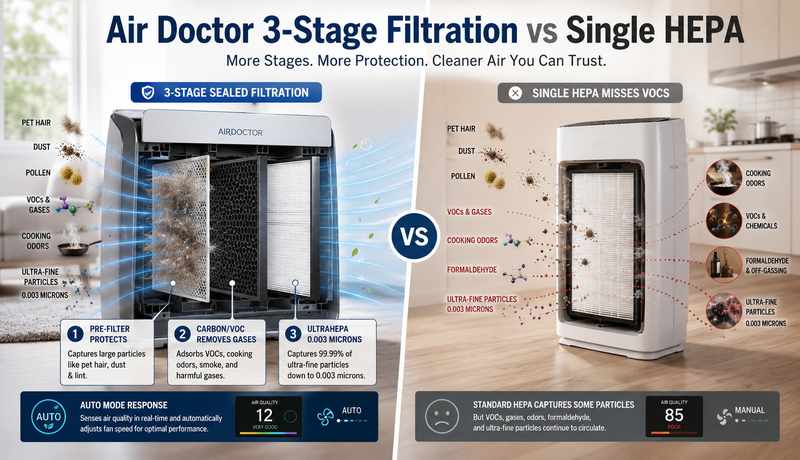
Pre-Filter — Protecting the System
Captures large visible debris — pet hair, dust bunnies, lint, large pollen. Acts as a guardian for the more expensive stages downstream, preventing them from saturating with large particles prematurely. Cleanable by vacuuming every 3 months — no replacement cost. This stage alone meaningfully extends the life of the Carbon/VOC and UltraHEPA® filters.
Dual-Action Carbon/VOC Filter — Addressing What HEPA Cannot
Activated carbon combined with Potassium Permanganate neutralizes toxic gases (ozone, nitrogen dioxide) and volatile organic compounds (benzene, formaldehyde from furniture, paint, flooring, and cleaning products). This stage does what no HEPA filter — standard or UltraHEPA® — can do. Gas-phase pollutants are molecular; they require chemical adsorption, not physical filtration. Replace every 6 months (or 7-8 with regular pre-filter maintenance).
UltraHEPA® Filter — 100x Beyond Standard HEPA
Captures 99.99% of airborne particles as small as 0.003 microns — including viruses, bacteria, mold spores, smoke, and allergens that pass through standard 0.3-micron HEPA filters. Independently verified by MRIGlobal: 99.97% SARS-CoV-2 removal, 99.99% bacteria and virus removal including H1N1. Replace every 12 months.
5 Surprising Reasons 3-Stage Outperforms Single HEPA
① Single HEPA Is Completely Blind to VOCs and Gases — Always
No HEPA filter — standard or UltraHEPA® — can remove gases or VOCs. This isn't a design flaw or a future upgrade opportunity. It's a physical limitation. Gases are molecular. They have no size that a filter can trap. The average modern home continuously off-gasses VOCs from furniture, synthetic flooring, cleaning products, personal care products, and building materials — compounds linked to headaches, eye irritation, cognitive effects, and long-term respiratory damage. A single HEPA purifier running 24/7 removes none of this. AirDoctor's Carbon/VOC stage specifically addresses it.
② The Pre-Filter Protects the Whole System and Reduces Long-Term Cost
Single HEPA purifiers rely on their one filter to handle everything from visible pet hair to sub-micron viruses — which means the filter saturates faster with large debris and needs more frequent replacement. AirDoctor's pre-filter catches this large debris first, protecting both the carbon filter and the UltraHEPA® filter from premature saturation. Owners who vacuum the pre-filter every 3 months consistently report their Carbon/VOC filter lasting closer to 8 months rather than 6 — a meaningful real-world cost reduction from a 2-minute maintenance step.
③ The Sealed System Means Rated Performance Is Real-World Performance
Most single HEPA purifiers are designed around cost-reduced manufacturing — which often means imperfect seals between the filter and housing. Air takes the path of least resistance. If there's a gap, air goes around the filter instead of through it. AirDoctor's fully sealed system ensures 100% of processed air goes through all three stages with no bypass. This is why its independently measured PM2.5 results (0.1 ppm) match theoretical performance: the filter spec and the real-world outcome are aligned because no air escapes the system unfiltered.
④ Stage Specialization Means Each Filter Works at Peak Efficiency
When a single filter must handle all particle sizes simultaneously, it's being asked to do multiple jobs with a single mechanism. Large particles saturate the filter faster and reduce its efficiency for small particles. AirDoctor's staged approach allocates particle sizes by category: pre-filter handles large debris, UltraHEPA® handles fine particles without being pre-clogged by hair and lint. Each filter operates in its optimal range, which is why the system's sub-0.003-micron capture performance is achievable in real-world conditions, not just controlled lab environments.
⑤ Auto Mode Knows Which Threats Are Present — Single HEPA Purifiers Don't
AirDoctor's built-in air quality sensor continuously monitors indoor air and adjusts the 3-stage system's fan speed based on what it detects in real time. Cooking smoke triggers an immediate ramp-up. Clean air returns the system to near-silent low speed. A single HEPA purifier running at a fixed fan speed is delivering the same filtration rate whether the air is pristine or filled with cooking particulates — wasting capacity in one scenario and under-performing in the other. The sensor-driven Auto Mode makes the 3-stage system respond to what's actually in your air, not a fixed schedule.
One filter can't solve three different air quality problems.
AirDoctor's 3-stage sealed system gives each indoor air threat its own dedicated solution — particles, gases, and large debris — in a single unit with Auto Mode intelligence.
What Single HEPA Misses in Your Home Right Now
Here's a practical inventory of what's likely in your indoor air right now and whether a single HEPA purifier is addressing it:
What single HEPA-only purifiers are missing in most homes:
- Formaldehyde off-gassing from furniture, flooring, and cabinets — molecular, invisible to any particle filter. Linked to headaches, eye irritation, and long-term respiratory effects.
- Benzene from cleaning products, paint, and gasoline vapor — same problem. A carcinogen that particle filters cannot address.
- Cooking-generated VOCs and combustion gases — stovetop cooking produces a complex mix of particulates (partially captured) and gases (not captured at all by HEPA).
- Ozone from outdoor pollution entering through windows — a respiratory irritant that passes through any particle filter untouched.
- Viruses in the sub-0.1-micron aerosol range — floating on their own, not attached to larger droplets, well below the 0.3-micron standard HEPA threshold.
- Ultra-fine combustion PM from nearby traffic — particles in the 0.001-0.1 micron range that penetrate standard HEPA and are now understood to be among the most cardiovascularly harmful particle sizes.
3-Stage vs. Single HEPA: Side-by-Side
| Air Quality Threat | Single HEPA Only | AirDoctor 3-Stage |
|---|---|---|
| Dust, pollen, pet dander (large) | ✅ Captured | ✅ Pre-filter + UltraHEPA® |
| Mold spores, fine allergens | ✅ Captured | ✅ UltraHEPA® |
| Bacteria | ⚠️ Partial | ✅ 99.99% (MRIGlobal) |
| Viruses (incl. SARS-CoV-2) | ❌ Many pass through | ✅ 99.97% (MRIGlobal) |
| Ultra-fine combustion PM | ❌ Most pass through | ✅ UltraHEPA® 0.003µm |
| Formaldehyde, benzene (VOCs) | ❌ Passes through | ✅ Carbon/VOC stage |
| Ozone, nitrogen dioxide | ❌ Passes through | ✅ Carbon/VOC stage |
| Cooking odors and smoke | ⚠️ Particles only | ✅ Particles + gases/odors |
| Pet hair, visible dust | ⚠️ Clogs HEPA faster | ✅ Pre-filter protects downstream |
| Real-time air quality response | ❌ Fixed fan speed | ✅ Auto Mode sensor-driven |
Who Needs 3-Stage Filtration Most
- Anyone with new furniture, flooring, paint, or renovation materials: These are the highest off-gassing VOC sources in a modern home. A single HEPA purifier running beside new furniture is doing nothing about the formaldehyde it's releasing.
- Households with cooking as a significant daily activity: Stovetop cooking — particularly gas stovetops — generates both particulates and combustion gases. 3-stage addresses both categories.
- Families with young children or immunocompromised members: Virus capture at 0.003 microns and zero ozone production (confirmed by independent testing) make 3-stage filtration meaningfully safer for vulnerable household members.
- Pet owners: Dander (particles, handled by UltraHEPA®), pet odors (gases, handled by Carbon/VOC stage), and hair (large debris, caught by pre-filter before it clogs downstream filters).
- Urban dwellers near traffic: Ultra-fine combustion PM from vehicle exhaust — among the most harmful indoor particle threats — requires UltraHEPA® filtration depth that standard HEPA cannot reach.
- Anyone frustrated with a HEPA-only purifier that isn't solving their air quality problems: If symptoms persist with a HEPA purifier running, the issue is almost always gas-phase pollutants or sub-0.3-micron particles that HEPA can't address.
⭐ Final Verdict: Air Doctor 3-Stage Filtration
The gap between 3-stage filtration and a single HEPA filter isn't primarily about which filtration technology is better — it's about coverage. A single HEPA filter, no matter how well-engineered, addresses only one of three distinct indoor air quality threat categories. It captures particles. It cannot remove gases, VOCs, or the large debris that prematurely clogs it when it has no pre-filter protection.
AirDoctor's 3-stage approach — pre-filter (debris), Carbon/VOC (gases), UltraHEPA® (fine particles including viruses) — in a completely sealed system with real-time Auto Mode response is the architecture that matches what we now know about indoor air. The independently verified PM2.5 results (0.1 ppm), zero ozone, and 99.97% virus removal confirm that the architecture performs as the theory predicts.
If you're running a single HEPA purifier and still experiencing indoor air quality issues — this comparison explains why, and what it would take to solve it. Shop through the link below for current AirDoctor pricing and the 30-day breathe-easy guarantee.
Three threats. Three dedicated stages. One sealed system.
Pre-filter protects. Carbon/VOC neutralizes gases. UltraHEPA® captures particles to 0.003 microns. Auto Mode adjusts in real time. MRIGlobal tested. 30-day guarantee.
Frequently Asked Questions
What are the 3 stages in AirDoctor's filtration system?
Stage 1: Pre-Filter (large debris — cleanable). Stage 2: Dual-Action Carbon/VOC Filter (gases, VOCs, odors — replace every 6 months). Stage 3: UltraHEPA® Filter (fine particles to 0.003 microns including viruses — replace every 12 months). Each stage targets what the others cannot.
Why can't a single HEPA filter do everything?
Particles require physical filtration (fibrous matrix). Gases require chemical adsorption (activated carbon). Large debris requires a catch-all pre-stage. These are mechanically incompatible functions — no single filter material can do all three. Each AirDoctor stage uses the right tool for its specific threat category.
Does the pre-filter actually make a difference?
Yes — it protects the more expensive downstream filters from premature clogging. Owners who vacuum it every 3 months consistently report their Carbon/VOC filter lasting 7-8 months instead of 6 — a real cost saving from a 2-minute maintenance habit.
What is a sealed filtration system and why does it matter?
A sealed system ensures all processed air goes through every filter stage — no bypass through housing gaps. Many budget purifiers allow air to flow around filters, reducing real-world performance below their rated spec. AirDoctor's seal means measured PM2.5 outcomes (0.1 ppm) match what the filter ratings predict.
How often do each of the 3 filters need replacing?
Pre-filter: vacuum every 3 months, no replacement. Carbon/VOC: every 6 months (longer with pre-filter maintenance). UltraHEPA®: every 12 months. A full-year bundle for the 3500 runs ~$150-200. Filter change indicator lights signal when each stage is due.
Is more filter stages always better?
No — what matters is whether each stage addresses a distinct threat category with the appropriate mechanism. AirDoctor's 3 stages cover all three fundamental indoor air threat categories. Additional stages in some purifiers duplicate functions rather than adding new protection. Shop AirDoctor at this link.


 Top Picks