
Ultra Reverse Osmosis vs Standard Water Filter 2026: 4 Key Differences You Must Know Before Buying

By James Harlow, WQA CWS · 10 min read · Rating: 4.8/5 ⭐⭐⭐⭐⭐ · Keyword: Ultra Reverse Osmosis vs Standard Water Filter
“The most common mistake I see homeowners make when buying a water filter is choosing based on brand recognition rather than the technology's capability to remove their specific contaminants. ‘Water filter' is an umbrella term covering technologies that are fundamentally different in mechanism and output. Activated carbon filters work through adsorption — attracting certain molecules to a porous surface. Reverse osmosis works through size exclusion — physically blocking molecules too large to pass through a semi-permeable membrane. These aren't different quality levels of the same thing; they address different categories of contaminants. AquaTru's Ultra Reverse Osmosis is worth understanding specifically because it adds 80% better water efficiency than conventional RO, plus 5 NSF certifications covering contaminant categories most pitcher and faucet filters are architecturally incapable of addressing.”
— James Harlow, WQA CWS, Water Quality Association Certified Water Specialist with 12 years advising residential and commercial water treatment
Why “Water Filter” Is Too Vague a Term to Trust
Walk into any home goods store and you'll find dozens of products all labeled “water filter.” Brita pitcher: water filter. PUR faucet attachment: water filter. AquaTru countertop: water filter. Under-sink reverse osmosis system: water filter. The same two words — but technologies that are as different from each other as a vitamin C tablet is from a full IV drip.
What “water filter” doesn't tell you is: which contaminants it actually removes, what mechanism it uses to remove them, whether it's been independently certified for those removal claims, and whether it can remove the specific substances in your local water supply that you're actually worried about. The technology is everything — and AquaTru's Ultra Reverse Osmosis represents a specific set of answers to those questions that standard filters, by their architecture, simply cannot match.
What Is Ultra Reverse Osmosis vs Standard Filtration?
Standard Water Filters — Activated Carbon & Ion Exchange
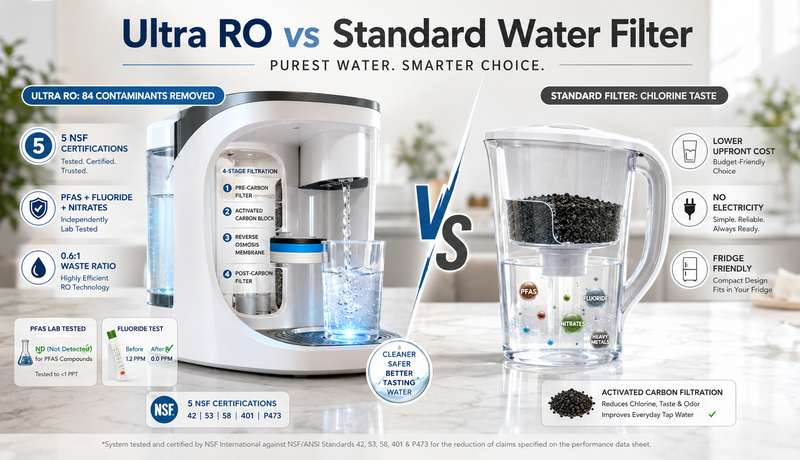
Standard filters (Brita, Pur, faucet attachments) use activated carbon adsorption: water flows through a porous carbon medium that attracts certain molecules to its surface. This is effective for chlorine, chloramines, and some organic compounds and heavy metals that have chemical affinity for carbon surfaces. Ion exchange (ZeroWater) additionally swaps dissolved ions. Neither mechanism can remove fluoride, nitrates, arsenic, PFAS at scale, or most dissolved inorganic compounds — these molecules simply don't adsorb to carbon or exchange on ion resin effectively.
AquaTru's Ultra Reverse Osmosis — 4-Stage Patented Technology
AquaTru's Ultra RO forces water through a semi-permeable RO membrane with pores approximately 0.0001 microns in diameter — so small that dissolved salts, heavy metals, PFAS, fluoride, nitrates, and most contaminants physically cannot pass through, regardless of their chemical properties. Combined with carbon pre- and post-stages and a patented electric pump achieving 80% less wastewater than conventional RO, this 4-stage system holds 5 NSF certifications for 84 certified contaminant removals — more than any other countertop system on the market.
4 Key Differences You Must Know Before Buying
① Contaminant Coverage: Size Exclusion vs Adsorption
Standard carbon filters remove what they have chemical affinity for — primarily chlorine and some metals. RO removes what is too large to pass through the membrane — virtually everything dissolved in water above the membrane's pore size. This is why AquaTru removes fluoride, arsenic, nitrates, PFAS, chromium-6, radium, and pharmaceuticals that carbon filters cannot: the RO mechanism doesn't depend on chemical affinity, only physical size. Ultra RO certifies 84 contaminants. Standard carbon filters typically certify 30–40.
② Efficiency: 0.6:1 Waste Ratio vs Standard RO's 3–5:1
All reverse osmosis systems produce wastewater — water that has passed over the membrane surface without permeating, concentrating contaminants for drain disposal. Traditional under-sink RO systems waste 3–5 gallons per gallon purified. AquaTru's patented electric pump technology achieves a 0.6:1 ratio — approximately 80% less wastewater, making it one of the most water-efficient RO systems available. Standard carbon pitcher filters produce no wastewater but also provide no RO-level contaminant removal.
③ Independent Certification: 5 NSF Standards vs 1–3
AquaTru holds IAPMO certifications to NSF Standards 42, 53, 58, 401, and P473 — verified for every contaminant claimed. Standard pitcher filters hold 1–3 NSF certifications and typically cannot be tested to NSF 58 (RO performance) or P473 (PFAS) because their technology doesn't address those categories. The 5-certification scope is the independent third-party verification that AquaTru's removal claims are tested, not theoretical.
④ Installation: Countertop RO Without Plumbing — A Category Innovation
Conventional RO requires under-sink installation. Pitcher filters require no installation. AquaTru's Ultra RO is specifically designed to deliver RO performance without plumbing — a countertop format that fills manually and produces purified water through its 4-stage system with only a standard 120V outlet. This makes RO-level contaminant removal accessible to renters, apartment dwellers, and anyone who cannot or won't modify their plumbing — a population that previously had no certified RO option.
Standard filters improve taste. Ultra RO changes what's actually in your water.
AquaTru's patented Ultra RO removes 84 certified contaminants — including PFAS, fluoride, arsenic, nitrates, and microplastics — using a technology standard filters are architecturally incapable of replicating.
What Each Technology Actually Removes
| Contaminant | Carbon Filter (Brita-type) | Ion Exchange (ZeroWater) | AquaTru Ultra RO |
|---|---|---|---|
| Chlorine / taste | ✅ | ✅ | ✅ |
| Lead | ⚠️ Partial | ✅ | ✅ |
| Fluoride | ❌ | ⚠️ Partial | ✅ 93.5% |
| PFAS (all types) | ❌ | ❌ | ✅ Non-detect confirmed |
| Arsenic | ❌ | ✅ | ✅ |
| Nitrates | ❌ | ✅ | ✅ |
| Microplastics (certified) | ❌ | ❌ | ✅ NSF 401 |
| Pharmaceuticals | ❌ | ❌ | ✅ NSF 401 |
| Wastewater produced | None | None | 0.6:1 (80% less than traditional RO) |
Honest Trade-Offs of Ultra RO vs Standard Filters
Where Ultra RO wins:
- Contaminant breadth — 84 vs 30–40 certified
- PFAS, fluoride, arsenic, nitrates removal — impossible for standard filters
- NSF certification depth — 5 standards vs 1–3
- Long-term cost vs bottled water — $0.11/gallon vs $1–3/gallon
- Zero installation (AquaTru-specific) — accessible to renters
Where standard filters win:
- Upfront cost — $40–100 vs $449
- No electricity required (gravity-fed pitchers)
- Fridge-compatible pitcher format
- No wastewater produced
- Sufficient for chlorine-only concerns
Technology Comparison Table
| Feature | AquaTru Ultra RO | Standard Carbon Pitcher | Traditional Under-Sink RO |
|---|---|---|---|
| Technology | 4-Stage RO + Carbon | Activated Carbon | RO + Carbon |
| Contaminants Certified | 84 | 30–40 | Varies (typically fewer NSF certs) |
| Waste Ratio | 0.6:1 | None | 3:1 to 5:1 |
| Installation | None (countertop) | None | Professional recommended |
| NSF Certifications | 5 | 1–3 | 2–3 (rarely P473) |
| Annual Cost | ~$100–120 | ~$40–60 | ~$60–150 + install |
Who Needs Ultra RO vs Standard Filtration
Choose Ultra RO (AquaTru) if:
- Your water quality report shows PFAS, lead, fluoride, arsenic, or nitrate levels of concern
- You're currently buying bottled water because you don't trust tap or standard filters
- You want 5 NSF certifications independently verifying the technology's claims
- You're a renter who needs full RO performance without installation
- You want to eliminate plastic bottle waste while maintaining bottled-water quality at home
Standard filtration is sufficient if:
- Your water report shows only chlorine taste as the documented concern
- Budget is the primary constraint and chlorine is the only issue
- No electricity or gravity-fed operation is required
- Your household's water use is very low and a fridge pitcher is more practical
⭐ Final Verdict: Ultra RO vs Standard Water Filter
Ultra Reverse Osmosis and standard activated carbon filtration are not the same technology at different quality levels — they address fundamentally different categories of water contamination using fundamentally different mechanisms. AquaTru's Ultra RO removes 84 certified contaminants across 5 NSF standards, including PFAS, fluoride, arsenic, and nitrates that standard carbon filters are architecturally incapable of removing. For the growing percentage of US households with documented PFAS, lead, or multi-contaminant concerns in their water supply, this technology gap is not a matter of degree — it determines whether you're protected.
Check your local water quality report against what your current filter's NSF certifications actually cover. If there's a gap — AquaTru's Ultra RO is how you close it.
84 certified contaminants. 5 NSF standards. 80% less wastewater than traditional RO.
AquaTru's Ultra RO delivers what standard water filters can't — independently verified across categories that include PFAS, fluoride, arsenic, and nitrates. Zero installation. Available now.
Frequently Asked Questions
What is AquaTru's Ultra Reverse Osmosis technology?
A patented 4-stage countertop RO system: pre-filter → carbon → RO membrane → coconut carbon VOC polish. Uses an electric pump for 0.6:1 waste ratio (80% less waste than traditional RO). Certified to 5 NSF standards for 84 contaminants.
What can't standard filters remove that Ultra RO can?
Fluoride, arsenic, nitrates, PFAS (fully), chromium-6, radium, microplastics (certified), and pharmaceuticals. Carbon filters lack chemical affinity for these compounds. RO removes them through physical size exclusion regardless of chemistry.
Is Ultra RO better than standard reverse osmosis?
On efficiency and certification: yes. AquaTru achieves 0.6:1 waste vs traditional RO's 3–5:1, and holds 5 NSF certifications including P473 for PFAS — which most traditional RO brands lack.
Do standard pitcher filters use reverse osmosis?
No — pitchers use activated carbon and/or ion exchange. RO requires a pressurized membrane that gravity-fed pitchers cannot implement. This is why pitcher filters cannot remove fluoride, arsenic, or PFAS at certified levels.
Does Ultra RO remove beneficial minerals?
Yes — RO is non-selective, removing minerals along with contaminants. AquaTru offers an optional Alkaline Remineralization filter to add minerals back and raise pH. The health impact of mineral removal is generally minimal — USDA data shows tap water provides more than 1% daily value for only 4 minerals. Shop at this link.


 Top Picks