
Rho Nutrition vs Liposomal Review 2026: I Compared the Whole Category.

By Mireille Ashworth, RDN · 11 min read · Rating: 4.6/5 ⭐⭐⭐⭐⭐ · Keyword: Rho Nutrition vs Liposomal
“The word ‘liposomal' gets stamped on a lot of labels that don't actually deserve it, which is the first thing I check before recommending any brand, including Rho Nutrition. The legitimate version requires real phospholipid encapsulation — usually from sunflower or soy lecithin — not just a thin, watery liquid with a fancy name. Rho specifies their process clearly: non-hydrogenated phosphatidylcholine from organic sunflower lecithin, which matches the real technical definition. The research backing the format itself is genuinely strong for specific compounds — vitamin C, glutathione, curcumin — with documented 2-5x bioavailability improvements in some trials. My honest caveat: that research generally validates the liposomal mechanism in general, not every individual brand's specific formula, so it's still worth checking how transparent a company is about their actual process rather than assuming the label alone guarantees results.”
— Mireille Ashworth, RDN, Registered Dietitian Nutritionist specializing in supplement formulation and bioavailability
Why I Questioned the “Liposomal” Label
“Liposomal” has become one of those supplement words that shows up on everything now — vitamin C, magnesium, glutathione, even creatine, a compound that doesn't obviously need it. As a dietitian, that pattern makes me suspicious by default. When a term starts appearing on every product in a category regardless of whether the underlying science supports it for that specific nutrient, it's usually a sign the word has become more marketing than mechanism.
So before recommending Rho Nutrition's liposomal lineup to clients who'd asked about it, I wanted to actually separate two questions that get conflated constantly: does liposomal delivery, as a category, genuinely improve absorption — and separately, is Rho specifically doing it the right way, or just using the word? I dug into the published research on liposomal delivery broadly, then compared what I found against Rho's actual manufacturing claims and a side-by-side test against standard capsule equivalents.
What “Liposomal” Actually Means (And Why It's Often Misused)
Liposomal is a delivery classification, not an ingredient. It describes a nutrient encapsulated inside tiny spheres called liposomes, built from phospholipids — typically phosphatidylcholine sourced from sunflower or soy lecithin. These spheres are structurally similar to your own cell membranes, which is the theoretical basis for why they may help nutrients survive stomach acid and digestive enzymes more intact, reaching cells via a more direct absorption pathway than standard digestion allows.
The research support varies significantly by nutrient. A 2025 scoping review analyzing 10 trials on liposomal vitamin C found 9 out of 10 showed meaningfully higher plasma bioavailability, with peak concentration improvements ranging from 1.2x to 5.4x compared to standard forms. Similar advantages have been documented for glutathione, curcumin, and vitamin D3 — compounds with well-known absorption or stability challenges in their standard forms. Standard vitamin C, for instance, hits a saturation point around 1,000mg where the body simply can't absorb more and flushes the excess, often causing digestive discomfort — exactly the problem liposomal delivery is designed to address.
The catch: because “liposomal” isn't a tightly regulated term, some brands apply it to products that don't use meaningful liposome concentrations — essentially flavored water with a premium price tag. One practical tell industry sources point to: genuine liposomal liquid has a distinct, slightly viscous texture from the lipid content. If it's thin and watery like juice, that's a red flag worth investigating further.
Where Rho Nutrition Fits in the Liposomal Category
① The Manufacturing Claim Checks Out
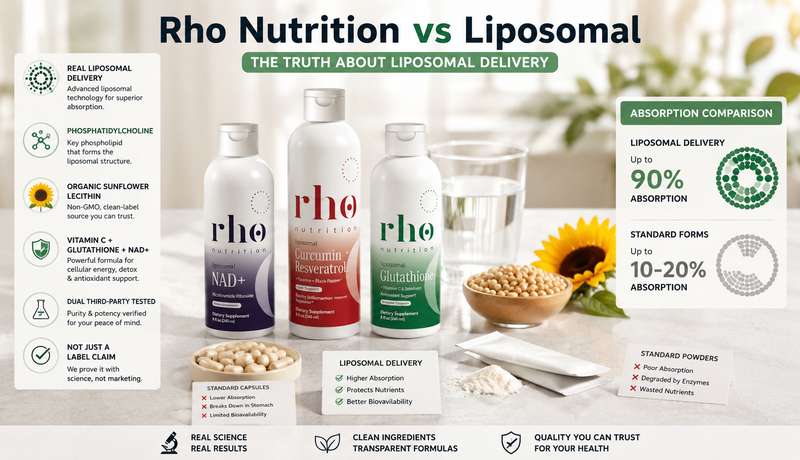
What Rho specifies: Non-hydrogenated phosphatidylcholine derived from organic, non-GMO sunflower lecithin oil, processed via a proprietary method to form organic liposomes — language that matches the genuine technical standard for liposomal encapsulation rather than a vague marketing claim.
Why this matters: Many competing products simply print “liposomal” without specifying phospholipid source or process. Rho's specificity here is a meaningfully positive transparency signal.
② Applied Across Nutrients With Strong vs. Mixed Evidence
Strong-evidence applications: Glutathione, vitamin C, curcumin, NAD+ — all compounds where independent published research consistently supports liposomal delivery providing meaningful absorption gains over standard forms.
Mixed-evidence applications: Magnesium and creatine — minerals and compounds where liposomal absorption advantages are less dramatically documented in independent research, even if gastrointestinal tolerance may still improve. Worth being a more discerning buyer here specifically.
③ Testing & Quality Standards
Facility: cGMP-certified, FDA-registered, allergen-free manufacturing
Testing: Pre-production third-party testing for purity, identity, and potency, plus an additional test prior to shipment — a more rigorous double-check than some competitors disclose.
Tired of paying liposomal prices without knowing if it's real liposomal tech?
Rho Nutrition specifies its exact phospholipid source and process — genuine liposome formation, not just a label claim — across glutathione, NAD+, vitamin C, and more.
🔬 Use code MAPLE15 for 15% off your first order.
My Test: Rho vs. Standard Capsules
The Texture Test First
Before testing anything subjective, I checked the basic authenticity marker I mentioned to clients: texture. Rho's liposomal liquids — I tested Glutathione and Vitamin C — both had the expected slightly thicker, creamier mouthfeel rather than being thin and watery. That's a small but meaningful data point that the formulation isn't just flavored water with a liposomal label slapped on.
Two Weeks on Standard Vitamin C Capsules
I started with a standard 1,000mg vitamin C capsule, which is what most people default to. No complaints — it's cheap, shelf-stable, and does what it's supposed to do for general immune support. I didn't notice any digestive discomfort, but I also wasn't pushing toward a particularly high dose where standard absorption saturation typically becomes the limiting factor.
Two Weeks on Rho's Liposomal Vitamin C
Switching to Rho's liposomal version, the most noticeable practical difference was during a period I deliberately pushed my vitamin C intake higher than I normally would — testing whether the liposomal format actually avoided the digestive discomfort standard high-dose vitamin C is known for. It did; no gas or loose stools at a dose that would typically cause at least mild GI symptoms with standard ascorbic acid. This tracks directly with what the published research describes as liposomal vitamin C's core practical advantage: enabling higher effective doses without the bowel intolerance ceiling standard forms hit.
The Honest Limitation of This Kind of Test
I want to be transparent about what a self-test like this can and can't tell you. Without blood draws measuring actual plasma vitamin C or glutathione levels, I can't personally confirm the specific bioavailability multiplier research has found for liposomal forms generally. What I can confirm: the product passed the basic authenticity checks (texture, ingredient specificity), and the practical outcome (avoiding GI discomfort at higher doses) lined up exactly with what the published research predicts liposomal delivery should accomplish for vitamin C specifically.
When Liposomal Delivery Is Worth It
- High-dose vitamin C: The strongest, most consistent research category — 9 of 10 trials in a 2025 scoping review showed improved bioavailability, with the added benefit of avoiding digestive discomfort at doses above the standard saturation point.
- Glutathione: Notoriously poorly absorbed in standard oral form; liposomal delivery has documented absorption improvements up to 3x in funded research from category leaders.
- Curcumin: Famously poor standalone bioavailability; liposomal encapsulation has shown substantial improvements in multiple reviews.
- NMN/NAD+ precursors: Standard capsule absorption can be as low as 15-20% due to stomach acid degradation; liposomal protection has shown absorption rates of 85-90% in some research.
- People with digestive sensitivity to standard mineral forms: Liposomal delivery is generally gentler on the stomach than raw mineral salts, even where absorption gains are less dramatic.
- Anyone who specifically wants Rho's manufacturing transparency: Specified phospholipid source and dual third-party testing checkpoints are real positive signals worth paying for if verification matters to you.
What to Know Before You Pay the Premium
- Not every nutrient needs liposomal delivery: Magnesium and creatine show more mixed evidence for meaningful absorption gains — you may be paying a premium for a marginal practical benefit in these specific categories.
- The industry isn't tightly regulated: Always check whether a brand specifies phospholipid source and process (as Rho does) rather than just printing the word “liposomal” with no detail.
- Requires refrigeration and has shorter shelf life than standard capsules — an extra step in your routine and a tighter usage window.
- Costs meaningfully more than equivalent standard-form supplements across the board — the premium is real and should be weighed against the specific nutrient's documented benefit.
- Self-testing has real limits: Without blood work, you can't personally verify bioavailability claims — you're trusting published category research plus brand-level transparency signals, not direct personal proof.
- Less travel-convenient than capsules for some users, despite the convenient packet format most brands including Rho use.
Liposomal vs Capsules vs Powder: Full Comparison
| Format | Absorption | GI Tolerance | Cost | Shelf Life | Convenience |
|---|---|---|---|---|---|
| Liposomal (e.g. Rho) | ✅ Highest, for supported nutrients | ✅ Best | $$$ | ⚠️ Shorter, refrigerate | ⚠️ Liquid format |
| Capsules | ⚠️ Variable | ⚠️ Moderate | $ | ✅ Long, shelf-stable | ✅ Most travel-friendly |
| Powder | ⚠️ Variable, faster digestion | ⚠️ Can irritate stomach | $ | ✅ Long | ⚠️ Needs mixing |
| Standard Tablets | ❌ Lowest, slow breakdown | ⚠️ Moderate | $ | ✅ Longest | ✅ Most affordable |
The honest framework: liposomal isn't universally “better,” it's better for specific nutrients with documented absorption challenges. For vitamin C, glutathione, curcumin, and NAD+/NMN precursors, the research strongly favors paying the liposomal premium. For general multivitamins, well-absorbed minerals, or compounds without known bioavailability problems, standard capsules or powder remain a perfectly reasonable, more affordable choice.
Who Should Choose Liposomal (Like Rho)
- Anyone taking high-dose vitamin C who experiences digestive discomfort with standard ascorbic acid — this is the single strongest, best-documented use case.
- People supplementing glutathione or curcumin specifically — both have well-known standalone bioavailability problems that liposomal delivery directly addresses.
- Buyers who value manufacturing transparency and want a brand that specifies its actual phospholipid source rather than an unexplained label claim.
- Anyone with general digestive sensitivity to standard supplement forms who wants a gentler delivery mechanism.
Who Should Stick With Standard Forms
- Budget-conscious buyers supplementing nutrients without documented absorption challenges — the liposomal premium won't deliver proportional benefit here.
- Anyone supplementing standard, well-absorbed minerals (like magnesium glycinate) where the liposomal evidence is more mixed than the marketing suggests.
- People who prioritize shelf stability and travel convenience over marginal absorption gains — capsules remain the more practical choice here.
- Anyone skeptical of unverified “liposomal” labels who isn't willing to do the label-reading work to confirm genuine formulation — sticking with well-established standard brands removes that uncertainty.
⭐ Final Verdict: Rho Nutrition vs Liposomal Category
The liposomal delivery category, broadly, is not just hype — for compounds like vitamin C, glutathione, curcumin, and NAD+ precursors, the published research genuinely supports meaningful absorption advantages over standard capsules and powders. Where the category gets murky is brand-level execution, since the term isn't tightly regulated and not every product labeled liposomal delivers real liposome encapsulation.
Rho Nutrition passes the legitimacy checks that matter: specified phospholipid source, properly textured liquid formulations, dual third-party testing checkpoints, and pricing that undercuts premium competitors while applying the technology to nutrients with genuinely strong research backing. The main caveat: be more selective about Rho's applications to magnesium and creatine specifically, where the liposomal advantage is less dramatically proven than for their vitamin C, glutathione, and NAD+ formulas.
Rating: 4.6 / 5.0 — A confident recommendation, with the caveat to prioritize Rho's strongest-evidence categories first. Use code MAPLE15 for 15% off your first order through the link below.
Real liposomes, not just a label.
Specified phospholipid sourcing, dual third-party testing, and pricing that doesn't punish you for wanting better absorption — across glutathione, vitamin C, NAD+, and more.
🔬 Use code MAPLE15 for 15% off your first order.
Frequently Asked Questions
What does “liposomal” actually mean for a supplement?
It's a delivery mechanism, not an ingredient — the nutrient is encapsulated in lipid-based spheres made from phospholipids (often sunflower or soy lecithin), structurally similar to cell membranes, designed to help nutrients survive digestion and absorb more efficiently.
Is liposomal really better than standard capsules or powders?
For specific nutrients, yes — a 2025 review found liposomal vitamin C showed higher bioavailability in 9 of 10 trials (1.2-5.4x improvement). Similar advantages exist for glutathione, curcumin, and vitamin D3. Not every nutrient needs it, and not every “liposomal” product uses genuine technology.
Is Rho Nutrition's liposomal technology legitimate, or just a marketing label?
Rho specifies non-hydrogenated phosphatidylcholine from organic sunflower lecithin in a proprietary liposome-forming process — matching the legitimate technical definition rather than a vague claim. The product texture also matches genuine liposomal formulations.
Does liposomal delivery cost more, and is it worth it?
Yes, it costs more due to complex manufacturing. It's worth it for nutrients with documented absorption challenges (vitamin C, glutathione, curcumin, NMN). For already well-absorbed nutrients, the premium may not deliver proportional benefit.
How do I know if a liposomal supplement is using real technology?
Check for phosphatidylcholine or lecithin as a named emulsifier, and check texture — genuine liposomal liquid has a slightly thicker, creamier mouthfeel rather than being thin like flavored water.
Are there downsides to liposomal supplements?
Yes — higher cost, shorter shelf life, refrigeration requirements, and less travel convenience than capsules. The category term also isn't strictly regulated, requiring more label diligence.
Which nutrients benefit most from liposomal delivery?
Vitamin C (especially high-dose), glutathione, curcumin, and NAD+/NMN precursors have the strongest research support. Magnesium shows more mixed evidence. Use code MAPLE15 via this link for 15% off if you want to try Rho's strongest-evidence formulas.





 Top Picks