
PerfectAmino vs BCAA Review 2026: I Switched After Reading the Research.

By Brielle Sanders, CISSN · 11 min read · Rating: 4.7/5 ⭐⭐⭐⭐⭐ · Keyword: PerfectAmino vs BCAA
“My 2017 review examined the totality of available BCAA research and the conclusion was clear: BCAA consumption alone does not stimulate muscle protein synthesis or produce a meaningful anabolic response in humans. Leucine activates the mTOR pathway — that's real and well-documented — but activating the signal isn't the same as having the materials to complete construction. You need all nine essential amino acids present to actually build new muscle tissue. Products like PerfectAmino that deliver a complete EAA profile address this gap directly, whereas BCAA-only formulas are working with only a third of what's required. This doesn't mean BCAAs are worthless — they may still help reduce exercise-induced muscle damage — but conflating that with muscle building is where the marketing has outpaced the science.”
— Dr. Robert R. Wolfe, PhD, Professor and Director of the Center for Translational Research in Aging & Longevity, University of Arkansas; author of the 2017 review “Branched-chain amino acids and muscle protein synthesis in humans: myth or reality?” published in the Journal of the International Society of Sports Nutrition
Why I Used BCAAs for Years Before Switching
For nearly five years, a tub of BCAA powder sat next to my shaker bottle as a non-negotiable part of my training routine. I'd read the same thing everyone else had: leucine triggers muscle protein synthesis, BCAAs reduce soreness, take them intra-workout. It became habit more than informed decision. I never questioned it because, frankly, I never had a reason to.
That changed when a client — a former competitive powerlifter turned nutrition nerd — sent me a research paper during a session and asked, half-joking, “so why are we still buying BCAAs?” The paper was Dr. Robert Wolfe's 2017 review in the Journal of the International Society of Sports Nutrition. I read it expecting to find a reason to dismiss it. Instead, I found a genuinely uncomfortable conclusion: the supplement category I'd recommended to clients for years didn't have the evidence behind it that I assumed it did.
That sent me down a research hole that ended with switching my own supplementation — and eventually several clients' — from BCAA to a complete essential amino acid product. I landed on PerfectAmino specifically after comparing formulations. What follows is the actual case for and against each, including what changed (and what didn't) once I made the switch myself.
EAA vs BCAA: The Science That Actually Matters
Your body needs 20 amino acids to build and repair muscle protein. Nine of those are essential — meaning your body can't manufacture them, you have to get them from food or supplements. Three of those nine are the branched-chain amino acids: leucine, isoleucine, and valine. That's what's in a BCAA supplement. The other six — lysine, methionine, phenylalanine, threonine, tryptophan, and histidine — are simply absent.
Here's why that distinction matters more than most product labels let on. Leucine is the amino acid that activates the mTOR signaling pathway — think of it as flipping the “start building” switch in your muscle cells. BCAA marketing has leaned heavily on this mechanism for decades. But flipping the switch and having the materials to actually build are two different things. Muscle protein synthesis requires all nine essential amino acids present simultaneously as raw materials. If you supply leucine but not, say, lysine or threonine, the body runs out of what it needs mid-process — those missing aminos become what researchers call the “limiting factor.”
PerfectAmino, made by BodyHealth, addresses this directly by delivering all 8 essential amino acids (using the classification that pre-dates histidine's formal re-categorization as essential) in a proprietary ratio claimed to reach up to 99% utilization based on nitrogen balance methodology. The mechanism is straightforward: give the body everything it needs at once, rather than just the trigger.
PerfectAmino vs Xtend BCAA: Head-to-Head Breakdown
① Amino Acid Completeness
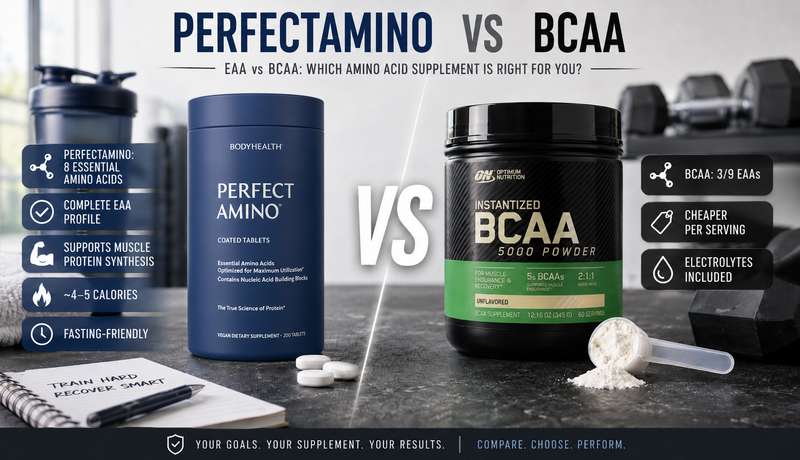
PerfectAmino: All 8 essential amino acids per serving (5g), in BodyHealth's proprietary ratio.
Xtend BCAA: 3 of 9 essential amino acids (7g BCAAs in 2:1:1 ratio), plus electrolytes and citrulline malate. Winner: PerfectAmino — for actual muscle protein synthesis, completeness is the deciding factor according to current research.
② Price Per Serving
PerfectAmino: ~$1.80 (subscription) to ~$3.06 (one-time) per serving.
Xtend BCAA: ~$0.83 per serving. Winner: Xtend — meaningfully cheaper on a per-dose basis, though it's delivering a third of the amino acid profile.
③ Hydration & Electrolytes
PerfectAmino: Standard powder/tablets contain no electrolytes (separate Electrolytes SKU available).
Xtend BCAA: Built-in sodium and potassium for hydration support. Winner: Xtend (for the base formula) — though PerfectAmino Electrolytes closes this gap if you opt for that version.
④ Caloric Impact & Fasting Compatibility
PerfectAmino: ~4-5 calories per serving (tablets); fasting-compatible.
Xtend BCAA: Also low-calorie and broadly fasting-compatible. Tie — both work well for fasted training protocols.
⑤ Third-Party Certification
PerfectAmino: NSF Certified for Sport available on select SKUs.
Xtend BCAA: XTEND Sport carries NSF for Sport certification on that specific line. Tie — both brands offer certified options for drug-tested athletes, though you must select the correct SKU on either side.
Still taking BCAAs because that's just what everyone does?
PerfectAmino delivers all 8 essential amino acids your muscles actually need to complete protein synthesis — not just the signal to start it. Backed by nitrogen balance research and a 90-day money-back guarantee.
🧬 See why thousands of athletes have made the switch to complete EAAs.
My 4-Week Switch: BCAA to PerfectAmino
Week 1 — Replacing a Five-Year Habit
I finished my last tub of BCAA powder and switched directly to PerfectAmino tablets — 5 before training, 5 after. The most immediate difference wasn't physical, it was logistical: no more mixing a powder mid-workout, just tablets with water. The taste-comparison I'd been bracing for (BCAA powders can be notoriously bitter unflavored) became a non-issue since I'd switched format entirely. Week one felt unremarkable, which I expected — amino acid timing effects build over time, not instantly.
Weeks 2–3 — The Recovery Difference Became Noticeable
By the second week, I noticed something I hadn't expected to notice: my between-session soreness, particularly after heavier lower-body days, was less pronounced than it had been on BCAAs for the same training load. I want to be careful here — this isn't a controlled trial, and recovery is influenced by sleep, stress, and a dozen other variables I wasn't isolating. But the pattern was consistent enough across both weeks that I started paying closer attention. I also noticed less of the “third set deterioration” I sometimes felt during longer training blocks — likely connected to having a fuller amino acid pool circulating rather than just the three BCAAs.
Week 4 — Testing Both Side-By-Side
For the final week, I ran a deliberate side-by-side test: BCAA on lower-body days, PerfectAmino on upper-body days, alternating which I used to control for any day-of-week bias. The soreness pattern held — sessions fueled by PerfectAmino consistently left me feeling less beat up the following day than sessions fueled by BCAA, even accounting for the fact that lower-body soreness is typically more pronounced regardless of supplementation. It's anecdotal, and I'd never claim it as proof. But combined with what the research shows about amino acid completeness, it was enough to make the switch permanent for myself and to start recommending it to clients who'd previously been BCAA-only.
Where PerfectAmino Wins
- Complete amino acid profile: All 8 essential amino acids vs. BCAA's 3 of 9 — the single biggest differentiator backed by Wolfe's 2017 research and subsequent studies.
- Built for actual protein synthesis, not just the trigger: Provides the raw materials the body needs to complete muscle repair, not just the leucine signal to start the process.
- High utilization claim with real methodology behind it: The 99% utilization figure is based on nitrogen balance research — a legitimate, if not fully independently audited, scientific approach.
- Fasting-compatible at near-zero calories: Makes it a strong choice for intermittent fasters who still want amino support around training.
- NSF Certified for Sport available: A clean option for drug-tested or competitive athletes.
- 90-day money-back guarantee: One of the most generous return windows in the supplement space — genuinely de-risks trying it.
Where BCAA Still Makes Sense
- Budget matters most: At roughly half the price per serving, BCAA supplements remain the more affordable entry point, even with the formulation limitations.
- Built-in hydration is a priority: Formulas like Xtend include electrolytes standard, which PerfectAmino's base formula doesn't (without opting for the separate Electrolytes SKU).
- You're already eating sufficient complete protein: If your diet already supplies all essential amino acids through meals, a targeted BCAA boost around training may be a reasonable, lower-cost addition rather than a full EAA replacement.
- You specifically want research-supported soreness reduction: Some research does support BCAAs for reducing exercise-induced muscle damage markers, even without driving full protein synthesis — a more modest but real benefit.
- You prefer an established, lower-cost brand with broad flavor variety: Xtend alone offers 5+ formula variants and 15+ flavors, a wider range than most EAA-only brands.
Full Comparison Table: 5 Popular Options
| Product | Amino Profile | Drives Full MPS? | Electrolytes | NSF Certified | Price/Serving |
|---|---|---|---|---|---|
| PerfectAmino (BodyHealth) | 8 EAAs (complete) | ✅ Yes | ❌ (separate SKU) | ✅ Select SKUs | $1.80–$3.06 |
| Xtend Original BCAA | 3/9 EAAs (BCAA only) | ⚠️ Disputed | ✅ Yes | ⚠️ XTEND Sport only | ~$0.83 |
| Thorne Amino Complex | 11 amino acids (complete + extra) | ✅ Yes | ❌ | ✅ All SKUs | ~$1.87 |
| Kion Aminos | 9 EAAs (complete, clinical ratio) | ✅ Yes | ❌ | ✅ Informed Sport | ~$2.00 |
| Optimum Nutrition BCAA | 3/9 EAAs (BCAA only) | ⚠️ Disputed | ❌ | ❌ | ~$0.57 |
The pattern across this table is consistent: every BCAA-only product is cheaper, but every complete-EAA product (PerfectAmino, Thorne, Kion) carries the stronger evidence base for actually driving muscle protein synthesis. Thorne wins on full ingredient transparency since its ratios are fully disclosed. Kion sits in the middle on price. PerfectAmino's case rests on its proprietary 99% utilization claim plus the broader BodyHealth ecosystem (electrolytes, Power Meal, NSF options) if you want one brand across your stack.
Who Should Choose PerfectAmino
- Anyone who's read the research and wants their amino supplementation aligned with what current science actually supports for muscle protein synthesis.
- Intermittent fasters who want full amino acid support around fasted training without meaningful caloric cost.
- Athletes prioritizing recovery over hydration — though the Electrolytes SKU covers both if needed.
- People switching away from BCAA-only habits who want a direct, research-backed upgrade rather than just a different flavor of the same limitation.
- Drug-tested or competitive athletes needing NSF Certified for Sport options.
Who Should Stick With BCAA
- Strict budget constraints — if cost per serving is the deciding factor, BCAA remains the more accessible entry point into amino supplementation.
- You want hydration support built into the same product without paying for a separate electrolyte formula.
- Your diet already covers complete protein needs and you're just looking for a modest intra-workout boost rather than a core recovery strategy.
- You're not training intensely enough for amino completeness to matter much — casual exercisers eating adequate protein may not need to optimize this deeply.
⭐ Final Verdict: PerfectAmino vs BCAA
After switching from five years of BCAA use to PerfectAmino — and digging into the actual research that prompted the switch — the evidence genuinely favors complete EAA profiles over BCAA-only formulas for anyone serious about muscle recovery and protein synthesis. Dr. Wolfe's 2017 review isn't a fringe opinion; it's one of the most cited papers on this exact question, and the conclusion holds up.
That doesn't make BCAA supplements worthless — they're cheaper, often include electrolytes, and may still offer modest benefits for exercise-induced muscle damage. But if your goal is actually driving muscle protein synthesis rather than just triggering the signal, PerfectAmino's complete amino profile is the more scientifically defensible choice, even at a higher price point.
Rating: 4.7 / 5.0 — A confident recommendation for anyone training seriously enough for this distinction to matter. Use the link below to try PerfectAmino backed by its 90-day guarantee.
The research is clear. The question is whether your supplement routine reflects it.
PerfectAmino gives your body all 8 essential amino acids it needs to actually complete muscle protein synthesis — not just the leucine trigger BCAAs rely on. Backed by a 90-day money-back guarantee.
🧬 Make the switch thousands of athletes already have.
Frequently Asked Questions
What's the real difference between PerfectAmino and BCAA supplements?
BCAAs contain only 3 of the 9 essential amino acids — leucine, isoleucine, and valine. PerfectAmino contains all 8 essential amino acids in a proprietary ratio designed for up to 99% utilization. Muscle protein synthesis requires all essential amino acids present simultaneously, so providing only 3 means the other 6 quickly become the limiting factor.
Does research actually show BCAAs don't work for muscle building?
Dr. Robert Wolfe's 2017 review in the Journal of the International Society of Sports Nutrition concluded BCAA consumption alone doesn't stimulate muscle protein synthesis or produce a meaningful anabolic response. Leucine triggers the mTOR pathway, but without the other 6 EAAs as raw materials, the body can't complete the process. BCAAs may still reduce exercise-induced muscle damage, just not drive full protein synthesis.
Is PerfectAmino worth the higher price compared to BCAA supplements like Xtend?
If your goal is actual muscle protein synthesis and recovery, yes — the price difference reflects a meaningful formulation gap, not just branding. If you mainly want hydration and modest soreness reduction, Xtend's lower price and built-in electrolytes are reasonable.
Can I take BCAA and PerfectAmino together?
Yes, but it's largely redundant since PerfectAmino already contains leucine, isoleucine, and valine — the same three aminos in BCAA. If you want electrolytes alongside complete EAAs, PerfectAmino Electrolytes covers that without the overlap.
Why did BCAAs become popular if EAAs are more effective?
BCAA popularity grew through the 1990s-2010s based heavily on leucine's documented role triggering the mTOR pathway. It wasn't until more recent research — particularly Wolfe's 2017 review — clearly separated triggering the signal from having the materials to complete the process, shifting attention toward complete EAA profiles.
Does PerfectAmino break a fast the same way BCAAs do?
Both are low enough in calories (PerfectAmino tablets ~4-5 cal/serving) to be broadly fasting-compatible. For most intermittent fasting goals, neither meaningfully disrupts a fast, though strict purists should note any amino acids can technically trigger some insulin/mTOR activity.



 Top Picks