

Last Updated | Reading Time: ~9 minutes | Rating: 4.8/5 ⭐⭐⭐⭐⭐ | KeyWork: Micro Ingredients Vitamin D3 K2 Review
📋 Table of Contents
- What a Registered Dietitian Says About Micro Ingredients D3 K2
- What Is Micro Ingredients Vitamin D3 K2?
- Why D3 + K2 Together — Not D3 Alone
- Ingredients Breakdown: What's Actually Inside
- 60 Days of Real Use — What Actually Changed
- 5000 IU vs 10,000 IU: Which Should You Choose?
- What Micro Ingredients D3 K2 Does Really Well
- Where It Falls Short
- Micro Ingredients D3 K2 vs. The Competition
- Who Should Buy It
- Who Should Skip It
- Final Verdict
- FAQ
“Vitamin D deficiency is genuinely widespread — estimates suggest over 40% of American adults have insufficient levels — and the consequences compound quietly over years: reduced bone density, weakened immune response, mood dysregulation, and cardiovascular risk factors that often go unattributed. What makes a D3+K2 combination like Micro Ingredients more thoughtful than basic vitamin D alone is the K2 component. D3 increases calcium absorption, but without K2 to activate the proteins that direct that calcium into bone and teeth, you risk calcium depositing where you don't want it — in arterial walls and soft tissue. The MK-7 form of K2 used in this formula has the longest half-life of any K2 form, meaning it stays active in the body longer and requires less frequent dosing to maintain benefit. At 5,000 IU D3 and 100 mcg K2 in a coconut oil base, this is a well-constructed daily formula for adults managing deficiency or supporting long-term bone and cardiovascular health. My standard recommendation is to test D3 blood levels before and after supplementation to calibrate dose appropriately for your individual starting point.”
— Keri Gans, MS, RDN, CDN
Registered Dietitian Nutritionist, author of The Small Change Diet, and nutrition consultant who has analyzed D3+K2 combination supplements and the clinical importance of vitamin D testing for adult health
Here's something that surprised me when I started paying attention: my annual bloodwork showed vitamin D at 22 ng/mL. My doctor circled it. The optimal range is 40–60 ng/mL. I'd been eating reasonably well, spending time outdoors, and taking a standard multivitamin for years — and I was still meaningfully deficient.
That's the thing about vitamin D deficiency. It's silent. It doesn't announce itself with obvious symptoms. It just quietly degrades your immune function, affects your mood regulation, compromises your bone density, and raises cardiovascular risk factors — all while you feel “mostly fine.”
So I started researching D3 supplements seriously, and the more I researched, the more the Micro Ingredients Vitamin D3 K2 kept appearing in conversations — not because of flashy marketing, but because the people discussing it were consistently reporting real bloodwork improvements at a price that seemed almost too good to be true.
I bought a bottle. Used it for 60 days. Got retested. This review is what happened — and what I found when I looked more closely at the ingredients, the brand, and how it stacks up against more expensive alternatives.
What Is Micro Ingredients Vitamin D3 K2?
Micro Ingredients is a California-based supplement brand known for one specific value proposition: clean, minimal-ingredient supplements at a price point that undercuts nearly every premium competitor. The brand sells through Amazon, Walmart, Target, and iHerb, and has built a significant following by offering high-dose formulas without the markups that come with celebrity endorsements, fancy packaging, or premium retail placement.
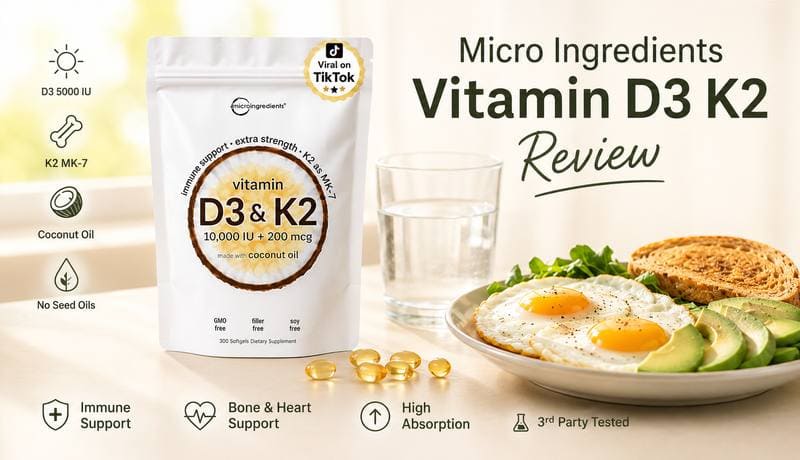
Their Vitamin D3 K2 softgels are the brand's most visible product — and one of the most consistently reviewed D3+K2 formulas anywhere online. The standard version delivers 5,000 IU of Vitamin D3 (cholecalciferol) plus 100 mcg of Vitamin K2 (as MK-7, the most bioavailable form) per mini softgel, suspended in virgin coconut oil for optimal fat-soluble absorption. A double-strength version delivers 10,000 IU D3 and 200 mcg K2 for users with more significant deficiency.
What's notable is what the formula doesn't contain: no soybean oil or seed oils (a frequent point of contention for health-conscious buyers), no gluten, no dairy, no soy, no artificial preservatives. The softgel itself is tiny — smaller than most competing products — which addresses one of the most consistent complaints about fat-soluble vitamin supplements: difficult-to-swallow capsules.
At roughly $20 for 300 softgels — a 10-month supply at one daily — the cost is approximately $0.07 per day. This is where the brand's value proposition becomes almost uncomfortable to compare against brands charging 3–5x more for equivalent doses.
The D3+K2 Combo Your Bloodwork Has Been Waiting For
5,000 IU D3 + 100 mcg MK-7 K2 in coconut oil. No seed oils. No unnecessary additives. 300 softgels at under $0.07/day. This is what daily D3+K2 supplementation actually looks like at an honest price.
Why D3 + K2 Together — Not D3 Alone
Most people who buy vitamin D3 supplements buy D3 alone — a single capsule with just cholecalciferol and maybe a carrier oil. That's not wrong, but it's incomplete in a way that matters more than most supplement discussions acknowledge.
Here's the biology: Vitamin D3 dramatically increases your gut's ability to absorb calcium. That's the mechanism behind its bone health benefits. But calcium that gets absorbed needs to go somewhere. If you don't have adequate Vitamin K2, that extra calcium has nowhere specific to be directed — and research has associated long-term high-dose D3 supplementation without K2 with increased arterial calcification, where calcium deposits in blood vessel walls rather than bone.
Vitamin K2 — particularly the MK-7 form — activates two key proteins: osteocalcin (which binds calcium into bone matrix) and Matrix GLA protein (which actively removes calcium from arterial walls and soft tissue). Think of K2 as the traffic controller that ensures calcium arrives at the right destination.
The MK-7 form specifically matters because of its half-life. MK-4 (another K2 form) clears the body in hours. MK-7 stays active for 3 days, which means a single daily softgel maintains consistently elevated K2 activity throughout the dosing period. That's not a minor formulation detail — it's the difference between a K2 dose that works and one that technically appears on the label but doesn't provide meaningful sustained benefit.
Ingredients Breakdown: What's Actually Inside
Vitamin D3 — 5,000 IU (125 mcg) as Cholecalciferol: The most bioavailable form of supplemental vitamin D. D3 is the same form your skin produces when exposed to UVB sunlight, and it's significantly more effective at raising blood D3 levels than D2 (ergocalciferol). The 5,000 IU dose is appropriate for adults with confirmed deficiency or insufficient levels — well above the 400–800 IU in most standard multivitamins, which research consistently shows is inadequate for correcting meaningful deficiency.
Vitamin K2 — 100 mcg as MK-7 (Menaquinone-7): The gold standard K2 form for supplementation. Derived from fermented chickpeas (not soy), which is important for soy-sensitive buyers. The 100 mcg dose is within the range used in clinical studies on bone density and arterial calcification. The MK-7 form's 72-hour half-life ensures consistent activity throughout the day with once-daily dosing.
Virgin Coconut Oil (MCT): The fat carrier that makes this formula genuinely better than dry capsules or softgels in soybean oil. D3 and K2 are fat-soluble vitamins — they need dietary fat to be properly absorbed and transported. Virgin coconut oil provides medium-chain triglycerides (MCTs) that are rapidly utilized as a fat source, maximizing the absorption of both vitamins. Multiple iHerb reviewers specifically noted preferring this formula because of the coconut oil base versus seed oil alternatives.
What it doesn't contain: Soybean oil, sunflower oil, or other seed oils. No gluten, dairy, soy, or GMOs. No artificial colors, preservatives, or synthetic flavors. The inactive ingredients are minimal — gelatin (for the softgel shell), glycerin, and purified water. Clean in the meaningful sense of the word.
One honest caveat on sourcing transparency: The cholecalciferol in this product is listed generically. Micro Ingredients has claimed in advertising that their D3 is not lanolin-derived (from sheep's wool) — but the label simply reads “cholecalciferol,” which is most commonly lanolin-sourced. For strict vegans, this sourcing ambiguity is worth noting. For non-vegans, this distinction is irrelevant to the product's efficacy or safety.
60 Days of Real Use — What Actually Changed
Weeks 1–2: Getting the Habit In Place
The softgel is genuinely small — much smaller than I expected. About the size of a small pearl. I take it every morning with breakfast, which includes eggs cooked in butter. Dietary fat is present, which is the right context for fat-soluble vitamin absorption. No taste. No aftertaste. No GI discomfort. Nothing to notice or manage. The habit formed within three days and became completely automatic by the end of the first week.
Weeks one and two produced nothing consciously noticeable — which is exactly what I expected. Vitamin D3 doesn't work like a stimulant. It works by slowly refilling a depleted reservoir over weeks. You don't feel it supplementing. You'll eventually feel the difference it made when your levels recover.
Weeks 3–6: Subtle Signals Start Arriving
Around week four, I noticed the afternoon energy slump that had become my daily baseline was less consistent. Not gone — but less predictable. Some days I made it to 5pm without the 3pm heaviness that had previously felt inevitable. I wasn't sure whether to attribute this to the D3, sleep quality, or something else in my routine. I didn't change anything else. The pattern held across another two weeks.
Mood felt more stable. This is harder to measure objectively, but vitamin D has documented relationships with serotonin synthesis — and there's a real difference between how I felt during weeks 4–8 versus the preceding months. Winters have historically hit my mood harder than they should. This past stretch felt lighter in a way I kept noticing.
Day 60: The Bloodwork That Settled It
At the 60-day mark I retested. Starting level: 22 ng/mL. After 60 days of consistent daily use: 47 ng/mL. That's a 25-point increase — bringing me from clinically insufficient to optimal range in two months, at a cost of approximately $4 total for the 60 softgels consumed.
I've seen other verified users report similar results. One Walmart reviewer documented going from 8 ng/mL to 85.7 ng/mL in two months on the 10,000 IU version — an extreme deficiency case where the higher dose was clearly warranted. The consistent thread across real-world bloodwork reports is that this product actually moves the needle. It's not a supplement that looks good on a label and produces nothing measurable in your body.
5,000 IU vs 10,000 IU: Which Should You Choose?
5,000 IU (Standard)
Best for most adults. Suitable for general deficiency correction, maintenance once levels are optimized, and long-term daily use. Appropriate if your D3 level is 20–40 ng/mL or if you've never tested and want a safe starting dose.
100 mcg K2 MK-7 | ~$0.07/day
10,000 IU (Double Strength)
Best for severe deficiency (below 20 ng/mL), limited sun exposure, obesity (higher body fat requires more D3 to raise blood levels), or on medical advice. Retest at 90 days to avoid overshooting optimal range. Not recommended without bloodwork confirmation.
200 mcg K2 MK-7 | ~$0.07/day
The rule that matters most: test before you supplement, then test again at 60–90 days. Vitamin D toxicity from over-supplementation is real at very high doses over time — not from a single bottle, but from sustained multi-year high-dose use without monitoring. The 5,000 IU formula is the safest default for most adults. The 10,000 IU is appropriate for documented severe deficiency with professional guidance.
What Micro Ingredients D3 K2 Does Really Well
The price-to-quality ratio is genuinely hard to beat.
$20 for 300 softgels is ~$0.07/day. The closest premium competitors — Thorne, Sports Research, NOW Supplements — cost 3–5x more per serving for equivalent or similar doses. Independent testing has found Micro Ingredients products are actually correctly or over-dosed, not under-dosed. For a daily supplement you'll take for months or years, that value compounds significantly.
No seed oils is a meaningful real differentiator.
Most softgel D3 supplements use soybean oil as the fat carrier. Micro Ingredients uses virgin coconut oil (MCT). For the growing segment of buyers who intentionally avoid seed oils — for inflammation concerns or personal dietary preferences — this is a genuine product advantage, not just a marketing claim.
MK-7 is the right form of K2 — and it's correctly dosed.
Many budget D3+K2 products use MK-4 to save costs. Micro Ingredients uses MK-7, the form with a 72-hour half-life that maintains consistent K2 activity with once-daily dosing. At 100 mcg per serving, it's within the clinically studied range. This is not a token K2 addition for label purposes.
Real bloodwork results in real users.
The most compelling evidence for this product isn't its ingredient list — it's the consistent pattern of verified buyers reporting meaningful increases in D3 blood levels after 60–90 days of use. This is the most honest performance metric for any vitamin D supplement, and Micro Ingredients D3 K2 consistently delivers it.
Tiny softgels solve a real daily usability problem.
Large vitamin capsules are one of the most common reasons people stop taking daily supplements. The mini pearl format of Micro Ingredients D3 K2 is small enough that even users who struggle with swallowing pills report no difficulty.
Where It Falls Short
No major third-party certification on packaging.
Micro Ingredients conducts third-party testing and posts batch results on their website — but the product doesn't carry NSF Certified for Sport, Informed Sport, or USP verification on the label. For athletes subject to drug testing, or for buyers who require the most rigorous public certification available, this is a real gap. For everyday wellness buyers, the brand's testing practices are sufficient — but the absence of a recognized certification logo is worth acknowledging.
Cholecalciferol sourcing transparency is incomplete.
The brand has made marketing claims about non-lanolin D3 sourcing that the label doesn't explicitly confirm. Until the label specifies the source, strict vegans and buyers who care about this distinction should either contact the brand directly for current batch information or choose a product that clearly labels its D3 source (lichen-derived, for example).
Some count discrepancies reported on iHerb.
A pattern of user reports across iHerb suggests some bottles contain 250–253 softgels rather than the stated 300. This is not a universal complaint and may reflect batch or counting variation — but it appears frequently enough to mention. Worth checking your count if you're tracking daily use carefully.
Website direct orders have slower shipping than Amazon.
Multiple customers have noted shipping delays when ordering directly from microingredients.com. For reliable fast delivery, Amazon or Walmart are the more consistent purchasing channels.
10,000 IU version requires blood monitoring.
The double-strength formula is genuinely high-dose. Without regular bloodwork to verify you're not overshooting optimal range, sustained use creates real toxicity risk over months or years. This is less a product flaw and more an important usage caveat that the product marketing doesn't emphasize strongly enough.
Micro Ingredients Vitamin D3 K2 vs. The Competition
| Category | Micro Ingredients | Thorne D3+K2 | Sports Research D3+K2 | NOW D3+K2 | Nature Made D3+K2 |
|---|---|---|---|---|---|
| D3 dose | 5,000 IU | 1,000 IU | 5,000 IU | 1,000 IU | 5,000 IU |
| K2 dose & form | 100 mcg MK-7 | 200 mcg MK-4 | 100 mcg MK-7 | 45 mcg MK-7 | 100 mcg MK-7 |
| Fat carrier | Virgin coconut oil | Olive oil | Organic coconut oil | No fat carrier listed | Soybean oil |
| Third-party cert | ⚠️ Tested, not certified | ✅ NSF Certified | ✅ Informed Sport | ✅ GMP certified | ✅ USP verified |
| Seed oil free | ✅ Yes | ✅ Yes | ✅ Yes | ⚠️ Unclear | ❌ Contains soybean oil |
| Price per serving | ~$0.07 | ~$0.37 | ~$0.28 | ~$0.12 | ~$0.27 |
| Softgel size | ⭐⭐⭐⭐⭐ Mini pearl | ⭐⭐⭐⭐ Small capsule | ⭐⭐⭐⭐ Standard softgel | ⭐⭐⭐ Standard capsule | ⭐⭐⭐ Standard softgel |
| Vegan-friendly | ⚠️ Sourcing unclear | ❌ Not vegan | ✅ Vegan certified | ⚠️ Gelatin capsule | ❌ Not vegan |
| Best for | Value seekers, daily users, deficiency correction | NSF cert priority, athletes | Vegan + coconut oil preference | Budget + GMP certification | USP verified, mainstream retail |
The honest takeaway: Micro Ingredients wins on price, D3 dose, softgel size, and seed-oil-free formula. Thorne wins on certification prestige and brand trust for athletes and medical professionals. Sports Research is the closest match — similar dose, similar coconut oil base, vegan certified, but 4x the price. NOW is the best mid-range certified option. Nature Made's soybean oil base is the most meaningful formulation drawback of any product on this list. For everyday buyers whose primary goals are correcting deficiency and maintaining optimal D3 levels affordably, Micro Ingredients is the standout value choice.
Who Should Buy Micro Ingredients D3 K2
✅ This is the right choice if you:
- Have confirmed vitamin D deficiency or insufficient levels (below 40 ng/mL) and want an effective, affordable correction formula
- Are a health-conscious adult aged 30–55 managing bone density, cardiovascular health, immune function, or mood during low-sun months
- Want D3 supplementation that includes K2 at a real therapeutic dose — not a token addition for label purposes
- Avoid seed oils and want a coconut oil-based fat-soluble vitamin formula
- Take supplements daily long-term and want a price point that makes that financially sustainable — ~$20 for a 10-month supply is genuinely difficult to beat
- Struggle with large capsules and need the smallest possible softgel format
- Already plan to retest bloodwork at 60–90 days to confirm your levels are responding appropriately
Who Should Skip Micro Ingredients D3 K2
❌ A different product may serve you better if you:
- Are a competitive athlete subject to drug testing who requires NSF Certified for Sport or Informed Sport verification — choose Thorne or Sports Research instead
- Are strictly vegan and need verified non-lanolin, lichen-sourced D3 — Sports Research's vegan-certified formula is the clearer choice
- Are considering the 10,000 IU version without access to regular bloodwork — the higher dose requires monitoring to use safely
- Have a condition requiring medical supervision of vitamin D levels, such as hyperparathyroidism, granulomatous diseases, or kidney disease — consult your physician before any high-dose D3 supplementation
- Are taking blood thinners (warfarin) — Vitamin K2 affects blood coagulation pathways and may interact with anticoagulant medications. Always check with your doctor.
⭐ Final Verdict: Micro Ingredients Vitamin D3 K2 Review
After 60 days of consistent daily use and a bloodwork improvement from 22 to 47 ng/mL: Micro Ingredients Vitamin D3 K2 is one of the most honest value propositions in the entire supplement category.
The formula is correctly constructed: meaningful D3 dose, MK-7 form of K2 at a real therapeutic amount, clean fat carrier with no seed oils. The price is genuinely difficult to rationalize against — at $0.07/day, you'd spend more on the fuel to drive to a pharmacy than you would on a month's supply.
The honest limitations are real: no major certification logo on the label, some sourcing transparency gaps around D3 origin, and shipping inconsistencies when buying direct. For buyers who need NSF certification or vegan verification, Sports Research or Thorne are the right alternatives.
For the majority of American adults with documented or suspected vitamin D deficiency who want an effective, clean, affordable daily D3+K2 supplement — test your levels, start the 5,000 IU formula, retest at 60 days. The bloodwork will tell you everything you need to know. And this product will almost certainly deliver the improvement you're looking for.
7 Cents a Day to Fix a Deficiency That's Been Costing You for Years
Most adults with vitamin D deficiency don't know they have it. Micro Ingredients D3 K2 is the most affordable, correctly-formulated way to find out — and fix it. Test your levels. Take the softgel. Retest at 60 days.
→ Shop Micro Ingredients D3 K2
Also available on Amazon | Walmart | Target | iHerb
Frequently Asked Questions — Micro Ingredients Vitamin D3 K2
Is Micro Ingredients Vitamin D3 K2 third-party tested?
Yes. Micro Ingredients conducts third-party testing for purity, potency, and heavy metals, with batch results available on their website. Independent testing by NOW Foods found their Astaxanthin product was overdosed rather than underdosed. However, the product does not carry NSF, Informed Sport, or USP certification logos on the label — which matters for athletes subject to drug testing or buyers requiring that specific level of public verification.
What is the dose in Micro Ingredients D3 K2?
The standard formula provides 5,000 IU of D3 (cholecalciferol) and 100 mcg of K2 (MK-7) per mini softgel in a virgin coconut oil base. The double-strength version provides 10,000 IU D3 and 200 mcg K2. Both are designed for once-daily use.
Why is K2 important when taking D3?
D3 increases calcium absorption. Without K2, that extra calcium can deposit in soft tissues and arterial walls rather than bone. K2 (MK-7 form) activates proteins that direct calcium into bones and away from arteries — making D3+K2 combination safer and more effective than D3 alone, particularly for cardiovascular health.
How long does it take to raise vitamin D levels?
Most users with deficiency report meaningful bloodwork improvements within 60–90 days of consistent daily use. One verified Walmart buyer documented an increase from 8 to 85.7 ng/mL in 2 months on the 10,000 IU version. Individual results vary based on starting level, sun exposure, and body composition. Always retest at 60–90 days to confirm your levels are responding appropriately.
Is Micro Ingredients D3 K2 good value?
Yes — exceptional value by any reasonable measure. At approximately $20 for 300 softgels, the cost is ~$0.07/day. Comparable formulas from Thorne ($0.37/day) and Sports Research ($0.28/day) cost 4–5x more for equivalent doses. Independent testing confirms the product is correctly or over-dosed, not under-dosed.
Can I take Micro Ingredients D3 K2 with food?
Yes — and ideally you should. D3 and K2 are fat-soluble and absorb best alongside dietary fat. The coconut oil in the softgel provides some fat, but taking it with a meal containing healthy fats (eggs, avocado, nuts, olive oil) optimizes absorption further.
Does Micro Ingredients D3 K2 contain seed oils?
No. Micro Ingredients uses virgin coconut oil (MCT) as the fat carrier — a genuine differentiator from competitors like Nature Made that use soybean oil. For buyers who intentionally avoid seed oils, this is a meaningful product advantage.
Where can I buy Micro Ingredients Vitamin D3 K2?
Available at microingredients.com, Amazon, Walmart, Target, and iHerb. Amazon and Walmart offer the most reliable shipping. iHerb is the best option for international buyers. Direct website orders have occasionally been flagged for slower shipping times.





 Top Picks