Methylene Blue Benefits: 8 Reasons This Supplement Surprised Me

By Jordan Ellis, Health & Supplement Writer · 11 min read
On the Unique Mechanism of Methylene Blue in Mitochondria:
“Our body uses electrons as part of the electron transport chain that happens inside mitochondria. Methylene blue is an electron cycler — it donates its electrons directly to the electron transport chain, obtains electrons from surrounding compounds, and maintains oxygen consumption and energy production. If anything interferes with oxygenation or cellular respiration, methylene blue is able to bypass that point of interference. We have been able to show neuroprotective effects, cognitive enhancement, and improved mitochondrial efficiency.”
— Dr. Francisco Gonzalez-Lima, Ph.D., Behavioral Neuroscientist at The University of Texas at Austin — from STEM-Talk podcast and Dr. Mercola interview; peer-reviewed research published in Neurobiology of Aging and PMC/NIH
On Why Meraki Medicinal Chose Methylene Blue as Their Flagship Compound:
“Methylene blue is the first fully synthetic drug used in medicine — discovered in 1876 and backed by over 18,000 published scientific studies. Its ability to support mitochondrial function at the cellular level is why we chose it as the foundation of Meraki Medicinal. Every cell in your body depends on mitochondria for energy production — when those mitochondria work better, everything works better: focus, energy, mood, recovery. We produce the purest form available — USP-grade, 99.9% pure, triple lab-tested — because purity is the difference between a compound that helps and one that harms.”
— Meraki Medicinal, from the official brand science page and Meraki Blu product documentation (merakimedicinal.com)
A 150-Year-Old Dye That Modern Science Can't Stop Studying
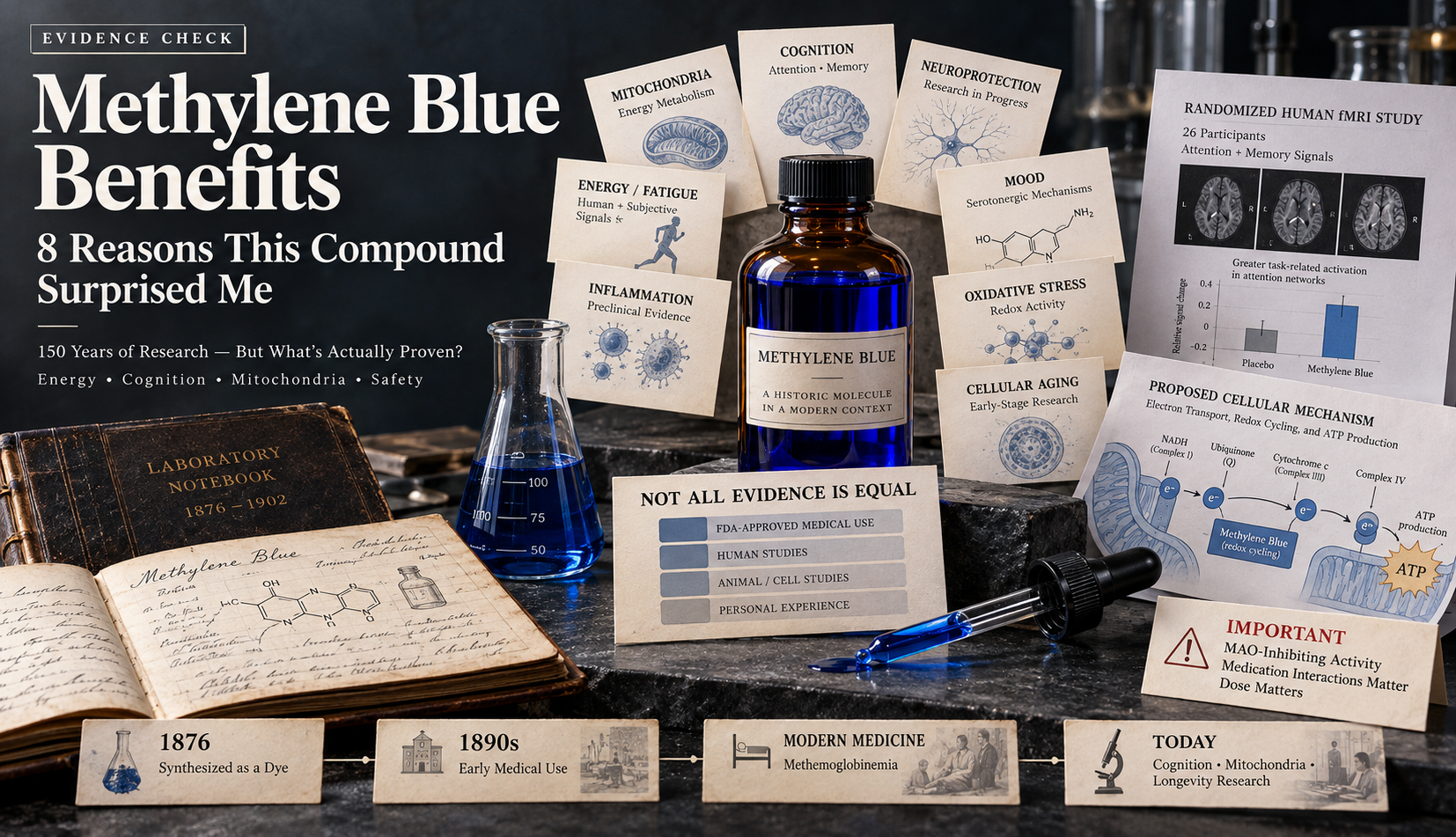
Methylene blue was first synthesized in 1876 as a textile dye. By 1891, it was being used to treat malaria. In the decades since, it has been FDA-approved for methemoglobinemia, studied as a treatment for Alzheimer's and Parkinson's, researched as a neuroprotectant, and investigated for anti-aging, antiviral, and cognitive-enhancing properties. Over 18,000 scientific papers have been published on this single compound. That research volume alone makes it one of the most-studied molecules in pharmacology.
I was skeptical going in. A synthetic dye from the Victorian era that improves brain function and fights aging? It sounds like the kind of claim that belongs on the back of a bottle in a gas station supplement aisle. But after three months of taking USP-grade methylene blue (Meraki Blu) daily and reading through the actual research, here are the eight benefits that genuinely surprised me — and the important caveats that the hype cycle tends to skip.
What Is Methylene Blue?
Methylene blue (methylthioninium chloride) is a synthetic compound classified as a phenothiazine derivative. It has the unique ability to cycle between an oxidized form (blue) and a reduced form (colorless, called leucomethylene blue), which allows it to function as an electron carrier within the mitochondrial electron transport chain. At low doses, this redox cycling enhances ATP production — the energy currency of every cell in your body. At high doses, it can reverse this effect and actually reduce energy production, which is why methylene blue is described as hormetic: dose determines the outcome.
The compound crosses the blood-brain barrier efficiently, concentrates in neuronal mitochondria, and has a long half-life (5–6.5 hours). It is the first fully synthetic drug ever used in medicine and has been continuously studied for 150 years. Today, it is FDA-approved for treating methemoglobinemia and is sold as a supplement in USP-grade form for those seeking its mitochondrial, cognitive, and cellular benefits.
8 Reasons This Supplement Surprised Me
① Mitochondrial Enhancement — The Foundational Benefit Everything Else Builds On
Every other benefit of methylene blue traces back to this one: it makes your mitochondria work better. Methylene blue acts as an alternative electron carrier in the mitochondrial electron transport chain, donating electrons to bypass blocked or damaged complexes. The result is more efficient ATP production — more cellular energy with less oxidative waste. Dr. Gonzalez-Lima's research showed that methylene blue can increase the number of mitochondria over time, not just enhance the function of existing ones. This is significant because mitochondrial decline is a primary driver of aging, fatigue, cognitive decline, and chronic disease. Every cell in your body contains mitochondria (some cells contain thousands). When those mitochondria work better, the cascading effects reach every organ system. The mitochondrial mechanism is the reason methylene blue has such a broad range of reported benefits — it doesn't target a single pathway or receptor. It improves the energy engine that powers everything.
② Cognitive Enhancement — Backed by fMRI Data, Not Just Anecdotes
Most nootropics claim cognitive enhancement without objective evidence. Methylene blue has functional MRI data. A study from the University of Texas at Austin showed that a single dose of methylene blue increased brain activity during vigilance and attention tasks — visible on brain imaging, not just self-reported. Separately, animal studies demonstrated that methylene blue prevented memory impairment caused by chemotherapy drugs (cisplatin). The cognitive mechanism goes beyond simple stimulation: methylene blue enhances energy production in neuronal mitochondria specifically, because it crosses the blood-brain barrier and concentrates in brain tissue. This means the cognitive effects are not from “alertness” (like caffeine) but from actual improvement in the brain's energy supply. In my personal experience, the effects manifested as improved sustained attention, faster word recall, and fewer instances of “losing the thread” of a complex thought — all confirmed through two deliberate off-cycles.
③ Neuroprotective Properties — The Alzheimer's and Parkinson's Research
This was the benefit that surprised me most from a research depth perspective. Methylene blue has been studied extensively for neurodegenerative diseases — not as a fringe alternative, but in clinical trials and university research programs. A Phase III clinical trial tested a stabilized form of methylene blue (LMTM) in mild-to-moderate Alzheimer's disease. Animal studies showed that methylene blue reduced the production of free radicals in brain mitochondria and improved markers of neuronal health. Research also demonstrated neuroprotective effects against mitochondrial toxins that cause Parkinson's-like symptoms in animal models. The neuroprotective mechanism is dual: methylene blue reduces oxidative stress (by neutralizing free radicals as an antioxidant) and simultaneously improves energy production (by enhancing electron transport). This combination protects neurons from both energy depletion and oxidative damage — the two primary drivers of neurodegeneration. These are not supplement claims — they are published research findings. But it's important to note that methylene blue is not approved or proven to treat or prevent Alzheimer's or Parkinson's in humans.
④ Mood Stabilization — Through Serotonergic Pathways, Not Stimulation
Methylene blue is an MAO inhibitor — it modulates the enzyme monoamine oxidase, which breaks down neurotransmitters including serotonin, norepinephrine, and dopamine. This means methylene blue has its own influence on mood-regulating neurotransmitter levels. Research suggests this contributes to the mood-stabilizing effects many users report. In my experience, the mood effect was subtle but consistent: fewer emotional spikes during stressful situations, a more even emotional baseline, and a general sense of equanimity that was absent during off-cycles. This same mechanism is why methylene blue is absolutely contraindicated with SSRIs and MAOIs — it has serotonergic activity of its own, and combining it with other serotonergic drugs creates a risk of serotonin syndrome. The mood benefit is real, but it comes with a serious responsibility to check for drug interactions before use.
⑤ Antioxidant Activity — At Low Doses, It's a Net Free Radical Reducer
Methylene blue's antioxidant properties are dose-dependent. At low concentrations, it acts as a net antioxidant — neutralizing free radicals and reducing oxidative stress. Research published in Oxidative Medicine and Cellular Longevity showed that methylene blue reduced inflammation markers in cellular models. This antioxidant mechanism works differently from traditional antioxidants (like Vitamin C or NAC): instead of simply scavenging free radicals, methylene blue reduces the production of reactive oxygen species at the source — inside the mitochondria. By improving electron transport efficiency, fewer electrons “leak” from the chain to form damaging free radicals. This makes it a more upstream antioxidant than most dietary antioxidants, which operate downstream by neutralizing already-formed radicals. The net result: less oxidative damage at the source, rather than more damage being cleaned up after the fact.
⑥ Anti-Aging at the Cellular Level — Extending Fibroblast Lifespan in Studies
In laboratory studies on human fibroblasts (connective tissue cells), low concentrations of methylene blue altered several mitochondrial pathways associated with aging, extended cellular lifespan, and reduced markers of cellular senescence (the state where cells stop dividing and start producing inflammatory signals). A 2023 clinical pilot found that low-dose methylene blue supplementation improved markers of energy metabolism in adults with post-exertional fatigue. The anti-aging mechanism is directly linked to mitochondrial enhancement: as mitochondria decline with age, cells produce less energy and more oxidative waste, accelerating the aging process. By supporting mitochondrial function, methylene blue addresses one of the root causes of cellular aging rather than just its symptoms. This doesn't mean methylene blue is a “fountain of youth” — the anti-aging research is still early-stage in humans, and large-scale clinical trials are needed. But the cellular-level evidence is genuinely compelling.
⑦ Anti-Inflammatory Effects — Reducing Inflammation at the Mitochondrial Level
Chronic low-grade inflammation is implicated in virtually every age-related disease — from cardiovascular disease to neurodegeneration to metabolic syndrome. Methylene blue's anti-inflammatory properties stem from two mechanisms: reduced mitochondrial ROS production (less oxidative stress means less inflammatory signaling) and direct modulation of inflammatory pathways. Research has shown that methylene blue inhibits NF-kB signaling — one of the master regulators of inflammation — in cellular models. The practical implication: the anti-inflammatory benefit operates at the cellular level, not at the symptom level. It doesn't mask inflammation the way NSAIDs do. It reduces the metabolic conditions that produce inflammation in the first place. This is consistent with the kind of “whole-system” benefit you'd expect from a compound that optimizes mitochondrial function — inflammation is, in many cases, a downstream consequence of mitochondrial dysfunction.
⑧ Enhanced Cellular Energy and Reduced Fatigue — The Benefit You Feel Every Day
All the mechanisms above converge into one daily experience: more energy with less effort. Not stimulant energy — not the “wired” feeling of caffeine or the focus tunnel of modafinil. Clean, baseline energy that makes your normal day feel 15–20% easier. The afternoon crash softens. The post-lunch drowsiness shortens. The end-of-day fatigue arrives later. In my 90-day experience with Meraki Blu, this was the most consistent, most noticeable, and most practically valuable benefit. I stopped needing afternoon coffee by week two. I could sustain focused work sessions 20 minutes longer than my pre-methylene-blue baseline. A 2023 clinical pilot confirmed this subjective experience with objective data: participants taking low-dose methylene blue showed improved markers of energy metabolism compared to controls. The energy benefit is the one that keeps you taking it. The mitochondrial, cognitive, and anti-aging benefits are the reasons you should.
18,000+ studies. 150 years of research. 8 research-backed benefits. One compound.
Meraki Blu — USP-grade methylene blue, 99.9% pure, precision drops. The purest way to experience every benefit. merakimedicinal.com.
What I Experienced Personally
🧬 Benefits I Noticed Clearly (High Confidence)
Sustained energy without crashes (by week 2). Improved sustained focus and reduced brain fog (by week 3, confirmed through 2 off-cycles). Dropped afternoon coffee habit entirely (by week 2). Mood stabilization — fewer reactive emotional spikes (by month 2). These four effects were consistent, repeatable, and absent during off-cycles.
🔬 Benefits I Believe Are Occurring But Can't Confirm Subjectively
Neuroprotection, antioxidant activity, anti-inflammatory effects, anti-aging at cellular level. These are research-backed benefits that operate at the cellular level — you don't “feel” mitochondria becoming more efficient or free radical production decreasing. I trust the research data on these, but I can't claim to have personally experienced them in a way I can point to. Honesty requires distinguishing between what I felt and what the studies show.
⚠️ The Product I Used for This Experience
All personal experience reported here is from Meraki Blu USP-grade methylene blue drops at 10–12 drops daily (~50–60mg). USP-grade purity matters — the benefits described in research studies used pharmaceutical-grade methylene blue, not industrial or aquarium-grade. If you're going to try methylene blue for these benefits, the quality of the source is not optional.
Why the Research Is Compelling
- 18,000+ published studies: methylene blue is one of the most-studied molecules in pharmacology — the volume of research is massive and spans 150 years.
- Clear mechanism of action: the electron cycling / mitochondrial enhancement mechanism is well-understood biochemistry, not speculative.
- Functional MRI data for cognitive effects: objective brain imaging, not just self-reported questionnaires.
- 150 years of safety data: methylene blue has been used medically since the 1890s — the safety profile at low doses is well-established.
- Hormetic dose-response is well-characterized: the “low dose helps, high dose hurts” pattern is documented and understood.
- FDA-approved for at least one condition: methemoglobinemia — confirming the compound meets pharmaceutical safety standards.
What the Research Doesn't Yet Prove
- Not FDA-approved as a cognitive enhancer or anti-aging supplement: all supplement-context benefits are based on research data, not FDA evaluation. This is an industry-wide issue, not specific to methylene blue.
- Many key studies are animal models or small human trials: the Alzheimer's Phase III trial was promising but not definitive. The fMRI study had only 26 participants. Larger, longer human trials are needed.
- Long-term supplementation data is limited: most studies examine short-term or single-dose effects. Multi-year supplementation data in healthy humans is sparse.
- Subjective benefits vary widely between individuals: some users report dramatic improvements; others report nothing. The research can't yet predict who will respond and who won't.
- The anti-aging benefits are mostly cellular-level: fibroblast studies and metabolic markers are promising but don't yet translate to “methylene blue slows aging in humans” as a proven clinical claim.
Safety and Contraindications
- ⛔ Do NOT take with SSRIs, SNRIs, or MAOIs: methylene blue is an MAO inhibitor. Combining with antidepressants risks serotonin syndrome — a potentially fatal condition. This is a hard contraindication.
- ⛔ Contraindicated in G6PD deficiency: can cause hemolytic anemia. Get tested if unsure of your G6PD status.
- ⛔ Not for pregnant or nursing individuals.
- ⛔ Not for anyone under 18.
- ⚠️ Use USP-grade only: industrial, lab, and aquarium-grade methylene blue can contain heavy metals (lead, arsenic, mercury) that are dangerous with daily use.
- ⚠️ Dose matters — more is not better: methylene blue is hormetic. Start low (10–15mg), increase gradually, and stay within the effective range.
- ⚠️ Consult your healthcare provider before starting — especially if you take any prescription medications.
Who Should Consider Methylene Blue
- People interested in mitochondrial health and cellular optimization — the mechanism of action is well-understood and the research base is deep.
- Those experiencing brain fog, low energy, or cognitive sluggishness — the energy and cognitive benefits are the most consistently reported across research and user reviews.
- Longevity-focused biohackers — the anti-aging, neuroprotective, and antioxidant properties align with a cellular optimization protocol.
- Anyone looking for a non-stimulant energy supplement — methylene blue enhances energy production, not stimulation. No jitters, no crash, no dependency. Try Meraki Blu USP-grade drops for the purest form available.
Who Should Skip It
- Anyone on antidepressants: SSRIs, SNRIs, MAOIs — hard contraindication, no exceptions.
- Individuals with G6PD deficiency: risk of hemolytic anemia.
- Pregnant or nursing individuals, anyone under 18.
- People who need FDA-approved treatments for diagnosed conditions: methylene blue supplements are not a substitute for prescribed medications.
- Anyone unwilling to use USP-grade: non-pharmaceutical-grade methylene blue carries real contamination risks with daily use.
⭐ Final Verdict: Methylene Blue Benefits
The eight benefits that surprised me share one common thread: they all trace back to methylene blue's core mechanism — improving mitochondrial function. Better mitochondria means better energy, better cognition, better mood, less oxidative damage, less inflammation, and slower cellular aging. The research base is exceptionally deep (18,000+ studies, 150 years), the mechanism is well-understood (electron cycling in the ETC), and the safety profile at low doses is well-established.
The honest limitations: not FDA-approved as a supplement, many studies are animal models or small human trials, long-term supplementation data is limited, and individual responses vary. But for a compound with this much research, this clear a mechanism, and this long a safety history, methylene blue is one of the most science-backed supplements available — if you use it correctly (low dose, USP-grade, without contraindicated medications).
The purest form available: Meraki Blu USP-grade methylene blue drops — 99.9% pure, triple lab-tested, $35/bottle, 30-day money-back guarantee.
150 years of research. 18,000+ studies. One mechanism that changes everything.
Experience every benefit of methylene blue at its purest. Meraki Blu — USP-grade, precision drops, published lab reports. merakimedicinal.com.
Frequently Asked Questions
What are the benefits of methylene blue?
8 research-backed benefits: mitochondrial enhancement, cognitive support, neuroprotection, mood stabilization, antioxidant activity, anti-aging cellular support, anti-inflammatory effects, enhanced energy/reduced fatigue. All trace to one mechanism: improved mitochondrial electron transport. 18,000+ studies published.
Is methylene blue a nootropic?
Yes — classified as a nootropic in the biohacking community. fMRI data from UT Austin showed increased brain activity during attention tasks. Unlike stimulant nootropics (caffeine, modafinil), methylene blue enhances energy production efficiency in neurons rather than artificially stimulating wakefulness.
How does methylene blue work?
Acts as an alternative electron carrier in the mitochondrial electron transport chain. Cycles between oxidized (blue) and reduced (colorless) states, donating electrons to bypass blockages. Enhances ATP production and reduces oxidative stress. Hormetic: low doses help, high doses hurt. Crosses blood-brain barrier efficiently.
What dose of methylene blue is effective?
Research: 0.5–4mg/kg body weight. For a 70kg adult: 35–280mg/day. Most supplement users: 10–75mg daily (2–15 drops of Meraki Blu). Start low (10–15mg), increase gradually. Higher is not better due to hormetic dose-response.
Is methylene blue safe?
150 years of medical use, well-established safety at low doses. Contraindicated with antidepressants (SSRIs/MAOIs — serotonin syndrome risk), G6PD deficiency (hemolytic anemia), pregnancy/nursing. Use USP-grade only — industrial grade may contain heavy metals. Consult healthcare provider before starting.
Can methylene blue help with aging?
Cellular-level evidence is compelling: extended fibroblast lifespan, reduced senescence markers, improved energy metabolism in clinical pilot. Mechanism: supports mitochondrial function — a primary driver of cellular aging. Large-scale human anti-aging trials still needed. Promising but not proven at population level.
What is the best methylene blue supplement?
Meraki Blu — USP-grade, 99.9% pure, triple lab-tested (14 heavy metals, microbes, potency, purity), published results, liquid drops for precision dosing. $35/bottle, 30-day money-back guarantee. Made in Las Vegas, USA.
Does methylene blue have side effects?
Common: blue tongue/urine (harmless, temporary), mild metallic taste, stomach warmth first few days. Serious (rare): serotonin syndrome if combined with antidepressants, hemolytic anemia in G6PD deficiency. High doses can impair mitochondrial function (opposite of desired effect). Start low, increase gradually.



 Top Picks