
Jolie Showerhead Filter Replacement: 3 Things I Wish I Knew

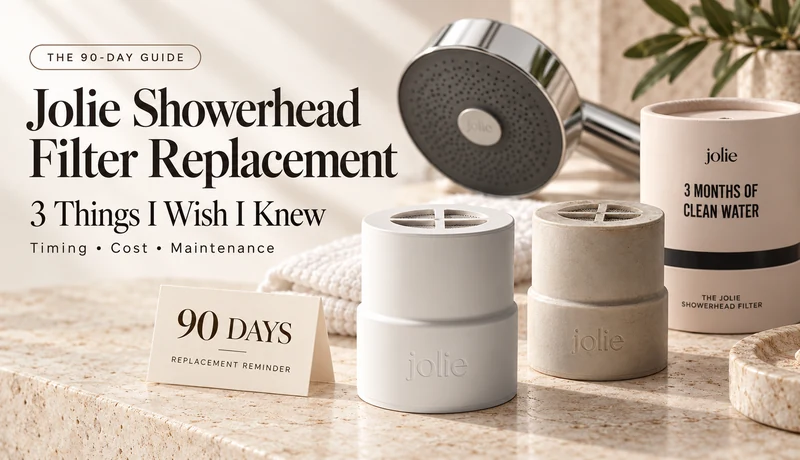
By Jess Hartley, Wellness & Home Writer · Rating: 4.4/5 ⭐⭐⭐⭐⭐ · 7 min read
“One of the most common mistakes people make with any point-of-use water filter — whether it's a pitcher filter, a faucet filter, or a shower filter — is treating filter replacement as optional once they've seen the initial results. I understand the logic: the showerhead still works, the water still comes out, the hair still gets washed. But a KDF filter medium like the one in the Jolie has a finite capacity. The copper-zinc alloy exchanges ions with chlorine and heavy metal ions until the exchange sites are saturated. Once saturated, the reaction stops — not gradually, and not partially. When the medium is exhausted, the filter no longer removes anything. The water that comes through an exhausted KDF filter is chemically identical to the water that would come through with no filter at all. For consumers, the practical implication is simple: the improvement you see in your hair and skin after installing a quality shower filter is entirely dependent on maintaining that filter on schedule. The upfront purchase is the headline; the replacement schedule is the commitment. Anyone evaluating a filtered showerhead should calculate the total annual cost — including replacements — before deciding whether it fits their budget and routine.”
— Dr. Andrew Chan, PhD, environmental engineer and water quality researcher with 18 years of experience in residential water treatment systems; formerly at the EPA Office of Water, currently an independent consultant to municipal water utilities
Nobody Tells You This When You Buy the Showerhead
I bought the Jolie shower filter the same way most people do — after reading a glowing review that focused almost entirely on the installation and the initial results. The review was honest about those things. What it didn't spend much time on was the part that actually determines whether a $155 showerhead becomes a long-term investment or a one-time experiment: the filter replacement cycle.
By month four, I'd replaced my first cartridge, done the math on what it would cost me per year, accidentally run the filter past its replacement date, and noticed what happens when you do. None of these are reasons not to buy the Jolie — I still have it, I still use it, and the results are still real. But there are three specific things I wish someone had told me upfront that would have changed how I budgeted for it and how I thought about the ongoing commitment.
Quick Recap: What the Jolie Filter Does
The Jolie filtered showerhead uses KDF-55 (a copper-zinc alloy medium) and calcium sulfite to remove chlorine, chloramines, and heavy metals from shower water at the temperatures people actually shower at. Unlike activated carbon filters, KDF and calcium sulfite maintain their effectiveness at hot water temperatures — which is why Jolie is considered technically superior to most competing shower filters for hot showers. The filtration works through a redox (oxidation-reduction) reaction: the KDF medium exchanges electrons with chlorine and heavy metal ions, neutralizing them.
The critical thing to understand about this reaction is what Dr. Chan explains above: the KDF medium has a finite number of exchange sites. Once those sites are all occupied, the reaction stops. The filter is done. This is why replacement isn't optional — and it's the foundation for all three things I wish I'd known.
3 Things I Wish I Knew Before Buying
① The Three-Month Replacement Is Not a Suggestion — It's When the Filter Stops Working
Most filter replacement schedules feel like a company trying to sell you more product. I assumed the Jolie three-month recommendation was in that category — a conservative estimate designed to maximize cartridge sales. So I let my first cartridge run to month four and a half before replacing it.
Here's what I noticed starting around week fourteen: the very faint chlorine smell that had disappeared when I first installed the Jolie started coming back. My hair started drying with slightly more frizz at the ends. By week sixteen, my post-shower skin tightness — the one I'd been so pleased about eliminating — had returned enough to remind me it was a thing. I replaced the cartridge and within a week, all of it improved again.
The chemistry behind this is what Dr. Chan described: the KDF medium doesn't gradually lose effectiveness — it processes water until its exchange capacity is exhausted and then it stops. The timeline for my household (two people, daily showers, city water with standard chlorination) turned out to closely match the three-month recommendation. Your timeline may vary based on how many people shower and how heavily chlorinated your water is — but treating the recommendation as the conservative outer limit rather than a vague suggestion is the right mental model.
📌 Practical takeaway: set a calendar reminder for 10–11 weeks after installation and check the cartridge color. Don't wait until you notice results slipping.
② The Real Annual Cost Is $255 in Year One — Budget for That Before You Buy
The $155 showerhead price is what's in every review headline. What's less prominently stated: four cartridges per year at approximately $25 each is $100 in annual filter costs, making the true first-year cost $255. From year two onwards, you're paying $100 per year to keep the filter working. This is not a hidden cost — Jolie is transparent about it — but I genuinely wish I'd done that math before I ordered rather than after.
To be fair about the comparison: I was spending roughly $35 per month on hair products that were partly managing the damage caused by chlorinated shower water. Addressing the water directly with the Jolie reduced my product spending enough that the filter cost is roughly cost-neutral over the course of a year for my situation. But that math doesn't work for everyone, and it's not guaranteed. The subscription option Jolie offers is genuinely useful here — automatic delivery every three months at a slight discount removes the “oops I forgot to reorder” problem that leads to running an exhausted filter. Available at jolieskinco.com.
📌 Practical takeaway: budget $255 for year one and $100/year ongoing. Consider the subscription option to automate the schedule.
③ Your Water Report Changes How Often You Need to Replace — Look It Up Before You Set Your Schedule
Jolie has a free water report tool on their site that pulls EPA and municipal utility data to show you what's commonly found in your local water supply — chlorine levels, chloramine use, heavy metal presence. I didn't check this until I'd already bought the showerhead. It turns out my city uses chloramines rather than free chlorine as the primary disinfectant, which is relevant because chloramines are harder to remove and deplete the KDF medium faster than free chlorine alone.
If you're in a city with high chlorination, heavy metal presence, or chloramine use, the filter may need replacing closer to every two months rather than three — which changes the annual filter math from $100/year to $150/year. If you're in an area with lower chlorine levels, the three-month estimate may be generous and your filters might last slightly longer. The point is: the three-month schedule is a population average. Your actual schedule is a function of your water quality and your household usage. You can also request a Consumer Confidence Report (CCR) directly from your municipal water utility for the most specific picture of what's in your water.
📌 Practical takeaway: check the water report at jolieskinco.com or your utility's CCR before finalizing your replacement schedule. High chloramine cities may need 8-week cycles rather than 12.
The filter is the commitment. Stay on schedule and it works.
Jolie showerhead + replacement filters at jolieskinco.com. Subscribe and save. Automatic delivery on your schedule.
How to Replace the Jolie Filter — Step by Step
Turn off the shower and let the water drain
No need to turn off the main water supply. Just make sure the showerhead isn't running when you do the swap. Any residual water in the housing will drain out — have a small towel handy.
Locate the filter housing on the back of the showerhead
The filter housing is the cylindrical section at the connection point between the showerhead and the shower arm. It has a slightly different texture from the main showerhead body and is designed to be removable by hand.
Unscrew the housing counterclockwise by hand
No tools needed. Turn counterclockwise until the housing detaches. If it's tight, a rubber jar opener can help — but do not use pliers or a wrench, which can damage the housing.
Remove the old cartridge and check its color
The used cartridge will be noticeably darker than a new one — the KDF-55 medium oxidizes from its original silver-gold color to a darker tone as it processes chlorine and heavy metals. A heavily darkened cartridge confirms it was due for replacement.
Insert the new cartridge with correct orientation
The Jolie replacement cartridge is directional — there's a flow direction marked on it. Insert it with the flow direction facing the water inlet (toward the shower arm connection). Inserting it backwards won't damage anything, but it won't filter effectively.
Screw the housing back on and run the water briefly
Hand-tighten clockwise until snug. Turn on the shower and let it run for 30–60 seconds — this flushes out any loose KDF particles from the new cartridge and confirms no leaks at the housing seal. Set your next replacement reminder for 10–12 weeks out.
What Happens When You Let the Filter Run Too Long
I ran my first Jolie cartridge to approximately four and a half months — about six weeks past the three-month recommendation. Here is a specific timeline of what I noticed:
Faint chlorine smell returned during the shower. Not strong — barely noticeable — but present in a way it hadn't been since the first week of Jolie use.
Hair air-dried with slightly more frizz at the ends than the previous few months. I initially attributed it to weather (summer humidity). I was wrong.
Post-shower skin tightness had returned enough that I was reaching for moisturizer immediately again. Scalp was reactive on day-two between washes. I checked the cartridge color — it was significantly darkened.
Replaced cartridge. Within five days: chlorine smell gone again, frizz reduced, skin tightness diminished. The speed of the return to baseline after replacement confirmed that the gradual decline I'd been experiencing was filter depletion, not something else.
The cartridge doesn't fail dramatically. It fades. The first sign is usually the smell, then hair texture, then skin — in roughly that order. If you're paying attention, you'll catch it around week thirteen or fourteen. If you're not, you may gradually think “the filter must have stopped working” and stop reordering — when really it just needed a fresh cartridge.
Full Cost Breakdown: First Year and Beyond
| Item | One-Time Buy | Subscription | Notes |
|---|---|---|---|
| Showerhead (one-time) | $155 | $155 | jolieskinco.com |
| Filter cartridges / yr (3-month cycle) | ~$100 | ~$85 (subscribe & save) | 4 cartridges × ~$25 one-time / ~$21 sub |
| Year 1 total | ~$255 | ~$240 | Showerhead + 4 replacement cartridges |
| Year 2+ total (filters only) | ~$100/yr | ~$85/yr | No showerhead cost after year 1 |
| High-chloramine city (2-month cycle) | ~$150/yr filters | ~$126/yr | 6 cartridges/yr for heavy chloramine water |
| Per-shower filter cost (avg) | ~$0.14 | ~$0.12 | Based on 2 people × 1 shower/day × 365 days |
Per-shower, the filter replacement cost works out to around $0.12–$0.14 — less than a third of a cup of coffee. The annual cost of $85–$100 is roughly equivalent to two to three bottles of a quality leave-in conditioner. Whether that trade-off makes sense depends entirely on how significant your chlorine-related hair and skin issues are and how much you're currently spending to manage them with products.
What Jolie Gets Right
- Visual depletion indicator: The cartridge's color change is a genuine functional feature. It gives you real information about filter status rather than requiring pure calendar guesswork.
- 60-second replacement process: No tools, no mess, no complexity. The easiest filter swap of any home water filter I've used.
- Subscription option with auto-scheduling: Jolie's subscribe-and-save removes the “oops I forgot” problem that causes most people to run an exhausted filter longer than they should.
- KDF medium is verifiable: The color change between a new and used cartridge confirms it was actually working.
- Replacement restores performance quickly: After swapping to a new cartridge, improvements return within days — confirmation that the filter is responsible for the results.
What Could Be Better
- No in-app or physical reminder system: Jolie doesn't push a notification or include a replacement date sticker. For a product whose performance depends on timely replacement, a simple reminder system would meaningfully improve the experience.
- Annual cost not prominently featured pre-purchase: The replacement cartridge cost is findable on the site but not front and center in the product description.
- No bulk pricing discount: Buying a year's worth of cartridges at once doesn't come with a meaningful volume discount beyond the subscription option.
- Variable cycle based on water quality isn't proactively communicated: The generic “3 months” guidance doesn't tell you to check your local water report and adjust accordingly.
Filter Replacement Cost: Jolie vs Competitors
| Brand | Showerhead Price | Cartridge Cost | Filter Life | Annual Filter Cost | Year 1 Total | Hot Water Effective |
|---|---|---|---|---|---|---|
| Jolie ⭐ | $155 | ~$25 | ~3 months | ~$100 | ~$255 | ✅ Full |
| Aquasana | $99–$149 | ~$30–$40 | ~6 months | ~$60–$80 | ~$160–$230 | Partial (carbon degrades) |
| AquaBliss | $35–$60 | ~$15–$20 | ~2–3 months | ~$60–$120 | ~$95–$180 | Reduced in hot water |
| Hello Klean | $120–$165 | ~$20–$30 | ~3 months | ~$80–$120 | ~$200–$285 | ✅ (KDF portion) |
| FilterBaby | $89–$129 | ~$20–$25 | ~3 months | ~$80–$100 | ~$170–$230 | Reduced (carbon-heavy) |
Who Should Buy (and Keep Replacing)
- Anyone who noticed real improvements after their initial Jolie installation — the results are filter-dependent. Maintaining the replacement schedule is what keeps those results happening.
- People in high-chloramine cities — check your local water report. High chloramine areas may need an 8-week rather than 12-week cycle.
- Buyers who want to minimize total cost — the Jolie subscribe-and-save option is a meaningful discount over one-time purchases and removes the “oops I forgot” problem.
- People considering Jolie but worried about ongoing costs — at roughly $0.14 per shower, it's one of the cheaper line items in most people's personal care budget.
Who Should Skip It
- If you don't want a recurring purchase commitment: The Jolie showerhead is a system, not a one-time product. If you're not comfortable with the ongoing cartridge cost, the initial purchase doesn't make sense.
- If your primary water concern is hardness: The replacement cartridge addresses chlorine, chloramines, and heavy metals — not calcium and magnesium. You need a water softener for hard water.
- If $255 in year one is a significant stretch: AquaBliss at $35–$60 entry point is the honest budget alternative, with the trade-off of reduced hot-water performance.
⭐ Final Verdict: Jolie Showerhead Filter Replacement
Three things I wish I'd known before buying: the three-month schedule isn't conservative padding — it's when the filter actually stops working. The year-one cost is $255, not $155. And your local water quality determines whether your cycle should be closer to two months than three. None of these are reasons not to buy the Jolie. They're reasons to buy it with accurate expectations rather than the ones the marketing creates.
The filter replacement itself is genuinely easy — sixty seconds, no tools, a visual indicator that tells you when it's time. The subscription option makes the logistics automatic. The ongoing cost per shower is negligible. What the Jolie asks of you is a commitment to treating the cartridge as a maintenance item rather than an optional add-on. If you can do that, the showerhead works the way the reviews say it does.
Rating: 4.4 / 5.0 — Available at jolieskinco.com.
The results are in the replacement. Stay on schedule.
Jolie filtered showerhead + replacement cartridges. Subscribe and save. KDF-55 filtration at hot shower temperatures. jolieskinco.com.
Frequently Asked Questions
How often do you need to replace the Jolie shower filter?
Every three months for a two-person household. Heavy chloramine cities or high-use households may need replacement closer to every two months. Check your local water report at jolieskinco.com to calibrate your schedule.
How much does the Jolie filter replacement cost?
~$25 per cartridge, ~$100/year at the standard 3-month cycle. Subscribe at jolieskinco.com to reduce the per-cartridge cost and automate delivery on your replacement schedule.
What happens if you don't replace the Jolie filter?
The KDF medium saturates and stops filtering — chlorine smell returns first (~week 13–14), then hair frizz, then skin tightness. An exhausted filter doesn't harm the water; it just stops improving it. Replace on schedule to maintain results.
How do I replace the Jolie filter cartridge?
Unscrew the filter housing counterclockwise by hand, remove the old cartridge, insert the new one with correct flow direction, screw housing back on. ~60 seconds, no tools. Run water for 30 seconds after installation.
Does Jolie offer a filter subscription?
Yes — auto-delivery every 2 or 3 months at a discounted per-cartridge price. Adjustable, pausable, cancellable anytime from your account at jolieskinco.com.
Can I use a third-party replacement filter in my Jolie showerhead?
Jolie recommends their own cartridges for correct KDF fill quality, flow rate, and the visual depletion indicator. Third-party options may vary in filtration performance.
How do I know when the Jolie filter needs replacing?
Three signals in order: (1) chlorine smell returns, (2) hair frizz or skin tightness starts creeping back, (3) the cartridge color is significantly darkened when you inspect it. Set a reminder for week 10–11 and check the color.
Is the Jolie filter replacement worth the ongoing cost?
At ~$0.14 per shower and ~$100/year, yes — for users who've seen genuine results. The filter addresses the cause of chlorine-related hair and skin issues; products address the symptoms. Available at jolieskinco.com →



 Top Picks