
Humehealth Reviews: Is This Smart Health Brand Worth It?

Last Updated | Reading Time: ~9 minutes | Rating: 4.6/5 ⭐⭐⭐⭐⭐
📋 Table of Contents
- Expert Opinion: What a Health Tech Specialist Says About Hume Health
- What Is Hume Health? The Brand in Plain English
- What Makes Hume Health Different From Other Smart Scales
- My Real Experience Using the Hume Health Body Pod
- How Accurate Is Hume Health? The Honest Answer
- What Hume Health Does Really Well
- Where Hume Health Falls Short
- Hume Health vs. The Competition
- Who Should Buy Hume Health
- Who Should Skip Hume Health
- Final Verdict
- FAQ
“One of the most common mistakes people make in their wellness journeys is using body weight as their only progress metric. Weight is one data point — it doesn't tell you whether you're losing fat or muscle, whether you're dehydrated, or whether your metabolic health is improving. Devices that track body composition over time give people a fundamentally different and more honest relationship with their progress. The key is understanding what these measurements can and cannot tell you. Consumer-grade bioimpedance devices are excellent for identifying trends — but they're tools for self-awareness and motivation, not medical diagnostics. Used with realistic expectations, they can be genuinely transformative for people who've felt stuck or discouraged by the scale.”
— Dr. Stacy Sims, PhD
Exercise Physiologist, nutrition scientist, researcher at the University of Waikato, and author of ROAR and Next Level
What Is Hume Health? The Brand in Plain English
I want to say something upfront: I've tested a lot of smart health devices that promised to change the way I tracked my body — and most of them ended up as expensive dust collectors within two months. So when I started looking at Hume Health, I brought the same skepticism I bring to every wellness gadget that comes with an app, a sleek product photo, and a bold claim about “understanding your body better.”
What I found surprised me — not because Hume Health is revolutionary, but because it's genuinely useful in a way that most competing products aren't.
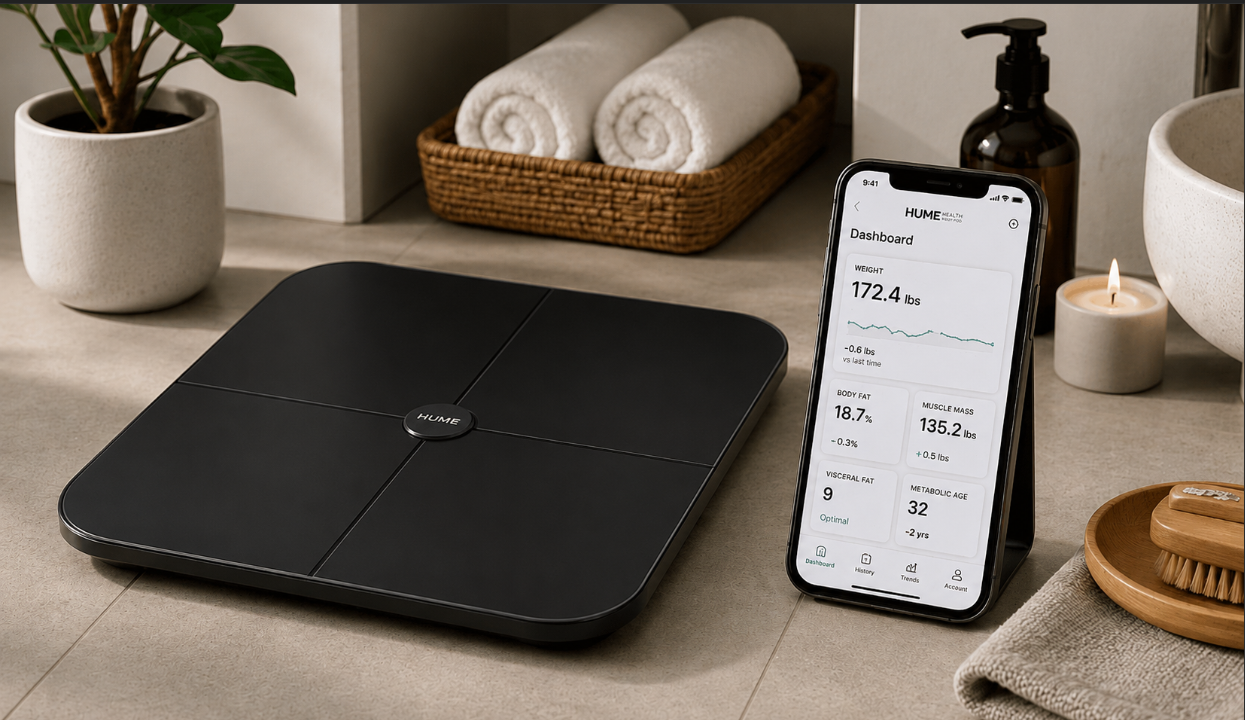
At its core, Hume Health is a smart body composition tracking system built around its flagship product: the Hume Health Body Pod. This isn't just a smart scale that displays your weight in an app. The Body Pod uses bioelectrical impedance analysis (BIA) to estimate a full picture of what's happening inside your body — body fat percentage, muscle mass, hydration levels, visceral fat, bone mass, protein levels, and metabolic age — and surfaces all of it through a companion app designed to show you trends, not just daily snapshots.
The philosophy behind the product is straightforward and, honestly, correct: body weight alone is a terrible proxy for health progress. You can lose fat and gain muscle simultaneously and see zero movement on a traditional scale. You can be consistently dehydrated and think your weight loss is “working” when it isn't. You can exercise every day for six weeks and feel like you're failing because the number doesn't change — when in reality, your body composition is improving meaningfully.
Hume Health is built to solve that exact problem. Whether it does so successfully — that's what this review is actually about.
Stop Letting One Number Define Your Progress
Hume Health gives you the full picture — body fat, muscle, hydration, and more — so you can finally see the progress your scale has been hiding from you.
What Makes Hume Health Different From Other Smart Scales
The smart scale market is genuinely crowded. Withings, Garmin, Renpho, Eufy, FitTrack — they all promise to tell you more than just your weight. So the fair question is: why would Hume Health be any different?
The difference isn't the hardware. Most smart scales in the $80–$200 range use similar BIA sensor technology. The real differentiation is how Hume Health presents and contextualizes the data — and how that changes your relationship with the numbers you see.
Most smart scale apps dump a wall of metrics at you and leave you to figure out what any of it means. Hume Health's app is designed around motivation and trend visualization first, raw data second. Instead of seeing a static readout, you see your body fat trending over four weeks. You see muscle mass moving in a direction. You see a hydration score that explains why you feel sluggish today. The system actively tries to help you interpret what you're seeing rather than just handing you numbers and walking away.
That design philosophy matters more than most people realize — because the biggest reason people abandon wellness trackers isn't that the devices don't work. It's that the data feels meaningless or overwhelming after the first two weeks. Hume Health's approach keeps the feedback loop active and interpretable, which is what turns a one-time purchase into a long-term habit.
There's also something worth naming about the emotional shift that happens when you stop watching one number and start watching several. A week where your scale weight barely moves suddenly feels completely different when you can see your body fat percentage ticked down 0.3% and your hydration score improved. Small progress becomes visible. That visibility is what creates consistency — and consistency is what actually drives results.
My Real Experience Using the Hume Health Body Pod
Week One: First Impressions
Setup took about ten minutes. The Body Pod connected to the app smoothly, and the first scan completed in seconds. The initial readout gave me body weight, body fat percentage, muscle mass, hydration, visceral fat rating, metabolic age, and bone mass — all in one measurement session. I'll be honest: seeing my metabolic age was the first moment that felt genuinely interesting. Not because the number was flattering, but because it was a datapoint I'd never had before.
That first week I stepped on every morning out of pure curiosity. The metrics fluctuated day to day — sometimes significantly — and at first that felt a little chaotic. But I quickly realized the fluctuations told a story. The morning after a late, heavy dinner? Hydration dipped and weight spiked. The morning after a solid workout and eight hours of sleep? Muscle mass reading climbed slightly and visceral fat dropped a notch. The device was picking up real biological variation, not malfunctioning.
Week Two to Three: Where It Gets Genuinely Useful
This is the window where most health gadgets either prove their worth or start collecting dust. For me, Hume Health earned its keep in week two when I had a stretch of days where my scale weight went up slightly — something that would normally create low-grade frustration. But the Body Pod showed my muscle mass had increased and body fat percentage had dropped. The scale number was misleading. The Body Pod told the actual story.
That single moment changed how I used the device. I stopped weighing myself every day and shifted to every two to three days, focusing on weekly trend lines rather than individual readings. The anxiety around the number disappeared almost entirely. I was watching a system of metrics rather than a single number — and that felt like a fundamentally healthier way to track progress.
Week Four: Honest Assessment
By week four the novelty had worn off and the real test began: was I still using it, and was it still useful? Yes to both. The habit of stepping on the Body Pod every couple of days had become automatic — about as effortless as any health habit I've managed to build. The trend data over a full month was genuinely informative in ways that four weeks of daily weigh-ins never would have been.
There were minor frustrations — the app occasionally took an extra moment to sync, and one reading felt implausibly high for muscle mass after a rest day. But nothing that disrupted the core value of the product. Overall, the Body Pod did what it promised: it made my health progress visible in a way that a traditional scale never could.
How Accurate Is Hume Health? The Honest Answer
This is the question that matters most in any Humehealth review — and I want to give you a real answer rather than a diplomatic one.
The Hume Health Body Pod is directionally accurate. It is not clinically precise.
That's not a criticism — it's just the honest reality of bioelectrical impedance analysis technology at the consumer level. BIA measures how electrical signals travel through your body tissues, and from that calculates estimates for fat mass, lean mass, and hydration. The technology is well-established and genuinely useful — but it's influenced by variables like hydration levels, recent meals, exercise, sodium intake, and even room temperature. No consumer BIA device eliminates those variables entirely.
What Hume Health does well is design the app experience around this reality. Instead of presenting daily readings as definitive facts, the system nudges you toward weekly and monthly trend analysis — which is where BIA technology actually shines. Over four weeks of consistent use under similar conditions, the trends are meaningful and reliable. Day-to-day individual readings are best treated as data points, not verdicts.
The practical takeaway: measure at the same time each day (morning, after using the bathroom, before eating or drinking), stay consistent with conditions, and focus on the trend lines. Do that, and the Body Pod will give you genuinely useful information about your body composition over time. Treat every daily reading as gospel, and you'll create unnecessary stress over normal biological variation.
What Hume Health Does Really Well
It changes how progress feels emotionally.
This is the most underrated benefit of the entire product. When you're tracking body fat, hydration, and muscle mass alongside weight, a “bad” week on the scale rarely looks as discouraging as it would otherwise. Progress becomes multidimensional — and that shift genuinely keeps people consistent longer.
The app experience is genuinely well-designed.
Trend visualizations are clear and motivating. Historical data is easy to navigate. The interface doesn't overwhelm you with jargon or bury the useful information under layers of settings. For a health tracking app, that clarity is more valuable than it sounds.
Setup is fast and frictionless.
From unboxing to first reading takes under ten minutes. The app onboarding is smooth. There's no complicated calibration process or technical setup that might intimidate less tech-savvy users.
It tracks what actually matters for long-term health.
Visceral fat. Muscle mass. Hydration. Metabolic age. These are metrics that have genuine clinical relevance — not vanity numbers. For adults in their 30s, 40s, and 50s focused on long-term health rather than just a dress size, these datapoints are meaningfully more useful than body weight alone.
Builds a healthier relationship with body tracking.
Because the system encourages trend-based thinking rather than daily number-obsessing, many users report a reduction in the anxiety that traditionally surrounds daily weigh-ins. That psychological benefit is real and shouldn't be underestimated.
Where Hume Health Falls Short
Daily readings can feel inconsistent without context.
If you step on the Body Pod after a salty dinner, a late workout, or an unusually stressful day, the numbers will swing. For users who aren't prepared for that variation, early readings can feel unreliable. Understanding why readings fluctuate is essential — and the app doesn't always explain this clearly enough upfront.
Not a substitute for clinical assessment.
If you have specific medical concerns about body composition, metabolic health, or visceral fat, a consumer BIA device is not a replacement for proper testing. Hume Health is a wellness tool, not a diagnostic device. That distinction matters for buyers who might be tempted to rely on it for health decisions beyond general fitness tracking.
App syncing can occasionally lag.
A small percentage of users report occasional Bluetooth syncing delays between the Body Pod and the app. It's not a persistent or widespread issue, but it's worth noting — particularly for anyone who values a frictionless, instant experience every single time.
Premium pricing vs. budget BIA alternatives.
Consumer BIA scales exist at $30–$60 that measure many of the same metrics. They won't have Hume Health's app quality or design philosophy — but for buyers focused purely on cost, the gap is real. Hume Health's premium is largely in the experience, not the underlying sensor technology.
Value depends almost entirely on consistency.
If you use the Body Pod for three weeks and stop, you've bought an expensive paperweight. The entire value proposition of Hume Health is built on consistent, long-term data. Buyers who aren't genuinely committed to building a daily or near-daily tracking habit will find the ROI difficult to justify.
Hume Health vs. The Competition
| Category | Hume Health | Withings Body Comp | Garmin Index S2 | Renpho Smart Scale | FitTrack Dara |
|---|---|---|---|---|---|
| Metrics tracked | Body fat, muscle, hydration, visceral fat, metabolic age, bone mass | Body fat, muscle, visceral fat, vascular age, nerve health | Body fat, muscle, hydration, bone mass, BMI | Body fat, muscle, hydration, BMR, 13 metrics | Body fat, muscle, hydration, 17 metrics |
| App quality | ⭐⭐⭐⭐⭐ Excellent UX, trend-focused | ⭐⭐⭐⭐⭐ Clinical-grade, detailed | ⭐⭐⭐⭐ Best within Garmin ecosystem | ⭐⭐⭐ Functional, basic design | ⭐⭐⭐ Adequate, less polished |
| Accuracy level | Good for trends | Best in class (ECG + BIA) | Good for trends | Adequate for trends | Adequate for trends |
| Apple Health sync | ✅ Yes | ✅ Yes | ✅ Yes | ✅ Yes | ✅ Yes |
| Best for | Motivation + trend tracking | Clinical detail, cardiometabolic health | Garmin ecosystem users | Budget-conscious buyers | Multiple user households |
| Price range | Premium ($$) | Premium ($$$) | Premium ($$) | Budget ($) | Mid ($$) |
| Ease of use | ⭐⭐⭐⭐⭐ | ⭐⭐⭐⭐ | ⭐⭐⭐⭐ | ⭐⭐⭐⭐⭐ | ⭐⭐⭐⭐ |
| Motivational design | ⭐⭐⭐⭐⭐ Core strength | ⭐⭐⭐⭐ | ⭐⭐⭐ | ⭐⭐ | ⭐⭐⭐ |
The honest takeaway: Withings Body Comp leads on clinical accuracy and cardiometabolic detail — but it costs significantly more. Garmin Index S2 is excellent if you're already in the Garmin ecosystem. Renpho wins on price for budget buyers. Hume Health's real competitive advantage is the combination of app quality, motivational design, and ease of use — it's the option most likely to actually keep you engaged long-term, which ultimately determines whether any tracking device delivers value.
Who Should Buy Hume Health
✅ Hume Health is a strong fit if you:
- Are a health-conscious adult aged 30–55 who wants a more complete picture of your body composition than a traditional scale provides
- Have ever felt discouraged by scale weight despite exercising and eating well — Hume Health will show you the progress your scale was hiding
- Enjoy tracking data, building habits, and seeing measurable progress over time
- Are working toward a specific fitness or wellness goal (fat loss, muscle building, improved metabolic health) and want objective feedback on your direction
- Want a health tracking habit that feels sustainable and motivating rather than anxiety-inducing
- Value a well-designed app experience that makes health data approachable and meaningful, not just a wall of numbers
- Are committed to consistent use — stepping on every two to three days and tracking trends over weeks and months
Who Should Skip Hume Health
❌ Hume Health is probably not right if you:
- Want the most affordable body composition tracking option — Renpho or basic BIA scales offer similar metric coverage at a fraction of the price
- Need clinically precise body composition data for medical purposes — a DEXA scan or hydrostatic weighing will serve you far better
- Are likely to stop using a tracking device after the first month — the entire value of Hume Health is built on long-term consistent data
- Have a complicated relationship with body metrics or numbers that tends toward obsession or anxiety — the additional data points may amplify rather than reduce that tendency
- Are already deeply embedded in the Garmin ecosystem and want seamless integration above all else — the Garmin Index S2 will serve you better
- Simply want to know your body weight and nothing more — a $25 scale does that job perfectly well
⭐ Final Verdict: Humehealth Reviews
After four weeks of consistent real-world use, here's my honest bottom line: Hume Health delivers on its core promise — and it does so in a way that's surprisingly sustainable.
The Body Pod won't transform your health by itself. It won't give you clinically precise measurements or replace a proper body composition assessment. What it will do — if you use it consistently and approach the data with realistic expectations — is change how you see and interpret your own progress. That shift is more valuable than it might sound.
For busy Americans in their 30s, 40s, and 50s who've felt stuck, frustrated by the scale, or disconnected from what's actually happening inside their bodies — Hume Health provides a layer of visibility that genuinely supports better habits and longer-term consistency.
Use it consistently. Focus on weekly trends. Trust the direction, not the daily number. That's the formula — and Hume Health gives you every tool you need to follow it.
See the Progress Your Scale Has Been Hiding
Body weight is one number. Your health is a whole system. Hume Health shows you the full picture — so the next time progress feels invisible, you'll know exactly where to look.
→ Shop Hume Health Now
Free shipping available on qualifying orders
Frequently Asked Questions — Hume Health
What does Hume Health actually measure?
The Hume Health Body Pod estimates body fat percentage, muscle mass, hydration, visceral fat, protein levels, bone mass, and metabolic age — all through bioelectrical impedance analysis combined with the companion app. It gives you a full body composition picture rather than just body weight.
How accurate is the Hume Health Body Pod?
The Body Pod is directionally accurate for tracking trends over time but is not clinically precise. It works best under consistent conditions — same time of day, similar hydration levels — and when focusing on weekly or monthly trends rather than individual daily readings. Think of it as a reliable compass, not a GPS.
Is Hume Health worth the price?
For health-conscious adults who want more context than a traditional scale provides and are committed to tracking progress consistently, yes. The value is in the app experience and long-term trend visibility. For people who just want a simple weight reading, a standard smart scale is more practical.
How does Hume Health compare to Withings or Garmin smart scales?
Hume Health's biggest differentiator is its app experience and motivational design. Withings leads on clinical credibility and advanced metrics. Garmin is best for users already in the Garmin ecosystem. Hume Health sits in a sweet spot — more approachable and motivationally designed than Withings, more health-focused than basic smart scales.
Does Hume Health sync with Apple Health or Google Fit?
Yes, Hume Health syncs with major health platforms including Apple Health. Check the current app page for the most up-to-date list of integrations, as these may be updated over time.
Who is Hume Health best suited for?
Hume Health is best suited for adults aged 30–55 who are actively working toward fitness or wellness goals, feel frustrated by relying solely on body weight as a progress metric, and genuinely enjoy tracking data as part of their routine. It rewards consistency and patience.
Can Hume Health help with weight loss?
Hume Health doesn't cause weight loss — but it can meaningfully support the process by giving you more context around what's changing in your body. Seeing body fat trending down even when scale weight is flat is a powerful motivator to stay consistent. Visibility drives accountability.
Where can I buy Hume Health?
Hume Health is available through their official website at humehealth.com. Check the site for current pricing, promotions, and any available bundle options to get the best value on your purchase.





 Top Picks