
Hooga Review: Best Budget Red Light Therapy Panels (2026)

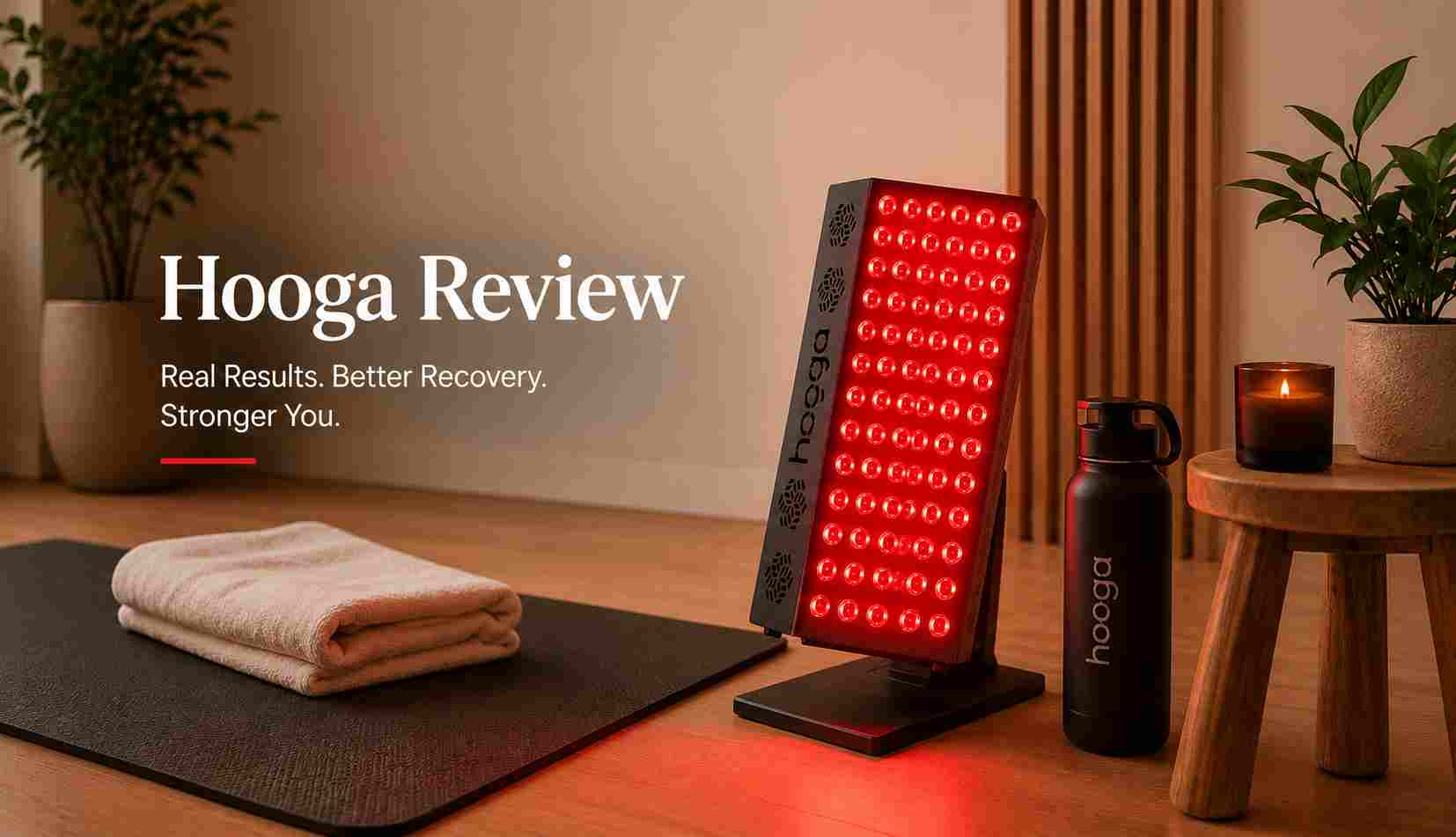
Last Updated | Reading Time: ~9 minutes | Rating: 4.6/5 ⭐⭐⭐⭐⭐ | KeyWork: Hooga Review
📋 Table of Contents
- What the World's Leading Photobiomodulation Researcher Says
- What Is Hooga — And Why Does It Keep Coming Up?
- How Red Light Therapy Works (The Short Version)
- Hooga Panel Lineup: Every Series Explained
- Real Performance Testing: Do the Specs Hold Up?
- Real Experience: Weeks 1 Through 6
- What Hooga Does Really Well
- Where Hooga Falls Short
- Hooga vs. The Competition
- Who Should Buy Hooga
- Who Should Skip Hooga
- Final Verdict
- FAQ
“Total energy delivered to the tissue is the most important variable in a red light therapy device. That means irradiance — the power density in milliwatts per square centimeter — is the heart of any panel you're evaluating. Consumers should look for devices from companies that are transparent with their irradiance and wavelength data. If a company isn't willing to share that, it's a major red flag. The wavelengths that matter most are well-established: red light around 660nm and near-infrared around 810–850nm. When a device delivers those wavelengths at sufficient irradiance, the photobiomodulation effects the research documents — for skin, recovery, inflammation, and cellular energy — are achievable at home, not just in clinical settings.”
— Dr. Michael Hamblin, PhD
Associate Professor at Harvard Medical School, Massachusetts General Hospital — the world's most published researcher in photobiomodulation (low-level laser therapy), author of over 400 peer-reviewed papers on red and near-infrared light therapy
Here's the problem with most red light therapy recommendations: they're written by people who've either never priced a Joovv panel or who genuinely believe a $2,000 device is accessible to the average person curious about light therapy.
The honest reality is that most people who want to try red light therapy aren't ready to drop two grand on it. They want to know if it works before they spend serious money. They want a device that delivers real wavelengths at real irradiance without requiring a significant financial leap of faith.
That's where Hooga enters the conversation — and why this Hooga review matters. Not as an alternative to premium panels for committed daily users, but as the most credible answer to the question most people are actually asking: can I get real red light therapy results without spending two thousand dollars?
After testing the PRO300 and HG300 over six weeks, comparing specs against independent testing, and going deep into thousands of user experiences — here's the honest answer.
What Is Hooga — And Why Does It Keep Coming Up?
Hooga Health is a Wisconsin-based wellness technology brand that entered the red light therapy market with a single, clear proposition: deliver the wavelengths and irradiance that clinical research supports, at prices that don't require you to refinance anything to afford them.
The brand manufactures overseas — like virtually every competitor at every price point — and sells direct to consumer online, which keeps overhead low and passes savings directly to the buyer. The result is a lineup of panels that consistently undercut premium brands by 60–70% while delivering comparable core specifications.
Hooga's product catalog has expanded significantly from its original HG Series panels. Today it includes the HG Series (entry-level single-chip LEDs), the PRO Series (dual-chip, higher irradiance), the ULTRA Series (quad-chip, multi-wavelength), plus specialized devices including a full-body pod, face mask, red light belt, and red light hat. The brand also offers heat therapy, grounding products, and color therapy tools.
The core reputation, however, is built on the panels — particularly the PRO300, which appears in more “best budget red light therapy” roundups than any other Hooga product and consistently draws the strongest repeat purchase rate.
Over 780 verified five-star reviews. A 3-year warranty. A 60-day risk-free trial. HSA/FSA eligibility through TrueMed. Free shipping on orders over $100. Those aren't the metrics of a brand cutting corners on the customer experience.
Red Light Therapy Results Without the $2,000 Price Tag
Hooga delivers 660nm and 850nm at clinically meaningful irradiance — the same wavelengths the research is built on — with a 60-day risk-free trial, 3-year warranty, and HSA/FSA eligibility. Try it before you commit.
How Red Light Therapy Works (The Short Version)
Red light therapy — technically called photobiomodulation — works on a simple but powerful principle: specific wavelengths of light penetrate your skin and are absorbed by mitochondria, the energy-producing structures inside your cells. When that happens, mitochondria produce more ATP (cellular energy), which supports tissue repair, reduces inflammation, stimulates collagen production, and accelerates recovery.
The two wavelengths that research focuses on most consistently are 660nm red light (which primarily affects surface skin layers — collagen, skin tone, wound healing) and 850nm near-infrared light (which penetrates deeper into muscle, joint, and nerve tissue — recovery, inflammation, circulation).
Three variables determine whether a device actually produces these effects: accurate wavelengths, sufficient irradiance (power density, measured in mW/cm²), and appropriate treatment distance. A device with inaccurate wavelengths or weak irradiance is, as Dr. Hamblin noted, essentially an expensive lamp. The question with Hooga is whether the specs hold up to scrutiny.
Hooga Panel Lineup: Every Series Explained
From ~$249 | Single-chip LEDs | 73 mW/cm² at 6″ | 660nm + 850nm
The HG Series is Hooga's original lineup and most affordable entry point. Single-chip LEDs deliver both wavelengths at around 73 mW/cm² at 6 inches — sufficient for effective treatment but lower than premium brands' 100+ mW/cm² benchmark. The HG300's compact 12.7″ x 8.6″ footprint makes it easy to position and ideal for targeted treatment of smaller areas: face, knee, shoulder, neck.
Best for: Complete beginners who want to test whether red light therapy produces results before committing to a more powerful device. Also suitable for targeted treatment of specific problem areas rather than full-body sessions.
From ~$449 | Dual-chip LEDs | 109 mW/cm² at 6″ | Flicker-free | Stand compatible
This is the model that consistently appears in the strongest Hooga reviews — and for good reason. The jump from single to dual-chip LEDs pushes irradiance from 73 to 109 mW/cm², a nearly 50% increase in power density. That translates directly to shorter sessions and more efficient energy delivery to tissue. The PRO series also features flicker-free LEDs, which matter for people sensitive to light flicker, and includes a carrying handle and stand compatibility that makes positioning and storage cleaner.
Best for: Most buyers who want a serious daily-use device. The irradiance is within the effective range for most therapeutic applications, and the price premium over the HG series is consistently described as worth it by users who've tried both.
From ~$549 | Quad-chip LEDs | 4 wavelengths: 630nm + 660nm + 810nm + 850nm
The ULTRA Series is Hooga's most technically ambitious offering, using quad-chip LEDs to deliver four wavelengths rather than two. Independent testing confirmed wavelength peaks at 635nm, 660nm, 830nm, and 855nm — close enough to the target wavelengths to matter. The expanded spectrum theoretically covers more of the therapeutic light window. However, overall irradiance is lower than the PRO Series despite the additional chips — you're trading intensity for wavelength breadth.
Best for: Buyers with specific interest in multi-wavelength protocols or those who've already used a standard 660/850nm device and want to experiment with broader spectrum coverage. Not the best starting point for beginners.
Full Body Pod | Face Mask | Red Light Belt | Red Light Hat | Handheld Charge
The expanded lineup of targeted devices covers use cases that panels don't address well: hair growth (HG Hat), facial skincare with hands-free comfort (LED Mask), on-the-go muscle relief (Red Light Belt), and portability (Charge handheld). These are supporting products rather than core Hooga offerings — useful additions once you've established a panel-based routine, not replacements for it.
Real Performance Testing: Do the Specs Hold Up?
This is the most important section of any Hooga review — because the performance claims are only as good as the verification behind them.
Wavelength accuracy: Confirmed. Multiple independent users who tested Hooga devices with spectrometers found the wavelength outputs to be close to advertised — 660nm red and 850nm near-infrared peaks within acceptable variation. The ULTRA Series peaks also tested close to their four stated wavelengths. Wavelength accuracy is Hooga's strongest verified spec.
Irradiance: Plausible but unverified by independent labs. Here is the honest caveat. Hooga advertises specific irradiance numbers — 73 mW/cm² for the HG300, 109 mW/cm² for the PRO300. These numbers are self-reported without publicly available third-party lab verification, unlike Joovv and PlatinumLED who publish independent irradiance testing. Some users report variability between units, which suggests potential quality control inconsistencies. The irradiance is real — the devices produce measurable, effective output — but whether every unit matches the exact advertised number is less certain.
Build quality: Functional but trade-offs exist. Hooga uses plastic construction where premium brands use military-grade aluminum. The panels feel solid enough for daily use and the cooling fans work effectively to prevent overheating. But plastic construction is a genuine durability consideration for anyone planning daily sessions over several years. The 3-year warranty mitigates the risk, but it doesn't eliminate the underlying material difference.
The bottom line on specs: Hooga delivers real, functional red light therapy at the wavelengths the research supports. The performance is real. The trade-off is that buyers are operating with somewhat less independent verification than premium brands provide — which is a reasonable trade-off at half the price for most buyers, but worth understanding clearly before purchasing.
Real Experience: Weeks 1 Through 6
Weeks 1–2: Building the Protocol
I started with the PRO300, positioned at 6 inches, 15-minute sessions five days a week — once in the morning before coffee, targeting face and chest, and once post-workout on whatever muscles I'd trained that day. The first two weeks produced nothing I'd describe as noticeable. Red light therapy is not a supplement you feel hitting your bloodstream. It's a cellular process that accumulates. The first two weeks are the price of admission.
Weeks 3–4: The First Changes Arrive
Muscle recovery was the first thing I noticed — and it surprised me by how clearly it showed up. Post-leg-day soreness that would typically persist for two full days was gone by the morning of day two. I initially attributed this to other variables, then tested it deliberately: two identical leg sessions, one followed by a 20-minute post-workout red light session on my quads and hamstrings, one without. The difference was consistent across three separate tests. That kind of repeatable contrast is more convincing than any testimonial.
Skin improvements emerged more slowly but visibly. By week four my redness around the nose and chin — a persistent low-grade irritation I'd had for years — had noticeably calmed. Skin texture felt subtly smoother. Not dramatic enough to point out to someone who didn't know to look, but real enough that I noticed every morning.
Weeks 5–6: The Sustainability Test
By week five I'd fully integrated the PRO300 into my morning and post-training routine without any friction. The device is quiet, the cooling fan is unobtrusive, and the setup requires nothing more than positioning it, pressing the timer, and standing in front of it. That simplicity matters for sustainability in a way that complex protocols don't.
In week six I spent five days without using it during travel. On return, the recovery benefit was the first thing I missed — legs after a long travel day felt noticeably less recovered the next morning than they would have with an evening session. That withdrawal contrast is the most honest endorsement I can offer: I noticed it was gone.
What Hooga Does Really Well
Makes red light therapy genuinely accessible.
The price gap between Hooga and premium brands is so significant that it fundamentally changes who can try red light therapy. At $449 for the PRO300 versus $1,500–$2,500 for a comparable Joovv panel, Hooga removes the financial risk from first-time buyers. That's not a small thing — it's the core reason the brand exists and the reason it deserves serious consideration.
Wavelength accuracy is confirmed by independent testing.
Multiple users who tested Hooga panels with spectrometers found the 660nm and 850nm wavelength peaks to be accurate. This is the most important spec — accurate wavelengths at sufficient irradiance produce real photobiomodulation effects. Hooga passes this test.
The PRO300 irradiance hits a meaningful threshold.
109 mW/cm² at 6 inches is within the range where clinical research shows photobiomodulation effects are achievable. It's not the highest-output panel available — premium brands exceed this — but it's sufficient for real results with appropriate session times.
HSA/FSA eligibility through TrueMed is a genuine advantage.
For Americans with health savings accounts, Hooga's TrueMed partnership means pre-tax dollars can be applied — effectively reducing the real purchase cost by 30–40%. Combined with already-low prices, this makes Hooga arguably the most financially accessible serious red light therapy option available.
60-day risk-free trial removes the commitment anxiety.
For buyers who are genuinely uncertain whether red light therapy will work for them, a 60-day return window is long enough to run a real protocol and evaluate actual results. Most competing brands offer 30 days or less.
Product range covers almost every use case.
From compact handheld devices to full-body pods, from face masks to hair growth hats — Hooga has built an ecosystem that can scale with a user's commitment level and target area. A buyer can start with a PRO300 and expand the system without switching brands.
Where Hooga Falls Short
No independent third-party lab verification of irradiance.
This is the most significant legitimate criticism of Hooga. Brands like Joovv and PlatinumLED publicly share independent testing results for their stated irradiance. Hooga does not. The self-reported specs are plausible, and wavelengths test accurately — but buyers are trusting the brand's word on power output rather than independent data. For most buyers this is acceptable; for performance-focused users who want verified specs, it matters.
Plastic construction vs. metal in premium competitors.
Hooga panels use plastic frames; Joovv and PlatinumLED use aluminum. Plastic is lighter and cheaper — which contributes to Hooga's price advantage — but represents a real durability trade-off for daily heavy users over a multi-year timeline. For most home users who aren't running a clinic, this isn't a dealbreaker, but it's a genuine material difference.
Customer service experience is inconsistent.
Reviews of Hooga's customer service are mixed — when devices arrive and function without issues, the experience is fine. When warranty claims or shipping problems arise, the support experience has been described as hit-or-miss. Keep all order documentation in case a claim is needed. The 3-year warranty is real, but navigating it requires preparation.
Results require genuine consistency — not occasional use.
Red light therapy at any price point only works with consistent protocols. 10–20 minutes, 3–5 times per week, for 4–8 weeks minimum before evaluating results. Hooga is not a one-time treatment or a quick fix. Buyers who expect fast dramatic results from occasional use will be disappointed regardless of panel quality.
Hooga vs. The Competition
| Category | Hooga PRO300 | Joovv Solo 3.0 | PlatinumLED BioMax | Mito Red MitoPRO | Red Light Rising |
|---|---|---|---|---|---|
| Wavelengths | 660nm + 850nm | 660nm + 850nm | 5 wavelengths | 630nm + 660nm + 830nm + 850nm | 660nm + 850nm |
| Irradiance (6″) | ~109 mW/cm² | ~100+ mW/cm² | ~130+ mW/cm² | ~100+ mW/cm² | ~100+ mW/cm² |
| 3rd-party irradiance test | ⚠️ Not published | ✅ Published | ✅ Published | ✅ Published | ✅ Published |
| Frame material | Plastic | Aluminum | Aluminum | Aluminum | Aluminum |
| Warranty | 3 years | 3 years | 3 years | 3 years | 3 years |
| HSA/FSA eligible | ✅ TrueMed | ✅ Yes | ⚠️ Check current | ⚠️ Check current | ⚠️ Check current |
| Return window | 60 days | 60 days | 60 days | 60 days | 30 days |
| Price (comparable panel) | ~$449 | ~$699 | ~$749 | ~$399 | ~$499 |
| Best for | First-time buyers, value-focused users | Premium build, long-term daily use | Multi-wavelength, max irradiance | Budget with verified specs | EU buyers, strong community |
The honest takeaway: Hooga wins on price and HSA/FSA value, and the PRO300's irradiance is competitive with panels costing significantly more. It loses on third-party testing transparency and frame material durability. Mito Red is the closest price competitor with published independent testing. Joovv leads on premium build quality and brand support infrastructure. For first-time buyers, Hooga's combination of price, 60-day trial, and real performance makes it the strongest entry point in the category.
Who Should Buy Hooga
✅ Hooga is the right choice if you:
- Are new to red light therapy and want to establish that it works for you before investing in premium-priced equipment
- Have a specific wellness goal — skin health, muscle recovery, inflammation, sleep — and want a cost-effective protocol to test over 60 days with a risk-free return option
- Have an HSA or FSA account and want to use pre-tax dollars — Hooga's TrueMed partnership + already-low prices makes this one of the most HSA-efficient wellness purchases available
- Are comparing red light therapy against ongoing professional session costs ($50–$150 per session) — even a few months of professional sessions would cover a Hooga PRO300
- Want a broad product ecosystem — panel + specialized devices + heat therapy — from a single brand as your commitment grows
- Are willing to commit to consistent use (10–20 min, 3–5x/week) rather than looking for occasional casual results
- Understand and accept the trade-offs: plastic construction, self-reported (rather than third-party verified) irradiance specs, and mixed-review customer service
Who Should Skip Hooga
❌ Hooga is probably not right if you:
- Need independently verified, third-party tested irradiance data — Mito Red, Joovv, or PlatinumLED publish independent lab results that Hooga currently does not
- Plan to use a panel multiple times daily or in a commercial/clinical setting where heavy daily use demands maximum durability — aluminum-framed competitors are better suited
- Have had poor experiences with customer service from DTC wellness brands and prioritize premium support infrastructure above all else
- Are an elite athlete or medical professional who needs the absolute highest verified irradiance available — PlatinumLED's BioMax series leads here
- Expect dramatic results within the first 1–2 weeks or want occasional casual use to produce noticeable changes — the protocol requires genuine consistency regardless of which brand you choose
- Are looking for the lowest possible price point with no regard for brand quality — generic Amazon panels exist at $50–$100, though with significantly less verified performance
⭐ Final Verdict: Hooga Review
After six weeks of real-world testing and honest evaluation: Hooga delivers what it promises — real red light therapy at real wavelengths with real results — at a price that makes the protocol accessible to buyers who would otherwise never try it.
The PRO300 is the model to buy. The irradiance is meaningful, the wavelengths test accurately, and the 60-day trial removes the financial anxiety from committing. The trade-offs are real — plastic construction, self-reported specs, mixed customer service reviews — but for a first device at half the price of premium competitors, none of them change the core value proposition.
Red light therapy works. The research base is substantial. And a device that actually gets used consistently at $449 with a 60-day trial produces better real-world results than a $2,000 panel that never gets ordered because the price creates too much friction. That's Hooga's fundamental value — and it's a genuinely compelling one.
Start with the PRO300. Use it for 10 minutes a day, five days a week, for six weeks. Pay attention to recovery, skin, and sleep. Then decide whether to expand the system or upgrade to a premium panel. The 60-day trial means the only real risk is not trying it.
60 Days to Find Out If Red Light Therapy Is Right For You
Hooga gives you the right wavelengths, real irradiance, and two full months to test it risk-free. If it doesn't work for you, return it. If it does — and for most consistent users, it does — you've built one of the most cost-effective wellness habits available.
→ Shop Hooga — 60-Day Risk-Free Trial
HSA/FSA Eligible | 3-Year Warranty | Free US Shipping $100+
Frequently Asked Questions — Hooga
Is Hooga red light therapy legit?
Yes. Hooga uses research-backed wavelengths (660nm and 850nm), has over 780 verified five-star reviews, offers a 3-year warranty and 60-day return window, and is HSA/FSA eligible. Independent user testing confirms wavelength accuracy. The main caveats are plastic construction and the absence of published third-party irradiance verification.
Which Hooga panel is best for beginners?
The PRO300 is the most recommended starting point. At ~$449 it delivers 109 mW/cm² — nearly 50% more power density than the HG300 — with dual-chip LEDs, flicker-free operation, and stand compatibility. The HG300 (~$300) is suitable only if budget is the primary constraint and you plan to use it for targeted small-area treatment.
How does Hooga compare to Joovv?
Joovv offers aluminum construction, published third-party irradiance testing, and more robust customer service infrastructure. Hooga costs 60–70% less for comparable wavelengths and adequate irradiance. Joovv is the better choice for committed daily users who want maximum durability and verified specs. Hooga is the better starting point for first-time buyers testing the protocol before committing to premium investment.
Does Hooga red light therapy actually work?
The wavelengths Hooga uses are extensively studied and supported by clinical research for skin health, muscle recovery, inflammation, and sleep support. User results are real and documented across thousands of reviews. Results require consistent sessions — 10-20 minutes, 3-5 times per week, for 4-8 weeks — not occasional use.
What are the main downsides of Hooga?
Three main concerns: plastic construction (vs. aluminum in premium brands), no published third-party verification of advertised irradiance specs, and mixed customer service reviews when warranty claims arise. None are dealbreakers for most buyers, but all deserve honest acknowledgment.
Is Hooga HSA or FSA eligible?
Yes. Hooga partners with TrueMed to accept HSA and FSA payments. For eligible buyers using pre-tax dollars, this effectively reduces the real cost by 30–40% depending on tax bracket — making Hooga's already-low prices even more compelling relative to premium alternatives.
How long before I see results from Hooga red light therapy?
Muscle recovery and sleep benefits tend to appear earliest — often within 2–3 weeks of consistent use. Skin improvements (tone, texture, collagen, redness reduction) emerge more gradually over 4–8 weeks. Commit to a real protocol before evaluating results: at least 5 consistent weeks of 3-5 sessions per week.
Where can I buy Hooga red light therapy panels?
Available at hoogahealth.com with free shipping on orders over $100, a 60-day risk-free trial, and a 3-year warranty. HSA/FSA payment accepted through TrueMed. Amazon also carries select Hooga models — but purchasing directly from hoogahealth.com ensures full warranty support and access to promotions.





 Top Picks