
Real Value or Overpriced? Duxot Chronograph Watch Under The Microscope

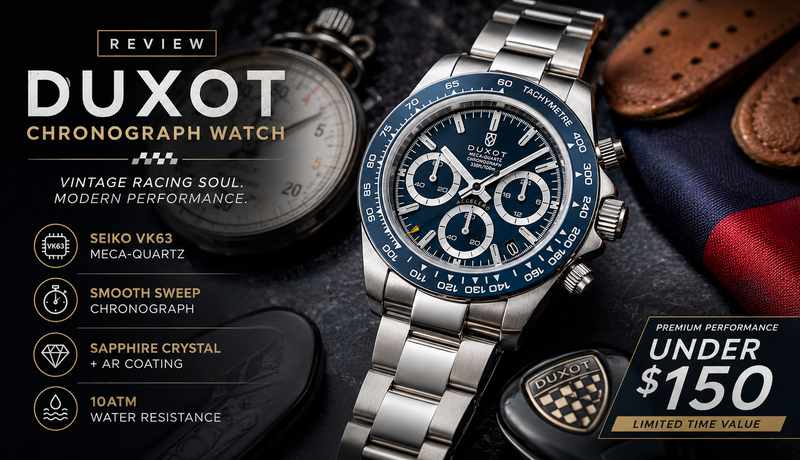
By Thomas Reinhart · 11 min read · Rating: 4.3/5 ⭐⭐⭐⭐⭐ · Keyword: Duxot Chronograph Watch
Table of Contents
- What Sets the Duxot Chronograph Apart
- The Chronograph Question: Quartz, Automatic, or Meca-Quartz?
- The VK63 Movement: Why It Matters
- Duxot Chronograph Models Reviewed
- Real Wear Test: Sport, Timing, and Daily Use
- Where the Duxot Chronograph Delivers
- Things to Know Before You Order
- How It Compares to Competing Sport Chronographs
- Who Should Buy a Duxot Chronograph
- Maybe Wait If…
- Final Verdict
- Frequently Asked Questions
Long Island Watch — Retail Review
“The Duxot Accelero Chronograph pairs the high-performance Seiko VK63 meca-quartz movement with an anti-reflective sapphire lens for clear visibility in any setting. The 40mm case perfectly balances presence and comfort — a sport chronograph that transitions seamlessly from active use to everyday wear.”
Long Island Watch — Authorized watch retailer and reviewer; product analysis of the Duxot Accelero Chronograph (longislandwatch.com)
The Chronograph Question: Quartz, Automatic, or Meca-Quartz?
When most people picture a sport chronograph, they imagine pushers on the side, a dial full of subdials, and a stopwatch function they'll use exactly twice. But the movement inside matters more than most buyers realize — and it's where Duxot made a smart choice that separates the Accelero from the crowd of sub-$200 chronographs.
Standard quartz chronographs are accurate but feel mechanical dead on the wrist — the seconds hand ticks rather than sweeps. Full automatic chronographs are beautiful but expensive to do properly. The Duxot Accelero takes the third path: a meca-quartz hybrid that gives you quartz accuracy with a smooth-sweeping chronograph hand. It's the movement choice that punches well above the price tag.
The VK63 Movement: Why It Matters for a Chronograph
The Seiko VK63 is a meca-quartz caliber — it uses a quartz oscillator for timekeeping accuracy while activating the chronograph function through a mechanical gear train. The practical result: your watch keeps time to within ±10 seconds per year (far more accurate than any automatic), and when you hit the chronograph pusher, the seconds hand sweeps continuously rather than ticking.
That sweep feels right. It's easier to read mid-activity, more satisfying to use, and more visually compelling. Brands like Tissot and Seiko use meca-quartz movements in their own sport watches at significantly higher prices. Getting this technology in a Duxot chronograph watch at $139–$149 promotional pricing is genuinely unusual.
Paired with an anti-reflective sapphire crystal and 10ATM water resistance, the Accelero's spec sheet reads like something that should cost twice as much. That's the real answer to real value or overpriced? — at promotional pricing, it's real value by a wide margin.
Duxot Chronograph Models: Which One Should You Get?
Accelero Chronograph — ~$139 promotional
The flagship of the chronograph lineup. Available in Cambridge Blue, Cascading White, and Chestnut Brown — each with a dial design that pays clear tribute to vintage racing and aviation chronographs from the 1970s. The 40mm case at 12mm thick sits flat and comfortable under a cuff. Subdials for running seconds, 30-minute chronograph counter, and date make this a genuinely functional sport tool, not just decoration. The Cambridge Blue is the collector's pick — it photographs beautifully but looks even better in person.
Case: 40mm · 12mm thick · 48mm L2L · 10ATM · Sapphire crystal with AR coating
Accelero Rainbow — ~$139–$149 promotional
Same VK63 movement and sapphire specs as the standard Accelero, but with bolder, more expressive dial colorways — Pearl Red, Pearl Green, Pearl White, Pearl Brown. If you want a chronograph that makes a statement on the wrist rather than blending into the background, the Rainbow series delivers that without sacrificing any of the functional credentials. The Pearl Green in particular has developed a following among people who want a sport watch with real personality.
Best for: Those who want color and character alongside serious chronograph specs.
Tiburon Chronograph — ~$149 promotional
Slightly more refined than the Accelero, with a cleaner dial layout in 39–40mm. The Buff White and Eclipse Black are the standouts — versatile enough to cross from sport to smart-casual without looking out of place. Same movement and specs. If the Accelero is the racing driver's watch, the Tiburon is what you wear when you want the chronograph function without the full sport aesthetic.
Best for: Versatility seekers, those wanting a chronograph for mixed dress codes.
A Seiko VK63 meca-quartz chronograph with sapphire crystal for under $150.
Most brands charge double for the same specs. Check current availability on the Accelero before your colorway sells out.
Real Wear Test: Sport, Timing, and Daily Use
Week 1 — First Impressions
I started with the Accelero in Cambridge Blue. The dial hits differently in person than in photos — the blue has depth, and the subdial layout is cleaner and more legible than I expected. Setting up the chronograph for the first time, the pushers felt firm and positive. Starting, stopping, and resetting — each function operated with a satisfying mechanical snap that reminded me why the VK63 is such a good movement choice for sport watches.
Weeks 2–3 — Active Use
I wore this through two gym sessions, a 10km run, and a weekend cycle ride. The 10ATM water resistance meant no anxiety about sweat or rain. The chronograph function got real use timing intervals during training — the smooth VK63 sweep made reading split times easy, even on the move. The anti-reflective coating on the sapphire crystal proved its worth in full sunlight: the dial remained completely readable where a standard mineral glass would have blinded you with glare. Timekeeping was spot-on accurate across three weeks without any adjustment needed.
Week 4 — Honest Evaluation
I set it next to a Seiko Chronograph SSB that costs roughly twice the promotional Duxot price. The Seiko's finishing is marginally tighter and the bracelet engineering is more refined. But the Duxot's sapphire crystal blows the Seiko's hardlex out of the water, and the vintage dial character of the Cambridge Blue simply doesn't exist in the Seiko lineup at any price. By week four, the Accelero had earned its place as my go-to sport watch for any situation where I needed a stopwatch on my wrist.
Where the Duxot Chronograph Delivers
- Seiko VK63 meca-quartz: Quartz accuracy + smooth mechanical sweep. A genuinely premium movement choice at this price point.
- Sapphire with AR coating: Scratch-resistant crystal that stays readable in direct sunlight. Most competitors use uncoated mineral glass.
- 10ATM water resistance: Real sport-capable water resistance for the gym, pool, and outdoor activities.
- Functional subdial layout: Running seconds, 30-minute chronograph counter, date — the functions you actually use, clearly arranged.
- Vintage sport design that stands out: Racing and aviation heritage aesthetics done with genuine style, not just a retro font and call it done.
- Exceptional promotional pricing: At $139–$149, the spec-per-dollar ratio is hard to find anywhere else in this category.
Things to Know Before You Order
- Always buy at promotional pricing: The Accelero shines at $139–$149. Full MSRP ($250–$320) puts it in territory with stiffer competition — check the site for active sales before purchasing.
- Meca-quartz means battery replacement eventually: Unlike an automatic, you'll need a battery swap every 2–3 years. A watchmaker or jeweler can do this in minutes for a few dollars.
- The 48mm lug-to-lug needs checking: At 48mm L2L, this can feel large on smaller wrists. Measure your wrist before ordering if you're under 6.5 inches.
How Duxot Compares to Other Sport Chronographs
| Brand / Model | Price | Movement | Crystal | Water Resist. | Sweep Hand | Rating |
|---|---|---|---|---|---|---|
| Duxot Accelero | $139–$149 | VK63 Meca-Quartz | Sapphire + AR | 10ATM | ✅ Smooth sweep | 4.3 ★ |
| Seiko SSB Series | $220–$320 | VK63 Meca-Quartz | Hardlex | 10ATM | ✅ Smooth sweep | 4.5 ★ |
| Tissot T-Sport | $300–$450 | Quartz Chrono | Sapphire | 10ATM | ❌ Ticking | 4.4 ★ |
| Citizen Eco-Drive Chrono | $200–$350 | Eco-Drive Quartz | Mineral | 10ATM | ❌ Ticking | 4.4 ★ |
| Fossil CH Series | $100–$180 | Standard Quartz | Mineral | 5ATM | ❌ Ticking | 4.0 ★ |
The Duxot Accelero is the only watch in this comparison offering sapphire crystal with AR coating plus a smooth-sweep VK63 meca-quartz movement under $150. Seiko uses the same movement at nearly double the price. Tissot and Citizen charge more while delivering a ticking chronograph hand.
Who Should Buy a Duxot Chronograph Watch
- You want a functional sport chronograph you'll actually use for timing — not just a decorative subdial
- You appreciate meca-quartz accuracy and the smooth sweep that standard quartz watches don't deliver
- You want sapphire crystal on a sport watch without paying Tissot or TAG prices
- You're drawn to vintage racing and aviation aesthetics — the Accelero's dial design is the real thing, not a lazy homage
- You want a gift for a sports enthusiast who uses a stopwatch function and cares about how their watch looks
- You're building a versatile watch rotation and need a sport piece that won't break the budget
Maybe Wait If…
- You're looking at full MSRP pricing — the Accelero is designed to be bought at $139–$149, not $250–$320
- You have a smaller wrist under 6.5 inches — the 48mm L2L can overhang; check the Tiburon (39–40mm case) as a more proportionate option
- You want an automatic movement in a chronograph — Duxot's chrono lineup is meca-quartz; look at the automatic diver models if movement type is a priority
Final Verdict
Real value — without question, at the right price.
The Seiko VK63 movement, sapphire crystal with AR coating, 10ATM water resistance, and a vintage sport dial design that actually earns attention — all at $139–$149 promotional pricing. The Duxot Accelero chronograph takes the spec sheet that usually requires a $300 budget and delivers it at roughly half the cost.
If you want a sport chronograph that does its job accurately, looks the part, and doesn't require an explanation when someone asks about it — the Duxot Accelero is one of the best answers available at this price. Just buy during a promotion, and you'll have no regrets.
Score: 4.3 / 5 — Highly Recommended at Promotional Pricing.
A proper sport chronograph. Under $150. With sapphire crystal.
Duxot Accelero colorways sell out during promotions. Check what's available now before the price goes back up.
Frequently Asked Questions
What movement does the Duxot chronograph use?
The Seiko VK63 meca-quartz — a hybrid movement combining quartz accuracy (±10 sec/year) with a mechanically-actuated chronograph that sweeps smoothly rather than ticking. It's the same movement family Seiko uses in their own sport chronographs at higher price points.
Is the Duxot Accelero chronograph worth buying?
At promotional pricing of $139–$149, absolutely yes. Sapphire with AR coating, VK63 meca-quartz movement, 10ATM water resistance, and vintage sport design — the spec-per-dollar ratio is genuinely hard to match in this category.
What is a meca-quartz chronograph?
A meca-quartz uses quartz oscillation for timekeeping precision but activates the chronograph function through a mechanical gear train. The result is quartz-level accuracy with a smooth-sweeping chronograph hand — noticeably better than standard quartz ticking hands during active timing use.
How water resistant is the Duxot Accelero chronograph?
10ATM (100 meters) — solid sport-level water resistance. Safe for swimming, gym use, and water sports. The screwdown caseback adds seal integrity. Not designed for scuba diving.
What size is the Duxot Accelero chronograph?
40mm case diameter, 12mm thick, 48mm lug-to-lug, 20mm lug width. Well-proportioned for a sport watch and comfortable on most wrists. If you have a smaller wrist, check the Tiburon at 39mm for a better fit.
Does the Duxot chronograph have sapphire crystal?
Yes — flat sapphire with anti-reflective coating. The AR treatment significantly reduces glare and keeps the dial readable in bright sunlight during active use. Most watches in this price range use uncoated mineral glass.
How does Duxot chronograph compare to Seiko and Citizen?
The Duxot uses the same VK63 movement as Seiko's own sport chronographs — at roughly half the price during promotions. It beats Citizen on crystal quality (sapphire vs. mineral) and beats both on design personality. Seiko and Citizen have longer reliability data, but the Duxot's spec sheet is genuinely competitive.



 Top Picks