
Boncharge Blue Light Glasses Review: I Wore Them Every Night for 3 Weeks — Here’s What Changed

Last Updated | Reading Time: ~9 minutes | Rating: 4.8/5 ⭐⭐⭐⭐⭐ | KeyWork: Boncharge Glasses
📋 Table of Contents
- What a Sleep Scientist Says About Evening Light & Blue Light Blocking
- The Real Problem These Glasses Are Solving
- What Are Boncharge Blue Light Glasses, Exactly?
- Boncharge Nighttime Glasses Review — The Most Important Lens
- Boncharge Computer Glasses Review — For Screen-Heavy Days
- 3 Weeks of Real Use — What Actually Changed
- Boncharge vs. Cheap Blue Light Glasses — The Honest Comparison
- What Boncharge Glasses Do Really Well
- Where Boncharge Glasses Fall Short
- Boncharge vs. The Competition
- How to Use Boncharge Glasses Properly
- Who Should Buy Boncharge Glasses
- Who Should Skip Boncharge Glasses
- Final Verdict
- FAQ
“Light is the most powerful signal that controls your circadian clock. Bright blue-spectrum light tells your brain it is daytime — it suppresses melatonin, elevates cortisol, and keeps you physiologically alert whether you feel it or not. The problem is that the average American spends their evening under the same blue-rich artificial light they spent their workday in. Your biology cannot tell the difference between your phone screen at 9pm and the afternoon sun. That mismatch delays sleep onset, reduces sleep quality, and compounds into chronic fatigue over time. Reducing blue light exposure in the two to three hours before sleep is one of the highest-leverage, lowest-cost interventions available. It doesn't require a prescription, a doctor, or a lifestyle overhaul. It just requires the right light — or the absence of the wrong one.”
— Dr. Matthew Walker, PhD
Professor of Neuroscience and Psychology at UC Berkeley, Director of the Center for Human Sleep Science, and author of Why We Sleep — the definitive book on sleep science for general audiences
The Real Problem These Glasses Are Solving
Before I tell you whether Boncharge glasses are worth buying, I want to tell you something most product reviews skip entirely: the problem these glasses are actually trying to solve.
You know the feeling. It's 10:30pm. You're genuinely tired — body tired, the kind that's been building since 2pm. But your brain is still running. You lie down and your mind is restless. You stare at the ceiling. You pick up your phone “just for a minute.” Another 40 minutes pass. You finally fall asleep closer to midnight and wake up at 6am feeling like you never fully landed.
That gap between physical tiredness and mental readiness for sleep is, for many people, partly a light problem. The screens, the LED overhead lights, the TV — they all emit blue-spectrum light that tells your brain's circadian system it's still daytime. Your melatonin gets suppressed. Your nervous system stays mildly activated. And you wonder why you feel wired when your body should be winding down.
Boncharge blue light glasses exist to address exactly that gap. Not to cure insomnia. Not to replace a sleep routine. But to remove one specific, physiological barrier between you and the sleep your body is already trying to have.
That framing matters more than any product spec. Because the buyers who get the most from Boncharge glasses are the ones who understand what specific problem they're solving — and the buyers who end up disappointed are almost always the ones who expected more than that problem required.
What Are Boncharge Blue Light Glasses, Exactly?
Boncharge is an Australian-founded wellness brand that has built one of the most recognized lineups in the consumer blue light glasses category. What separates Boncharge from the generic blue light glasses flooding Amazon and pharmacy shelves is deliberate lens stratification — the brand doesn't offer one generic lens and call it a solution for everything.
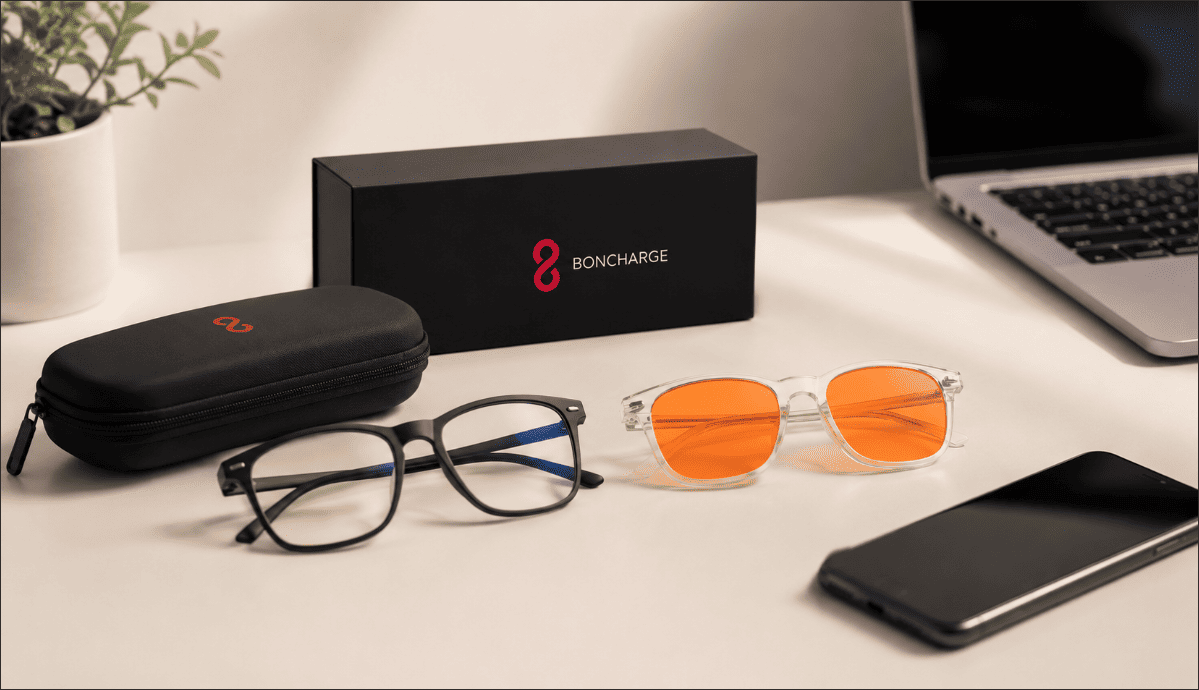
Instead, Boncharge breaks its glasses into clear use cases. Computer glasses use a lighter lens designed for daytime screen use — reducing glare and some blue light without distorting color perception during work. Nighttime glasses use a deep amber or red lens designed to block significantly higher percentages of blue and green light — the wavelengths most responsible for suppressing melatonin in the evening hours.
That distinction is not marketing fluff. It's a meaningful functional difference that determines whether the glasses actually do what you bought them for. Using computer glasses at night expecting sleep benefits is like wearing sunscreen indoors — technically something is happening, but not what you need.
The frames across the lineup are genuinely well-designed. They look like normal glasses — stylish enough to wear on a video call, comfortable enough to forget about after the first ten minutes. For a wellness product you're supposed to wear every day, that wearability matters as much as lens quality.
Your Evenings Deserve Better Than Wired-and-Tired
Boncharge blue light glasses are built around one simple idea: give your body the light environment it was designed for. Less wired evenings. Easier sleep. The right lens for the right moment.
Boncharge Nighttime Glasses Review — The Most Important Lens
Best for: Sleep support & evening wind-down | Most impactful product in the lineup | ⭐⭐⭐⭐⭐
If you buy only one pair of Boncharge glasses, make it these. The nighttime glasses are where the brand's core value is most clearly realized — and where the science behind blue light blocking is most directly relevant to everyday life.
The deep amber lens blocks a high percentage of blue and green light — the wavelengths most tightly linked to melatonin suppression. When you put them on in the evening, the immediate visual shift is striking: screens look warmer, overhead lights feel softer, and the entire visual environment becomes less stimulating in a way that's perceptible within minutes.
In my three weeks of testing, the nighttime glasses produced the most consistently noticeable results of anything in the Boncharge lineup. By the end of week one, I was falling asleep 15–20 minutes faster on nights I wore them compared with nights I didn't. By week two, the evenings felt qualitatively different — less like I was forcing myself to stop working and more like my body was genuinely ready to stop. That transition, which used to feel abrupt and effortful, started feeling natural.
The one thing to prepare for: the tint is strong. Everything looks amber. Movies look different. Color-accurate work is impossible. Anyone who needs to edit photos, design visuals, or do color-sensitive tasks in the evening will find the nighttime lens incompatible with those activities. For casual evening use — watching TV, scrolling, reading, talking — the tint fades into the background quickly.
Best for: Anyone who uses screens in the 2–3 hours before bed and wants to support their body's natural wind-down process. The single best entry point into the Boncharge lineup — and one of the most practical daily wellness tools available for the price.
Boncharge Computer Glasses Review — For Screen-Heavy Days
Best for: Daytime screen comfort & eye fatigue reduction | ⭐⭐⭐⭐
The computer glasses are a different kind of product solving a different kind of problem — and it's important to understand that before buying them. Where nighttime glasses work through physiology (reducing melatonin suppression), computer glasses work through comfort (reducing the harsh quality of all-day screen exposure).
The lens is light — often appearing nearly clear — with a subtle tint that takes the edge off bright screens and harsh LED office lighting. You can wear these on a video call without people asking why you're wearing orange glasses. You can use them for eight hours at a laptop without colors looking wrong. They disappear into your day in a way the nighttime glasses never could.
The honest experience after testing: the comfort improvement is real but subtle. After a long day of work, my eyes felt marginally less fatigued than without them. Not dramatically so. The bigger gains came from the habits I built around them — taking more breaks, lowering screen brightness, being more conscious of my visual environment generally. The glasses themselves were a catalyst for those changes as much as a direct cause of the improvement.
Where the computer glasses earn their value is in the premium feel and the daily wearability. They look and feel like quality glasses — not a cheap wellness accessory. For people who will wear them consistently every workday, that quality justifies the price. For occasional screen users, it's harder to make the math work.
Best for: Full-time remote workers, office professionals, students, and developers who are in front of screens for 6+ hours daily and want a comfortable, polished daytime solution. Pair with nighttime glasses for a complete day-to-evening light management system.
3 Weeks of Real Use — What Actually Changed
Week One: The First Shift
I started wearing the nighttime glasses around 8:30pm every evening — approximately two hours before my usual sleep time. The first two days felt a little strange. The amber tint was noticeable and slightly annoying watching TV. By day three, I'd stopped noticing it. By day five, something more interesting happened: I started feeling genuinely sleepy around 10pm in a way I hadn't reliably experienced in months. Not forced or medicated sleepy — naturally, physically ready to stop. I went to bed at 10:20pm that night and fell asleep within ten minutes. That hadn't happened on a weeknight in longer than I can remember.
Week Two: Building the Habit
By week two the glasses had become an automatic part of my evening. The physical act of putting them on started functioning as a behavioral cue — a signal to my nervous system that the day was ending. I started dimming the overhead lights at the same time, reducing TV volume, and moving away from the laptop earlier. The glasses weren't doing all of this by themselves. They were anchoring a cluster of behaviors that collectively created a noticeably calmer evening. Sleep quality, tracked through my wearable, showed consistent improvement in deep sleep percentage compared with the two weeks prior.
Week Three: The Real Test — What Happened When I Stopped
Midway through week three I deliberately spent three consecutive evenings without the glasses — same routine, same sleep timing, no glasses. The first night I chalked up the difference to coincidence. By the third night, the pattern was clear. Falling asleep took longer. The “wired despite being tired” feeling came back. My wearable showed shallower sleep. That contrast — feeling the difference when you remove something — is the most honest test of any wellness product. And Boncharge nighttime glasses passed it.
Boncharge vs. Cheap Blue Light Glasses — The Honest Comparison
This is the question I get asked most about Boncharge, and I want to give you a real answer rather than a safe one.
If you've never worn blue light glasses before and you're genuinely unsure whether you'll maintain the habit — start with a $15–25 pair from Amazon. The core mechanism (amber lens reducing blue light) is present even in cheap glasses. Test whether wearing tinted glasses in the evening changes anything for you before spending more.
If you already know the habit is worth building — or if a cheap pair confirmed it is — Boncharge is the right upgrade. Here's why the premium matters in practice: cheap blue light glasses are often optically inconsistent, with uneven tinting, poor lens coatings, and frames that become uncomfortable within an hour. You end up taking them off. And glasses you take off don't help.
Boncharge's optical quality is noticeably better — clear, consistent lenses with good coatings that don't produce distortion or visual artifacts. The frames sit comfortably for hours. You forget you're wearing them, which is the point. And crucially, Boncharge stratifies its lenses by use case — cheap glasses give you one generic tint that's usually neither optimized for daytime comfort nor evening sleep protection. You get a compromise at both ends.
The honest verdict: cheap glasses can introduce you to the concept. Boncharge is the version you actually build a lasting habit with.
What Boncharge Glasses Do Really Well
Purpose-built lens categories that actually match different needs.
This is Boncharge's most important advantage over generic blue light glasses. Daytime lenses and nighttime lenses serve fundamentally different functions. Getting that distinction right — and making it easy for buyers to choose correctly — is the kind of thoughtful product design that separates a serious wellness brand from a category opportunist.
The nighttime glasses create a genuinely powerful sleep routine anchor.
Beyond the physiological effect, the act of putting on the nighttime glasses becomes a behavioral cue. This kind of “habit stacking” — pairing a new behavior with an existing routine — is one of the most effective ways to build lasting wellness habits. Boncharge glasses, almost accidentally, are excellent habit anchors.
Frame quality and wearability are above average for the category.
The glasses feel like quality eyewear, not a wellness accessory dressed up as glasses. They're comfortable for extended wear, look good, and don't develop the annoying fit issues that plague cheaper options over time. For a product that only delivers value when you're actually wearing it, that matters enormously.
The science behind the product is real and well-established.
Unlike some wellness categories that rest on thin or contested evidence, the relationship between blue light, melatonin suppression, and sleep quality is well-documented. Boncharge isn't selling a hypothesis. It's solving a problem with a physiologically grounded mechanism.
Works as part of an ecosystem.
For buyers who also use Boncharge's red light products or other circadian wellness tools, the glasses integrate naturally into a complete light management routine. Morning light. Evening darkness. The glasses are the evening half of that equation.
Where Boncharge Glasses Fall Short
The nighttime tint is genuinely strong and not for everyone.
Deep amber lenses change everything — movie colors, design work, video quality, food appearance. If you use screens for color-sensitive work in the evening, or simply can't tolerate how warm everything looks, the nighttime glasses will frustrate you. This isn't a flaw so much as a design reality: strong light blocking requires a strong tint. Managing expectations here is critical.
Computer glasses' daytime benefits are subtle.
The computer glasses won't produce dramatic eye strain relief if your problem is fundamentally about screen distance, brightness, dry air, or an outdated vision prescription. Blue light is one factor in digital eye fatigue — and for some users, not the dominant one. Don't expect these to solve a problem they weren't designed to fix.
Premium pricing requires commitment to justify.
Boncharge glasses cost more than the generic alternatives. That premium is justified — but only by consistent use. Buying them and wearing them twice doesn't create value. The buyers who get their money's worth are the ones who wear them every evening without thinking about it.
They don't fix broken sleep habits — only support good ones.
If you're drinking coffee at 9pm, sleeping at inconsistent times, keeping your bedroom warm and bright, and eating heavily before bed, Boncharge glasses will help marginally at best. Light is one factor in sleep quality. The glasses work best when they're enhancing an already decent sleep environment, not rescuing a chaotic one.
Boncharge vs. The Competition
| Category | Boncharge | Felix Gray | Swannies | TrueDark | Amazon Generic |
|---|---|---|---|---|---|
| Lens categories | Day + Night (clearly separated) | Day focus, light tints | Day + Night options | Strong night focus | Generic single tint |
| Nighttime blocking strength | ⭐⭐⭐⭐⭐ Deep amber | ⭐⭐⭐ Lighter tint | ⭐⭐⭐⭐ Strong amber | ⭐⭐⭐⭐⭐ Deepest available | ⭐⭐ Inconsistent |
| Daytime wearability | ⭐⭐⭐⭐⭐ | ⭐⭐⭐⭐⭐ Best in class | ⭐⭐⭐⭐ | ⭐⭐⭐ | ⭐⭐ |
| Frame quality | ⭐⭐⭐⭐⭐ Premium | ⭐⭐⭐⭐⭐ Premium | ⭐⭐⭐⭐ | ⭐⭐⭐⭐ | ⭐⭐ |
| Circadian science alignment | ⭐⭐⭐⭐⭐ Core brand identity | ⭐⭐⭐⭐ | ⭐⭐⭐⭐ | ⭐⭐⭐⭐⭐ | ⭐⭐ |
| Style range | ⭐⭐⭐⭐⭐ Wide range | ⭐⭐⭐⭐⭐ Fashion-forward | ⭐⭐⭐⭐ | ⭐⭐⭐ | ⭐⭐ |
| Price range | Mid–Premium ($$–$$$) | Premium ($$$) | Mid ($$) | Premium ($$$) | Budget ($) |
| Best for | Complete day + night light management | Fashion-conscious daytime users | Budget-conscious night users | Hardcore biohackers, strongest blocking | Testing the concept cheaply |
The honest takeaway: Felix Gray wins on daytime fashion appeal and clear-lens aesthetics. TrueDark goes deepest on nighttime blocking for serious biohackers who want maximum melatonin protection. Swannies offer solid nighttime performance at a lower price. Boncharge wins on the combination of complete day-to-night coverage, frame quality, and brand ecosystem. If you want one brand to handle your entire light management routine — morning to evening — Boncharge is the most cohesive option.
How to Use Boncharge Glasses Properly
The glasses only work when you're actually wearing them — which sounds obvious but is worth saying because consistency is where most people fail with wellness products.
For nighttime use: put them on 2–3 hours before your intended sleep time. Pair with dimming overhead lights, reducing screen brightness, and moving away from high-intensity tasks. The glasses work best when they're enhancing an already calmer evening, not fighting against a maximally stimulating one. Leave them somewhere visible — on your coffee table, next to your TV remote — so putting them on becomes automatic rather than effortful.
For daytime use: wear the computer glasses during your screen-heavy work sessions. Pair with the 20-20-20 rule (every 20 minutes, look at something 20 feet away for 20 seconds), proper monitor positioning, and screen brightness set to match ambient light. The glasses support comfortable screen use — they don't replace the habits that make screen use comfortable.
What not to do: don't wear nighttime glasses during the day — the deep tint reduces alertness-promoting light that your circadian system needs in the morning. And don't use computer glasses at night expecting meaningful sleep support — the lighter lens doesn't block enough of the critical melatonin-suppressing wavelengths.
Who Should Buy Boncharge Glasses
✅ Boncharge glasses are the right choice if you:
- Use screens — phone, laptop, TV — in the 2–3 hours before bed and regularly feel “wired but tired” at bedtime
- Take your sleep quality seriously and want a practical, evidence-based tool to support your circadian rhythm
- Have already tried cheaper blue light glasses and confirmed the habit is worth investing in properly
- Work 6+ hours daily in front of screens and want a quality daytime option for long-session comfort
- Already care about sleep hygiene and evening routines — the glasses will slot naturally into habits you're already building
- Want a wellness purchase that you'll actually use consistently rather than something that gets put in a drawer after two weeks
- Are interested in Boncharge's broader product ecosystem — the glasses pair well with their red light and circadian lighting products
Who Should Skip Boncharge Glasses
❌ Boncharge glasses are probably not right if you:
- Have never tried blue light glasses before and want to test the concept cheaply first — a $15 pair answers that question adequately
- Need to do color-accurate work in the evenings — design, video editing, photo work — where the amber tint is incompatible
- Expect the glasses to solve insomnia caused by anxiety, poor sleep scheduling, noise, temperature, or other non-light factors
- Have poor sleep but haven't addressed the basics — consistent sleep timing, dark room, cool temperature, limited caffeine
- Rarely use screens in the evening — if your natural routine already limits evening light exposure, the marginal benefit is small
- Want the deepest possible nighttime blocking for extreme biohacking purposes — TrueDark's darkest lenses go further than Boncharge
⭐ Final Verdict: Boncharge Blue Light Glasses Review
After three weeks of consistent real-world use, the answer to whether Boncharge blue light glasses are worth it is clear: yes — specifically for the nighttime glasses, and specifically for people who will actually wear them every evening.
The science is real. The sleep improvement is real. The behavioral anchor effect — the way putting on the glasses signals your body that evening has officially begun — is something I didn't expect and ended up valuing more than the direct physiological benefit.
The computer glasses are a genuine quality-of-life upgrade for heavy screen users, though the benefit is more subtle and depends on how much of your eye fatigue comes from light quality specifically versus other ergonomic factors.
Start with the nighttime glasses. Wear them every evening for two weeks without fail. If you feel the difference when you skip a night — and most people do — you'll have answered the only question that matters: is this working for me?
Two Hours Before Bed. Every Night. That's All It Takes.
Boncharge nighttime glasses are the easiest daily wellness habit you haven't built yet. Put them on. Dim the lights. Let your body remember what winding down is supposed to feel like.
→ Shop Boncharge Glasses Now
Free shipping available on qualifying orders
Frequently Asked Questions — Boncharge Blue Light Glasses
Do Boncharge blue light glasses actually work?
For sleep support, yes — when used consistently as part of an evening wind-down routine. The amber nighttime lenses reduce melatonin-suppressing blue light, which makes falling asleep easier for most users. The physiological mechanism is well-established. For daytime eye strain, the effect is more subtle and varies by individual.
What is the difference between Boncharge nighttime and computer glasses?
Nighttime Boncharge glasses use a deep amber or red tint that blocks a high percentage of blue and green light — designed for sleep protection in the 2–3 hours before bed. Computer glasses use a lighter, near-clear lens for daytime screen comfort without distorting colors. They serve different purposes and should not be used interchangeably.
Are Boncharge glasses worth the price vs cheap alternatives?
If you're serious about building a lasting light management habit, yes. Boncharge's frame quality, optical consistency, and lens stratification justify the premium. Cheap glasses can introduce you to the concept — but the habit sustainability is significantly better with quality glasses you actually want to wear every day.
How long before bed should I wear Boncharge nighttime glasses?
2–3 hours is ideal for meaningful melatonin protection based on circadian research. Even 60–90 minutes creates a noticeable difference compared to no blocking. Consistency across nights matters more than perfect timing on any single night.
Will Boncharge glasses fix my insomnia?
No. Blue light glasses address one specific factor in a often multi-factor sleep problem. They work best as one component of a broader sleep hygiene routine alongside consistent sleep timing, a dark bedroom, limited caffeine, and reduced evening stimulation. Don't expect a single product to fix what multiple habits built over time.
Can I wear Boncharge glasses all day?
The daytime computer glasses are designed for all-day wear. The deep amber nighttime glasses should not be worn during the day — they block too much of the alertness-promoting light your circadian system needs in the morning and afternoon to function correctly.
Do Boncharge glasses help with headaches from screens?
Some users report reduced screen-related headaches. However, screen headaches are often caused by multiple factors — brightness, glare, poor posture, dry eyes, uncorrected vision. Blue light glasses help with light quality but won't solve headaches caused by other ergonomic or vision-related issues.
Where can I buy Boncharge glasses?
Boncharge glasses are available directly through boncharge.com. Check the site for current frame styles, lens options, bundle deals, and any available discount codes for first-time buyers.





 Top Picks