
AVI-8 vs. Orient vs. Seiko: Three Watches, Three Personalities — Which One Actually Fits Your Life?

Last Updated | Reading Time: ~9 minutes | Rating: 4.8/5 ⭐⭐⭐⭐⭐ | KeyWork: AVI-8 vs. Orient vs. Seiko
📋 Table of Contents
- What a Leading Watch Authority Says About Affordable Automatics
- Why This Comparison Actually Matters
- AVI-8 Watches — Aviation Soul, Everyday Wear
- Orient Watches — Affordable Elegance Done Right
- Seiko Watches — The Safe Bet That Almost Always Pays Off
- Real-World Wear Test — Which One Felt Best After 30 Days?
- Head-to-Head Comparison Table
- Where Each Brand Genuinely Excels
- Where Each Brand Falls Short
- Who Should Buy Each Brand
- Who Should Skip Each Brand
- Final Verdict
- FAQ
“In the affordable automatic segment, what matters most isn't the movement spec sheet — it's whether the watch actually earns a permanent spot on your wrist. Seiko has been doing that for decades, and they remain the benchmark. But the category has become genuinely more interesting. Brands like Orient have always punched above their price with finishing quality that surprises people when they first see it in person. And now you're seeing aviation-inspired labels come in with real personality and Japanese movements — that's a compelling value proposition for buyers who want something that doesn't look like everyone else's watch. The floor for quality at under $300 has never been higher. The challenge isn't finding a good watch. It's knowing which good watch fits your actual life.”
— Teddy Baldassarre
Founder of TeddyBaldassarre.com — one of the most followed independent watch education platforms and authorized luxury watch retailers in North America, with over 1.5 million YouTube subscribers. Teddy has spent over a decade reviewing, rating, and writing about watches across every price tier, from sub-$100 automatics to six-figure timepieces.
Why This Comparison Actually Matters
Walk into any watch forum, subreddit, or YouTube comment section and ask which affordable automatic to buy — and you'll get three names thrown back at you before you've finished the sentence: Seiko, Orient, and increasingly, AVI-8.
That's not a coincidence. These three brands represent three genuinely distinct answers to the same question: how do you get the most out of an automatic watch budget under $300?
Seiko answers with proven reliability and maximum versatility. Orient answers with classical elegance and exceptional finishing for the price. AVI-8 answers with personality — bold aviation-inspired design that makes the watch feel like a deliberate style choice rather than a practical default.
None of these answers is wrong. But the right answer for you depends on something most comparison articles gloss over entirely: not what's on paper, but what the watch actually feels like to own over time. After a month, six months, a year — does it stay on your wrist or end up in a drawer?
That's exactly what this comparison digs into.
AVI-8 Watches — Aviation Soul, Everyday Wear
Best for: Buyers who want visual character & aviation heritage | Movement: Japanese automatic (Seiko NH35 / Miyota) | ⭐⭐⭐⭐½
If you've been shopping affordable automatics for a while, AVI-8 is the brand that tends to catch you off guard. On paper, the specs are straightforward: Japanese movements, steel cases, mineral or hardlex crystals, prices mostly under $300. But the moment you actually see one in person — or strap it on a wrist — something clicks.
These watches have presence. The dials are layered and textured in ways that most sub-$300 watches simply don't bother with. The aviation-inspired design language — military numerals, bi-compax sub-dials, exhibition casebacks, broad arrow hands — creates a visual depth that makes you stop and look twice. Where Seiko and Orient tend toward restraint, AVI-8 leans fully into character.
The Flyboy Airmaster line is where the brand's identity lives most completely. The NH34 GMT variant in particular is one of the most remarkable value propositions in the category right now — a mechanical GMT complication at a price that would be impossible without the Seiko NH34 caliber. Watch experts noticed immediately when this model came through at the Toronto Timepiece Show in 2024, and it's been generating conversation ever since.
Mechanically, AVI-8 sources rather than manufactures — the NH35, NH34, and Miyota 8218 movements all come from established Japanese suppliers. That means AVI-8 isn't engineering its own calibers, but it also means the movements inside are proven, serviceable, and reliable for daily use over years.
What sets AVI-8 apart isn't the movement — it's the emotional investment. You put on an AVI-8 and you feel like you made a decision. Not a safe default. A choice. For buyers who've been wearing the same Seiko 5 for two years and want something that turns a head, that feeling matters.
Keep in mind: some AVI-8 models run large and thick. The bold dial designs that read so well in photos can feel overwhelming on narrower wrists or in stripped-down, minimalist outfits. Always check the lug-to-lug measurement before buying, not just the case diameter.
Your Wrist Deserves More Than the Default Pick
AVI-8 watches bring genuine aviation heritage and layered dial personality to an automatic watch under $300. See the full collection and find your model.
Orient Watches — Affordable Elegance Done Right
Best for: Classic dress style & refined everyday wear | Movement: In-house Orient automatic calibers | ⭐⭐⭐⭐½
Orient is the quiet achiever of this comparison. While Seiko wins on brand awareness and AVI-8 wins on personality, Orient wins on something more nuanced: the ability to make a watch feel like it costs twice what you paid for it.
The Bambino series is the clearest example. The domed mineral crystal, the sunburst dial that catches light differently depending on the angle, the polished and brushed case finishing — these details feel deliberate and refined in a way that genuinely surprises people when they see the price tag. First-time buyers often assume Orient must be a mid-tier Swiss brand before they look it up.
What makes Orient particularly notable in this comparison is the movement story. Unlike AVI-8 — which sources Japanese calibers from Seiko and Miyota — Orient designs and manufactures its own automatic movements in-house. The F6 caliber family has decades of service history behind it, and Orient being part of the Seiko Epson group means manufacturing standards are higher than the price suggests. These movements run reliably and service them is straightforward through Orient's service network.
The day-to-day ownership experience with Orient tends to be quiet in the best possible way. There's no dramatic revelation after the first week — just the gradual realization that the watch keeps looking good. Six months in, a Bambino still feels elegant. The designs don't chase trends, which means they don't date quickly either. That aging-gracefully quality is underrated in a price segment where many watches feel fresh for three months and stale after that.
The honest limitation: Orient's strength is also its constraint. These are predominantly dress-casual watches. You can wear an Orient Bambino to dinner, to an office, to a wedding even — but it doesn't naturally crossover to rugged outdoor use, dive activities, or very sporty casual outfits the way a Seiko 5 Sports does. If you need one watch for every situation, Orient may feel too one-note. If you already own a sporty watch and want something more refined, it's exceptional value.
Seiko Watches — The Safe Bet That Almost Always Pays Off
Best for: Versatility, reliability & long-term daily wear | Movement: In-house Seiko automatic calibers | ⭐⭐⭐⭐⭐
There's a reason Seiko comes up in almost every affordable watch conversation. Not because it's fashionable to recommend Seiko — if anything, the opposite — but because the ownership experience is so consistently good that it's genuinely hard to steer people away from it without a specific reason to do so.
The Seiko 5 Sports line is probably the brand's most democratic offering: sub-$300, in-house NH movement, 100m water resistance, day-date, solid lume, available in more dial and strap configurations than most buyers will ever need. You can swap the bracelet for leather on a weekday and rubber on the weekend. You can wear it with jeans or with business casual. It doesn't demand outfit coordination. It just works.
Seiko also runs deeper than most buyers initially realize. The 5 Sports is the entry point; the Prospex and Presage lines take you somewhere more serious in the $200–$500 range, and the overall Seiko ecosystem — from accessories to service centers to an enormous enthusiast community — means you're never without support or inspiration. That community is something no other brand in this comparison can match at the same scale.
The lume deserves a specific mention. Seiko's LumiBrite is among the best performing lume in the affordable segment, and it's genuinely practical — not just a spec-sheet item. If you've ever reached for your phone at 3am to check the time because your watch isn't legible, you'll understand why this matters.
The honest friction point: Seiko's mainstream success has made some of its most popular models almost ubiquitous in watch-aware circles. If you're buying your first automatic watch, that recognition is a plus — it validates the choice. If you already own a couple Seikos and want something that feels more individually yours, you'll probably start looking elsewhere — and that's exactly where AVI-8 and Orient become interesting.
Real-World Wear Test — Which One Felt Best After 30 Days?
Week One: First Impressions vs. First Wears
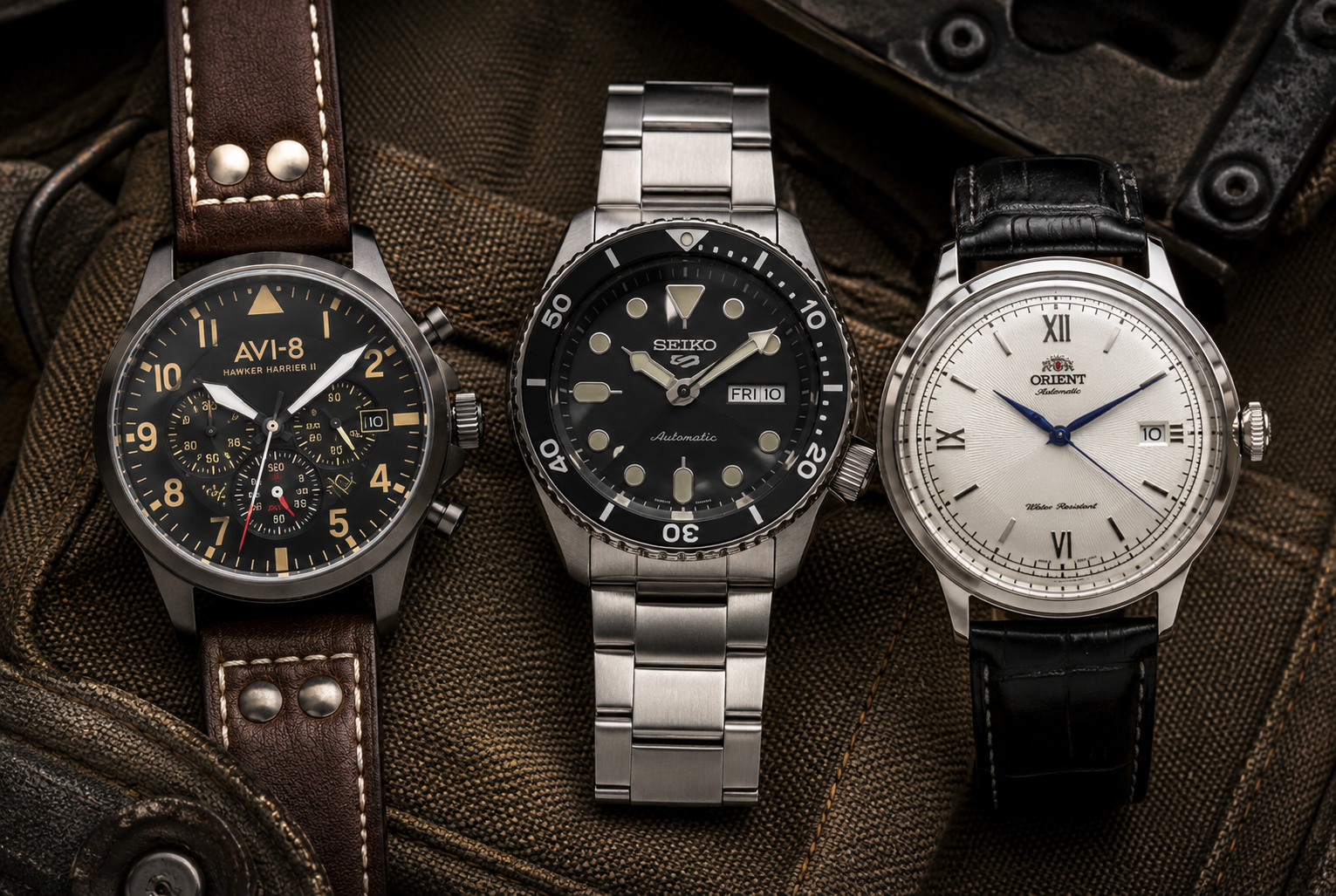
Three watches went on rotation: an AVI-8 Flyboy Airmaster on a brown leather strap, an Orient Bambino V in champagne, and a Seiko 5 Sports on its steel bracelet. Day one, the AVI-8 attracted the most unsolicited questions — specifically from people who don't follow watches. The layered dial does something to people who aren't expecting it. The Orient drew quieter, warmer reactions from people who do pay attention to accessories. The Seiko was simply there, doing what it does, unremarkable in the best sense.
Week Two: Comfort and the “forget you're wearing it” test
The Seiko 5 Sports passed the forget-you're-wearing-it test consistently. Eight hours at a desk, then a gym session, then dinner — the bracelet sat comfortably across all of it. The Orient felt noticeably lighter and more delicate, which worked beautifully with dress shirts but felt slightly out of its depth during a Saturday of errands. The AVI-8 — depending on the model — can wear large. On a larger wrist, the Flyboy felt powerful. On a smaller wrist, it started to feel assertive by the end of the workday.
Weeks Three and Four: The Rotation Test
By week four, a pattern had formed. The Seiko got worn most often — mostly because it required no thought. The Orient came out for dinners, meetings, and days when the outfit was doing something intentional. The AVI-8 got reached for when there was energy to match — road trips, weekend plans, situations where putting on a watch was itself part of getting ready. All three found a purpose. None felt redundant. But if only one could stay, the Seiko went everywhere and the AVI-8 went to the most memorable moments.
Head-to-Head Comparison Table
| Category | AVI-8 | Orient | Seiko |
|---|---|---|---|
| Design Identity | Bold aviation / military-inspired | Classic dress / vintage elegance | Sporty, practical, versatile |
| Movement Source | Sourced (Seiko NH35/NH34, Miyota) | In-house Orient calibers | In-house Seiko calibers |
| Dial Personality | ⭐⭐⭐⭐⭐ Most expressive | ⭐⭐⭐⭐ Refined & timeless | ⭐⭐⭐ Clean & practical |
| Everyday Versatility | ⭐⭐⭐ Best casual / statement wear | ⭐⭐⭐⭐ Dress to business-casual | ⭐⭐⭐⭐⭐ Adapts to almost anything |
| Finishing Quality | ⭐⭐⭐⭐ Strong for microbrand tier | ⭐⭐⭐⭐⭐ Punches above price | ⭐⭐⭐⭐ Consistent & proven |
| Lume Performance | ⭐⭐⭐ Adequate | ⭐⭐⭐ Adequate | ⭐⭐⭐⭐⭐ LumiBrite — best in class |
| Service Network | ⭐⭐⭐ Mail-in / third party | ⭐⭐⭐⭐ Orient service centers | ⭐⭐⭐⭐⭐ Largest service network |
| Community & Ecosystem | ⭐⭐⭐ Growing enthusiast base | ⭐⭐⭐⭐ Strong dress-watch community | ⭐⭐⭐⭐⭐ Largest watch community globally |
| Price Range | ~$150–$350 | ~$120–$300 | ~$150–$400 (5 Sports tier) |
| Best For | Personality-driven buyers | Dress / elegance buyers | All-around practical buyers |
| Biggest Weakness | Can feel too bold for formal wear | Less sporty / rugged versatility | Familiar look; less individuality |
Where Each Brand Genuinely Excels
AVI-8 — The personality edge no other brand at this price can match.
At under $300, most automatic watches look like…affordable automatic watches. AVI-8 breaks that mold. The layered dials, aviation numerals, and mechanical-looking sub-dial arrangements create a visual complexity that makes you look twice. For buyers who care about their watch being a conversation piece rather than just a timekeeper, AVI-8 delivers more character per dollar than either Orient or Seiko at this price tier.
AVI-8 — GMT complications at an impossible price point.
The Flyboy Airmaster GMT using the Seiko NH34 is remarkable value for a mechanical dual-time watch. This is a complication that used to cost $500+ minimum. AVI-8 gets you there under $300. For frequent travelers or anyone who needs a home-time display, there's nothing else at this price that competes.
Orient — In-house movement at a price where most brands source from others.
This matters more than it sounds. An in-house movement means Orient controls the caliber design, quality standards, and long-term parts availability. The F6 family has a long, reliable service history. When you buy an Orient, you're not at the mercy of a third-party movement supplier's decisions — and that's rare at this price point.
Orient — Finishing that genuinely surprises at the price.
The domed crystal on a Bambino, the way a sunburst dial moves in light, the polished case bevels against brushed sides — Orient puts care into details that most sub-$300 watches treat as afterthoughts. It's the brand most likely to impress watch-knowledgeable people when they pick it up and start examining it.
Seiko — LumiBrite and real-world practical performance.
Seiko's lume is legitimately the best in this category. On a Prospex or a 5 Sports, the hands and indices glow for hours after a brief light charge. This sounds like a minor spec until you've squinted at an unlighted Orient at 2am trying to figure out if you're late. Seiko's practical-first design philosophy means these watches work in real conditions, not just well-lit desk photos.
Seiko — The widest model range and the deepest enthusiast community.
Whatever your style — field watch, diver, pilot, dress, casual sport — Seiko has a model for it at an affordable price point. The community behind the brand is enormous, which means straps, mods, service resources, and second-opinion advice are always available. That ecosystem has long-term value that no spec comparison can fully capture.
Where Each Brand Falls Short
AVI-8 — Versatility is genuinely limited by the design approach.
A Flyboy Airmaster with a busy sub-dial layout and a chunky steel case is not a watch you wear to a board meeting, a wedding, or a formal dinner without it reading as a style mismatch. The bold personality that makes AVI-8 exciting is also what limits the situations it fits naturally. Buyers who need one watch for every context should think carefully before leaning on AVI-8 as a sole daily driver.
AVI-8 — No in-house movement story.
This doesn't affect day-to-day reliability, but it matters to certain buyers. AVI-8 is assembling watches around third-party calibers, which means the brand's value proposition is entirely in the case, dial, and design — not the movement. For watch enthusiasts who care deeply about movement provenance, AVI-8 asks you to value style over horological substance.
Orient — Not built for rough use.
The dress-oriented models in the Bambino lineup use mineral crystals that scratch more easily than Seiko's Hardlex and are significantly more vulnerable than sapphire. If your daily life involves manual work, outdoor activities, or situations where watches take punishment, an Orient dress watch will show wear faster than you'd want. The brand's sporty offerings (Mako, Ray) are more robust, but the identity is still firmly in elegant rather than tough territory.
Orient — Smaller community and fewer mod options.
Compared to Seiko's enormous enthusiast ecosystem, Orient's community is more limited. Strap compatibility, modding options, and deep-dive service resources are less widely available. For buyers who enjoy the hobby side of watch ownership — swapping straps, exploring forums, doing light case work — Seiko offers a richer experience.
Seiko — The familiarity problem.
The Seiko 5 Sports is one of the most recognizable watches in the sub-$300 category. For first-time buyers, that recognition is reassuring. For more experienced buyers, it can make the watch feel less personal over time. If you've worn the same ref for two years and want something that feels more distinctly yours, Seiko won't solve that — and this is exactly the moment buyers start looking at AVI-8.
Who Should Buy Each Brand
✅ Buy AVI-8 if you:
- Already own a Seiko or two and want something that feels like a genuine style choice, not a safe default
- Love aviation, military, or mechanical aesthetics and want that energy on your wrist daily
- Want a GMT complication at under $300 — the Flyboy Airmaster NH34 is almost unreasonably good value
- Dress casually most of the time — jeans, boots, casual jackets, weekend outfits — where bold wrist presence reads naturally
- Travel regularly and want a functional, good-looking watch that starts conversations at airports and coffee shops
- Are comfortable wearing a watch that prioritizes character over universal versatility
✅ Buy Orient if you:
- Spend most of your time in office, business-casual, or dress environments where understated elegance matters
- Want an in-house automatic movement at a price where most competitors source from third parties
- Care about finishing quality and are the kind of person who notices domed crystals, sunburst dials, and polished case bevels
- Already own a sport watch and want a dress piece to complement it without spending $500+
- Prefer timeless design over trend-driven styling — you want a watch that looks as good in five years as it does today
- Want the watch that wows people who know watches when they pick it up and check the price
✅ Buy Seiko if you:
- Are buying your first automatic watch and want the safest, most supported entry point in the category
- Need one watch that genuinely works across casual, professional, outdoor, and travel use
- Work in physical environments where a watch takes daily punishment and needs to survive it
- Care about lume performance — LumiBrite is the practical benchmark at this price tier
- Want to grow into the hobby — the Seiko community and mod ecosystem offer years of exploration
- Want long-term peace of mind from a brand with a global service network and decade-proven movements
Who Should Skip Each Brand
❌ Skip AVI-8 if you:
- Need a watch that transitions smoothly from casual to formal — AVI-8's bold designs fight against formal contexts
- Have smaller wrists (under 6.5 inches) and find large cases uncomfortable — check lug-to-lug before buying
- Want an in-house movement as part of your buying criteria — AVI-8 sources all its calibers externally
- Are buying your very first automatic watch and want maximum versatility while you figure out your preferences
❌ Skip Orient if you:
- Need a truly all-purpose daily watch that handles outdoor, sporty, and rough-wear situations
- Care about lume — Orient's glow performance is modest compared to Seiko LumiBrite
- Want access to a large mod and customization community — Orient's ecosystem is much smaller than Seiko's
❌ Skip Seiko if you:
- Already own multiple Seikos and want something that feels more individually distinct on the wrist
- Dress formally most days and want refined elegance over sporty practicality — Orient does that better at this price
- Want a watch people outside the watch community will comment on — Seiko's best models are widely recognized and won't surprise enthusiasts
Ready to Pick Your Watch?
AVI-8 delivers aviation personality at an automatic price that shouldn't be possible. If you've made your decision — or you're ready to explore the full lineup — this is where to start.
→ Shop AVI-8 Watches Now
Free shipping available on qualifying orders
⭐ Final Verdict: AVI-8 vs. Orient vs. Seiko
If you only remember one thing from this comparison, make it this: these three brands aren't actually competing for the same buyer. They're competing for three different versions of you.
Seiko is for the version of you that wants a reliable partner for everyday life — the watch that goes everywhere, handles everything, and never asks you to think twice about whether it's appropriate. For first-time automatic buyers and anyone prioritizing practical long-term value, Seiko remains the most defensible recommendation in the category.
Orient is for the version of you that dresses with intention — the person who appreciates finishing quality, cares that their accessories feel considered, and wants a watch that quietly impresses rather than loudly announces. At this price point, Orient's Bambino series remains one of the most genuinely surprising value propositions in watchmaking.
AVI-8 is for the version of you that wants the watch to be part of a feeling — a watch that matches energy, creates presence, and reminds you you made a deliberate style choice. The Flyboy Airmaster GMT in particular is a technological and value achievement that deserves far more attention than it gets. If you're ready to move past the defaults and own something with genuine personality, AVI-8 is the most interesting brand in this comparison right now.
Frequently Asked Questions — AVI-8 vs. Orient vs. Seiko
Is AVI-8 a trustworthy watch brand?
Yes. Most AVI-8 watches use Japanese automatic movements from Seiko or Miyota — both well-proven in the affordable watch market. The brand's core strength is its aviation-inspired visual design rather than movement innovation, but mechanically these watches are reliable for daily wear and long-term ownership.
Is Orient better than Seiko for a first automatic watch?
It depends on your lifestyle. Seiko offers more versatility across sport, casual, and semi-formal settings and has a wider model range and service network. Orient excels in dress-casual elegance and delivers better finishing quality at the same price tier. For pure everyday practicality, Seiko is slightly easier to recommend; for dress-focused use, Orient is exceptional value.
What movements do AVI-8 watches use?
AVI-8 uses third-party Japanese movements depending on the model — commonly Seiko NH35 or NH34 automatic calibers and Miyota automatic movements. For quartz models, the brand uses TMI (Seiko group) movements. None are in-house calibers, but all are proven, widely serviceable, and reliable over years of use.
Which brand — AVI-8, Orient, or Seiko — holds its value best?
Seiko holds secondary market value best of the three, due to strong brand recognition, collector communities, and iconic models with documented desirability. Orient retains value moderately well. AVI-8 has a smaller resale market — though limited-edition aviator models can attract collector interest as the brand grows.
Can I wear AVI-8 watches in a professional office setting?
Some AVI-8 models work well in professional environments — particularly slimmer, cleaner-dialed pieces on leather straps. The bolder chronograph and multi-sub-dial models lean casual and may read as visually loud in formal office contexts. Always check the specific model's diameter and dial complexity before buying for office wear.
Which is the best affordable automatic watch brand under $300?
For all-around value, Seiko leads — models like the 5 Sports series deliver proven movements, excellent lume, and strong versatility. Orient is the stronger value for dress-focused buyers. AVI-8 offers the most visual character and personality per dollar for buyers who want something less mainstream and more expressive.
How long do Orient automatic movements last?
Orient's in-house calibers — the F6 family and newer variants — are well-regarded for longevity. With proper care and servicing every 3–5 years, Orient movements routinely run reliably for 20+ years. Orient's ownership by Seiko Epson gives the brand access to manufacturing standards that genuinely punch above the price point.
Does AVI-8 make automatic watches?
Yes. AVI-8 produces both automatic and quartz models. Their automatic pieces typically use Seiko NH35 or Miyota 8218 movements. Models like the Flyboy Airmaster GMT use the Seiko NH34 caliber and feature exhibition casebacks — making the movement part of the watch's visual appeal alongside the dial design.



 Top Picks