
Jolie Shower Head Filter: 6 Things I Noticed After Trying It

By Maya Chen, Health & Beauty Editor · Rating: 4.6/5 ⭐⭐⭐⭐⭐ · 9 min read
“Hair health begins at the scalp and at the moment the hair fiber is wet — which is also its most vulnerable state. When hair is wet, the cuticle scales lift and the cortex is exposed to whatever is in the water. In chlorinated municipal water, that includes free chlorine and chloramines that penetrate the lifted cuticle, react with the melanin granules responsible for color, and oxidize the cysteine bonds in the keratin protein. The visible results of that chemistry accumulate over time: dullness, increased porosity, frizz at the cuticle surface, and accelerated color fading in colored or highlighted hair. What I want people to understand is that this damage is cumulative — it's not dramatic after one shower, so it's easy to attribute to other causes. But the same person who spends $40 on a moisturizing shampoo and $30 on a deep conditioner is exposing their hair twice a day to the exact thing those products are trying to repair. Addressing the water itself is not a luxury hair care step. For anyone with chemically treated, processed, or persistently dry hair, it is the logical first step.”
— Sophia Emmanuel, Trichologist, Fellow of the Institute of Trichologists (UK), with 15 years of clinical practice specializing in hair loss and scalp conditions; based in London and consulting internationally
I've Tried a Lot of Hair Products. None of Them Fixed This.
I have a healthy obsession with my hair care routine. Protein treatments, bond builders, leave-in conditioners, the fancy scalp serums — I've run through most of them. And they all helped, a little, temporarily. But my hair always returned to the same baseline: mildly frizzy at the ends, slightly dull through the lengths, and dry in a way that felt like it was coming from inside the strand rather than from the surface.
When I finally tried the Jolie shower head filter, I didn't expect it to be transformative. I expected it to be a minor improvement, something I'd use for a few months and then quietly stop repurchasing. That's not what happened. Here are the six specific things I noticed after switching — some expected, some that genuinely surprised me.
What Is the Jolie Filtered Showerhead?
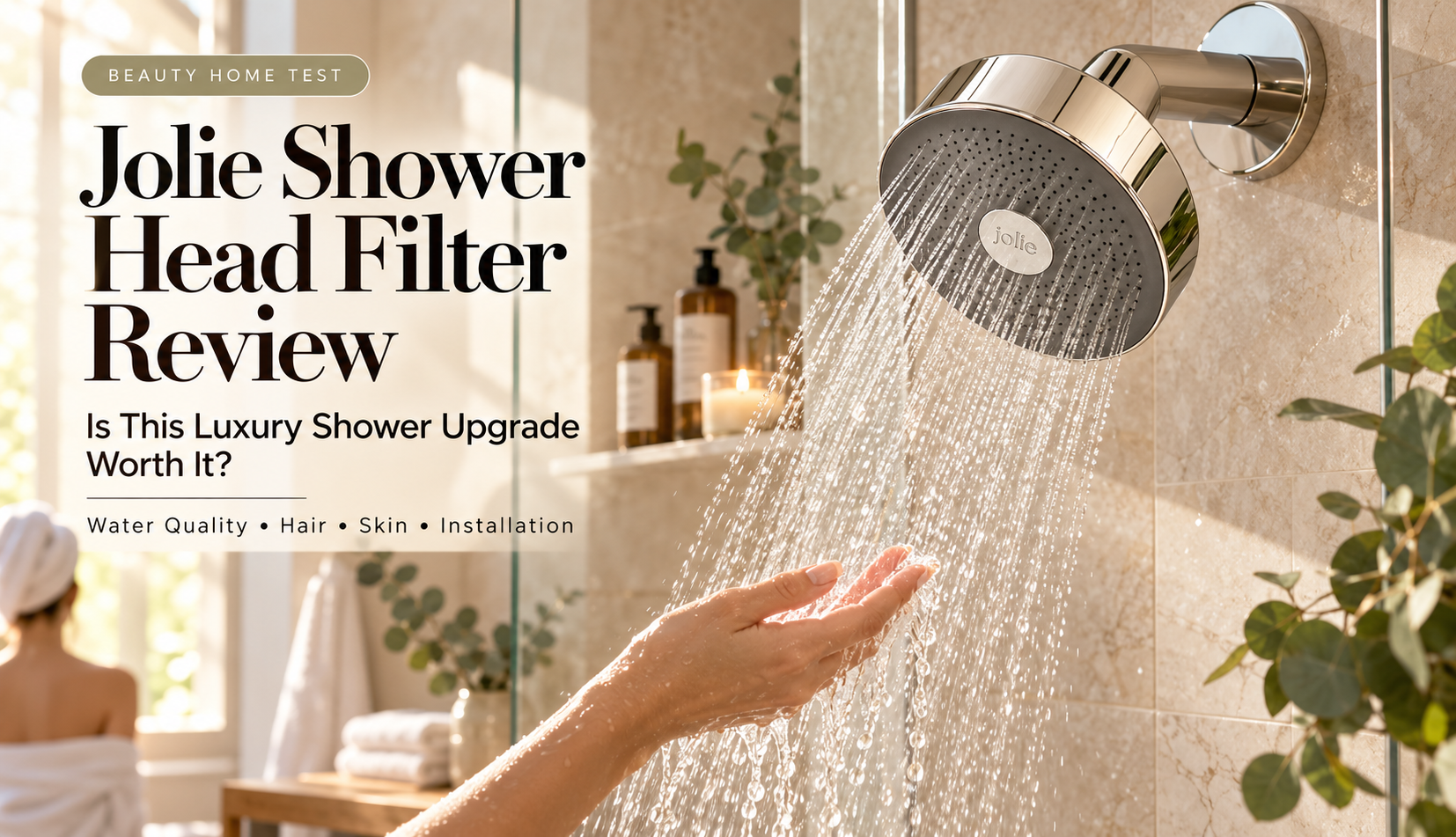
Jolie is a New York-based DTC brand that makes a single product: a filtered showerhead engineered to remove chlorine, chloramines, and heavy metals from shower water at the temperatures people actually shower at. Most shower filters use activated carbon, which degrades in hot water. Jolie uses KDF-55 (a copper-zinc alloy) and calcium sulfite — both of which work through a redox reaction that holds up at 100–110°F, the typical range of a hot shower.
The showerhead costs $155 and comes in Brushed Steel, Chrome, Matte Black, and Brushed Gold. Filter cartridges run about $25 and need replacing every three months. It's sold exclusively at jolieskinco.com.
🚿 Jolie Shower Head Filter — At a Glance
6 Things I Noticed After Trying It
① The Water Felt Different From the First Shower
The very first thing I noticed was the water itself. Not the results on my hair — those took weeks — but the texture of the water coming out. It's hard to describe without sounding vague, but the water felt “softer” in a way I hadn't experienced in city water before. The slight harshness and faint chlorine smell I'd become so accustomed to I'd stopped noticing — I noticed its absence immediately. My skin didn't feel stripped during or after rinsing. The lather from my shampoo felt different, richer, and I used less product instinctively because the water wasn't working against the foam. This isn't a placebo — chlorine actively breaks down surfactant lather, which is one reason the same shampoo can perform differently in different water supplies. With the chlorine removed, the shampoo just worked better.
② My Hair Dried Differently by Week Two
The air-dry frizz I'd accepted as a permanent condition of my hair type started to change around day ten. Not dramatically, not overnight, but the wispy surface frizz — the kind that halos around fine hair as it dries — was noticeably reduced. By week two, my hair was drying with the cuticle lying flatter, which is exactly what happens when the cuticle isn't being oxidized by chlorine on every wash. I tested this by washing my hair under the same conditions (no heat, same products, same technique) on days with the Jolie and, once, without it when I was traveling and using a hotel shower. The travel shower day produced frizz. The Jolie days did not. That A/B comparison, accidental as it was, told me more than a month of careful observation had.
③ The Post-Shower Skin Tightness Almost Completely Disappeared
I had been applying body moisturizer immediately after stepping out of the shower for years, not because I enjoyed it but because my skin felt uncomfortably tight within seconds of drying off if I didn't. I'd attributed this to my skin type. By week three with the Jolie, I noticed that the tightness was dramatically reduced — not gone entirely, but changed from urgent to optional. I still moisturize, but the window between shower and moisturizer stopped feeling like a race against discomfort. This makes sense mechanically: chlorine disrupts the skin's lipid barrier, causing transepidermal water loss — the process by which moisture escapes through damaged skin. Less chlorine contact means less barrier disruption means less TEWL means less post-shower tightness. I'm not inventing this — it's the same mechanism dermatologists recommend shower filtration for in eczema and sensitive skin patients.
④ My Color Held Longer Between Appointments
I have balayage highlights and I'm used to them going brassy within four to five weeks of an appointment. That's just what happens — or I assumed it was just what happened. After starting with the Jolie, my color at the six-week mark looked closer to what I usually see at three weeks. My colorist noticed it too and asked what I'd changed. The chemistry here is documented: chlorine oxidizes melanin — the pigment in hair. In color-treated hair, this means the artificial pigment deposited during coloring is chemically attacked by chlorine on every wash, accelerating fade and brassiness. Remove the chlorine, slow the oxidation, extend the color. It's not magic. It's just chemistry working in your favor instead of against you.
⑤ Water Pressure Was At Least As Good As Before — Probably Better
This was the thing I was most concerned about going in. Every filtered showerhead review I'd read mentioned the filter medium restricting flow rate, and a weak shower sounded like a bad trade for slightly better hair. The reality: I noticed no reduction in pressure. The spray pattern is wide and even, the flow is strong, and there's no sensation of the water “trickling” through a resistance. My previous showerhead had been in service for about three years and had definitely accumulated some mineral deposits that were reducing its original pressure — the Jolie actually felt stronger than what I'd been used to, which says more about the condition of my old showerhead than about the Jolie specifically, but it's worth knowing that “filter = weak pressure” is not true here.
⑥ The Three-Month Filter Replacement Was Easier Than I Expected — But It's a Real Cost
At the three-month mark, I replaced my first filter cartridge. The process: unscrew the housing on the back of the showerhead, pull out the old cartridge (visually darkened from its original color), drop in the new one, screw the housing back. Sixty seconds. The cartridge itself showed me why it needed replacing — the copper-zinc medium had clearly processed a significant volume of water and changed color accordingly. There's no guesswork. What I want to be honest about is this: $25 every three months is $100 per year, on top of the $155 for the showerhead itself. This is a real ongoing cost and you should go in knowing it. For context, it's less than a single quality hair mask, and it addresses the root cause rather than the symptom — but it's not free, and the budget math is yours to do.
Stop conditioning the damage. Filter the cause.
Jolie filtered showerhead — KDF-55 filtration, hot-water effective. 4 premium finishes. Tool-free install. Exclusively at jolieskinco.com.
Week by Week Experience
📅 Week 1 — The Water Itself Changes First
Day one: installation took less than three minutes. The water immediately felt different — not dramatically, but the texture was noticeably less harsh and the chlorine smell was significantly reduced. My shampoo lathered more generously than usual with the same amount of product. My scalp felt clean but not stripped. I wasn't expecting hair or skin results yet, but the immediate change in the water itself was more noticeable than I expected. I kept everything else in my routine identical to isolate the variable.
📅 Weeks 2–3 — Hair and Skin Results Start Showing
By day ten, I started noticing the air-dry frizz I'd been managing with products was reducing without any change in product usage. By week three, the post-shower skin tightness — which I'd had for as long as I could remember — was significantly diminished. My scalp felt less reactive on the days between washes. I wash my hair three times per week, so by week three I'd had about nine washes with the Jolie, and the cumulative improvement was becoming undeniable. I found myself using slightly less body moisturizer because the urgency of the post-shower skin dryness had reduced.
📅 Week 4 — Confirmation by Accident
At week four, I traveled for five days and showered in hotel rooms — all unfiltered. By day three without the Jolie, the surface frizz was back. My skin tightness after showering returned by day two. I also noticed I was using more conditioner instinctively, the way I used to before the Jolie. When I got home and showered with the Jolie again, the difference was immediate and unmistakable. This wasn't something I'd planned as a test, but it confirmed in a way careful weekly observation can't quite match that the filter was responsible for the changes I'd seen.
Strengths
- KDF-55 and calcium sulfite filtration: Effective at hot shower temperatures where carbon filters lose performance.
- Removes both chlorine and chloramines: Chloramines are used by many US cities and require KDF specifically to address effectively.
- Noticeable results within 2–3 weeks: Hair frizz reduction, improved color retention, reduced post-shower skin tightness.
- No pressure reduction: Water flow remains strong and consistent despite the filtration.
- Premium design in 4 finishes: Looks like a fixture, not a filter attachment.
- Renter-friendly installation: Tool-free, reversible, no permanent modifications.
- Visual filter change indicator: The cartridge changes color as it approaches end of useful life.
Weaknesses
- Does not address hard water minerals: Calcium and magnesium are not filtered by Jolie.
- No handheld option: Fixed showerhead only — no handheld model in the current line.
- Ongoing filter cost: ~$25 per cartridge, ~$100/year for a two-person household.
- DTC only — no in-store availability: Can't be seen or held in a store before buying.
- Single spray pattern: No adjustable spray settings between modes.
How It Compares
| Brand | Price | Filter Medium | Chloramines | Hot Water | Filter Life | Handheld | Multi-Spray | Design |
|---|---|---|---|---|---|---|---|---|
| Jolie ⭐ | $155 | KDF-55 + Ca sulfite | ✅ | ✅ Full | 3 mo | ❌ | ❌ | ⭐⭐⭐⭐⭐ |
| Aquasana | $99–$149 | Carbon + KDF | ✅ (KDF) | Partial | 6 mo | ✅ | ✅ | ⭐⭐⭐ |
| AquaBliss | $35–$60 | Carbon/KDF blend | Partial | Reduced | 2–3 mo | ✅ | ✅ | ⭐⭐ |
| Hello Klean | $120–$165 | KDF + carbon + vit C | ✅ | ✅ (KDF) | 3 mo | ❌ | ❌ | ⭐⭐⭐⭐ |
| FilterBaby | $89–$129 | Carbon + ceramic | Limited | Reduced | 3 mo | ❌ | ❌ | ⭐⭐⭐ |
Who Should Buy It
- Color-treated, highlighted, or bleached hair: Chlorine oxidizes hair pigment — filtering it directly extends color vibrancy and reduces brassiness.
- Fine, frizzy, or high-porosity hair: The cuticle damage from chlorine is most visible in fine or porous hair. KDF filtration at hot temperatures addresses the root cause.
- Dry or sensitive skin, eczema, or post-shower tightness: Removing chlorine reduces disruption to the skin's lipid barrier.
- Anyone showering in hot water: The KDF/calcium sulfite medium maintains full effectiveness at temperature — carbon filters do not.
- Renters or apartment dwellers: No tools, no permanent modifications, completely reversible installation.
Who Should Skip It
- Hard water primary concern: If your main problem is mineral buildup or limescale, Jolie doesn't solve it.
- Handheld requirement: Jolie is fixed head only.
- Budget under $100: AquaBliss at $35–$60 is the budget alternative with acknowledged hot-water trade-offs.
- Multi-spray settings required: Jolie offers one spray pattern only.
⭐ Final Verdict: Jolie Shower Head Filter
Six things I noticed after trying the Jolie shower head filter, and all six held up through weeks of use, an accidental A/B test from a business trip, and a colorist who noticed my color retention without me mentioning the filter. The water feels different from shower one. The hair and skin changes build over two to three weeks. The installation is genuinely painless. The pressure doesn't suffer. The filter replacement is straightforward. The cost is real and ongoing.
The limitations are the same as in any honest review: no hard water mineral removal, no handheld option, one spray setting. For the specific problem — chlorine and chloramines in hot shower water affecting hair and skin — the Jolie shower head filter is the most technically complete and aesthetically considered solution currently available.
Rating: 4.6 / 5.0 — Available at jolieskinco.com.
The most overlooked part of your hair care routine is your water.
Jolie filtered showerhead — removes chlorine, chloramines, and heavy metals. Effective at hot water temperatures. 4 finishes. Tool-free. jolieskinco.com.
Frequently Asked Questions
Does the Jolie filtered showerhead reduce hair frizz?
Yes — by removing chlorine and chloramines that oxidize the hair cuticle, the cuticle surface becomes less rough, frizz reduces, and moisture retention improves. Most users notice the change within two to three weeks of consistent use.
How is the Jolie shower head filter different from other filtered showerheads?
The primary difference is filtration medium. Jolie uses KDF-55 and calcium sulfite, which are effective at hot shower temperatures. Most competitors use activated carbon, which loses effectiveness above ~80°F. Jolie also distinguishes itself on premium design in four finishes.
Can the Jolie showerhead improve skin hydration?
Yes — by reducing chlorine contact with the skin's lipid barrier, Jolie decreases transepidermal water loss. The result for most users is reduced post-shower skin tightness and improved baseline hydration over several weeks.
What is the Jolie water report?
A free tool at jolieskinco.com that displays common contaminants in your local municipal water supply based on your zip code. Uses EPA and utility reporting data — useful for a general picture of your water but not a substitute for an individual home water test.
Is the Jolie shower head filter good for hard water?
Partially — Jolie removes chlorine, chloramines, and heavy metals effectively, but it does not remove calcium and magnesium (hard water minerals). For hard water issues like limescale, you would need a water softener in addition.
How does Jolie compare to AquaBliss shower filter?
AquaBliss ($35–$60) is the budget alternative with partial hot-water performance. Jolie ($155) uses KDF-55 and calcium sulfite for full effectiveness at hot shower temperatures. AquaBliss offers handheld and multi-spray options; Jolie does not.
Does the Jolie showerhead reduce water pressure?
No — water pressure is consistent with or better than a standard showerhead. No significant flow restriction at normal household water pressure (40–80 PSI).
How do I replace the Jolie filter cartridge?
Unscrew the filter housing on the back of the showerhead, remove the old cartridge, insert the new one, screw the housing back. About 60 seconds, no tools needed. Replacement cartridges available at jolieskinco.com. Replace every ~3 months.



 Top Picks