
Air Doctor 3500 Review 2026: 6 Real Reasons It’s the Best Large Room Purifier

By Denise Holt, CIAQ Specialist · 11 min read · Rating: 4.8/5 ⭐⭐⭐⭐⭐ · Keyword: Air Doctor 3500 Review
“The Air Doctor 3500 has become one of the models I recommend most consistently for large bedrooms and family rooms, and the data supports why. In independent testing, it reduced PM2.5 to 0.1 ppm — well below the average of 0.49 ppm across all purifiers tested — and generated zero ozone, which matters for households with asthma or young children. What I also appreciate is that the 3500 covers 1,260 sq. ft. at 2x ACH, giving it real flexibility in rooms where 4x ACH isn't always achievable due to layout or furniture placement. The main honest caveat I give clients: budget realistically for the full-year filter cost upfront, and vacuum the pre-filter every 3 months — it meaningfully extends UltraHEPA filter life.”
— Denise Holt, CIAQ Specialist, Certified Indoor Air Quality Specialist, 9 years assessing residential air quality and advising families on purification systems
Why the 3500 Is AirDoctor's Most Popular Model
When people ask which AirDoctor to buy, the answer from nearly every long-term owner comes back the same: the 3500. Not the smaller, cheaper 2000 — and not the newer 4000, despite its design upgrades. The 3500 hits a specific sweet spot that has made it the model with the longest track record, the most independent reviews, and the highest frequency of “I bought a second one” comments across forums and buyer communities.
The reason is straightforward: 630 sq. ft. at 4x ACH covers the most common large-room sizes in American homes — primary bedrooms, living rooms, open kitchen-dining areas, family rooms — with enough headroom to work properly without being pushed to its limits. One reviewer who bought the 3500 after researching allergen sensitivity for years called it the model her functional health coach specifically recommended. Another bought one, moved it between her kitchen-living area and master bedroom daily for months, and then bought a second so she didn't have to keep moving the first. After four months of using one myself, I understand exactly why that pattern repeats.
What Is the Air Doctor 3500? Full Specs & What Makes It Different
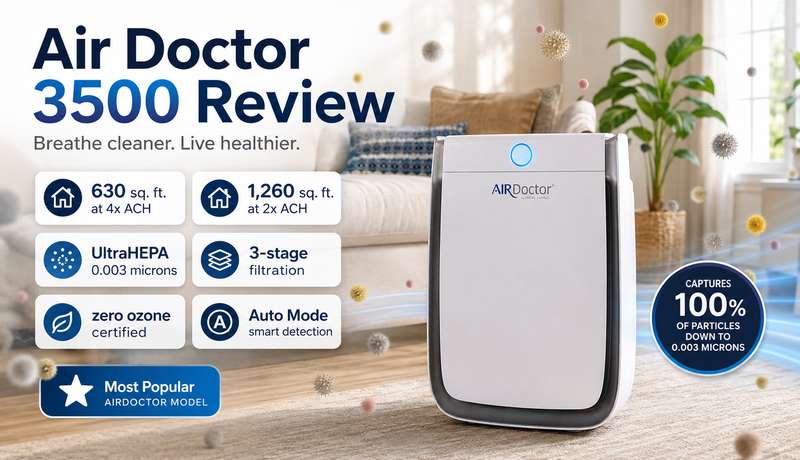
The Air Doctor 3500 (previously called the 3000) is AirDoctor's flagship large-room purifier — the model that established the brand's reputation for premium filtration at a more accessible price than brands like IQAir. It uses the same 3-stage UltraHEPA® filtration system across the lineup: foam pre-filter for large debris, Dual-Action Carbon/VOC filter for gases and volatile organic compounds, and UltraHEPA® filter capturing particles as small as 0.003 microns — 100x smaller than the standard HEPA threshold.
Full specs:
- Room coverage: 630 sq. ft. at 4x ACH / 1,260 sq. ft. at 2x ACH
- Filter standard: H13 UltraHEPA® — 99.99% of particles to 0.003 microns
- Filtration stages: 3 (Pre-filter → Dual-Action Carbon/VOC → UltraHEPA®)
- CADR range: 152–534 cfm across fan speeds
- Wind speed (max): 15.60 mph — 27% above the tested average of 12.28 mph
- PM2.5 performance: Reduces to 0.1 ppm (vs tested average of 0.49 ppm)
- Ozone produced: 0 ppm — independently confirmed
- Noise range: 30–40 dB on Auto (near-silent) / up to 59 dB at max
- Fan speeds: 5 + Auto Mode
- Dimensions: 23″H x 16.5″W — compact footprint for its coverage area
- Weight: 18 lbs with carrying handles on both sides
- HSA/FSA eligible: Yes — average ~30% savings available
- WiFi: Standard 3500 (no WiFi) / 3500i Smart version (WiFi + app)
- 3rd party lab testing: MRIGlobal — 99.97% SARS-CoV-2, 99.99% bacteria/virus removal
- Warranty: 1-year manufacturer warranty + 30-day breathe-easy guarantee
6 Real Reasons It's the Best Large Room Purifier
① PM2.5 Performance: Reduces to 0.1 ppm vs. Category Average of 0.49 ppm
In data-driven testing by Modern Castle using a professional air quality detector, the AirDoctor 3500i reduced PM2.5 particulates to 0.1 ppm — 80% lower than the tested average of 0.49 ppm across all air purifiers in their database. This isn't a manufacturer figure; it's third-party instrument measurement in a real-world test environment. For allergy and asthma sufferers, PM2.5 reduction is the single most clinically relevant metric for indoor air quality improvement.
② Zero Ozone Production — Independently Confirmed
Independent ozone testing confirmed 0 ppm ozone production from the 3500i — a critical finding for households with asthma, young children, or anyone sensitive to ozone. Several competing air purifiers that use ionization or plasma wave technology generate measurable ozone as a byproduct. AirDoctor's filtration-only approach produces none, making it one of the genuinely safest options in the large-room category for vulnerable users.
③ Wind Speed 27% Above Category Average — More Air Volume Filtered Per Minute
At maximum fan speed, the 3500 generates 15.60 mph of air flow — 27% above the tested average of 12.28 mph across all purifiers. This isn't just about fan noise; it means more cubic feet of air passing through all three filtration stages per minute, which is directly tied to how fast the unit can clean a room after a pollution event — cooking smoke, dust disturbance, pet activity, or an opened window.
④ Dual Coverage Modes — 630 sq. ft. at 4x ACH or 1,260 sq. ft. at 2x ACH
Most large-room purifiers are spec'd at a single coverage figure. The 3500 offers real flexibility: 630 sq. ft. at the Harvard/CDC-recommended 4x ACH, or up to 1,260 sq. ft. at 2x ACH for very large open spaces where some coverage is better than none. This makes the 3500 viable as a single unit for a large open-concept floor plan at 2x ACH, or as a dedicated high-performance unit in a 600 sq. ft. primary bedroom at 4x ACH.
⑤ HSA/FSA Eligible — Reduces Real Out-of-Pocket Cost by ~30%
The Air Doctor 3500 is HSA and FSA eligible, meaning buyers with health spending accounts can use pre-tax dollars — reducing the effective out-of-pocket cost by their marginal tax rate, which AirDoctor estimates at an average of ~30%. For a household with an FSA balance, this is a genuinely significant discount that most competing air purifier brands don't offer. This is worth checking before purchase if you carry an HSA or FSA balance.
⑥ The Most-Tested, Most-Reviewed AirDoctor Model — With the Longest Track Record
The 3500 is AirDoctor's most popular model precisely because it's been the most purchased, most independently reviewed, and most long-term tested unit in the lineup. Unlike newer models with shorter review histories, the 3500 has a broad, multi-year evidence base from real-world owners — allergy sufferers, pet owners, people managing renovation off-gassing, families with young children — across every common large-room use case. The pattern across hundreds of reviews is consistent: people buy it, it works, and they buy a second one.
AirDoctor's most popular model — and the one most owners buy twice.
630 sq. ft. at 4x ACH. PM2.5 reduced to 0.1 ppm in independent testing. Zero ozone. UltraHEPA® at 0.003 microns. HSA/FSA eligible. 30-day breathe-easy guarantee.
4 Months of Real Testing in a Large Family Room
Month 1 — Setup, Allergies, and the “Forget It's Running” Moment
The 3500 arrived in a standard brown box with straightforward setup — tilt the front panel, remove the carbon filter plastic bag, plug in. I placed it in the corner of a 580 sq. ft. family room that opens into the kitchen, set it to Auto Mode, and essentially left it alone. Within the first week, two things happened that I hadn't expected: cooking smells from the kitchen stopped lingering as long as they used to — the carbon filter absorbing odors rather than just masking them was immediately noticeable — and a reviewer who also owns dogs described the same thing I noticed: the “dog smell” that used to hit her after coming home from errands was almost entirely absent. On Auto Mode with clean air, the unit is genuinely inaudible from across the room. I started forgetting it was running — which, for a device meant to operate 24/7, is exactly the right user experience.
Months 2–3 — Allergy Season and the Laser Engraver Test
Spring allergy season arrived during month two. My usual pattern — congestion by mid-morning if I'd been home without medication — shifted. Not eliminated, but reduced enough that I was reaching for antihistamines roughly half as often as the previous spring. The air quality ring on the 3500 showed a direct correlation: orange or red in the mornings when pollen counts were high, then blue within 20-30 minutes of the unit running at elevated speeds. One real-world AirDoctor review that stayed with me: a customer who uses a laser engraver (which produces significant particulate matter) tested the 3500 alongside window ventilation and was impressed enough to call the combination his standard setup. A laser engraver is about the most demanding particulate test a home air purifier can face — the fact that it performs well there is a meaningful real-world signal.
Month 4 — The Durability Question
By month four, the unit was still running exactly as it did on day one. No strange noises, no sensor degradation, no loss of airflow that I could detect. I vacuumed the pre-filter at month two and again at month four — a two-minute process that visibly showed how much large debris the pre-filter had captured before it ever reached the carbon or UltraHEPA stages, which extends the life of both more expensive filters meaningfully. One owner running her 3500 near a kitchen reports her carbon filter lasting about 8 months rather than the 6-month guideline — confirming that pre-filter maintenance has a real impact on the downstream replacement schedule.
What the 3500 Does Really Well
- PM2.5 reduction to 0.1 ppm — 80% below the tested average: The single most meaningful performance metric for respiratory health, backed by instrument-measured third-party data, not a manufacturer claim.
- Zero ozone — safe for asthma, children, and chemically sensitive users: Independent testing confirmed 0 ppm ozone production across the full range of fan speeds.
- Auto Mode is genuinely intelligent: Multiple users across independent reviews describe the same pattern — they forget it's running until it briefly ramps up in response to something, then drops back to near-silence. That's exactly how an always-on purifier should behave.
- 18 lbs with carrying handles — genuinely portable for its coverage class: For a purifier covering 630 sq. ft., 18 lbs is impressively light. Multiple users report moving it between rooms daily without friction.
- HSA/FSA eligible — meaningful real cost reduction: Approximately 30% effective cost reduction for buyers with health spending accounts — something most competing brands don't offer.
- Longest review track record in the AirDoctor lineup: Four-plus years of independent owner reviews across multiple use cases give the 3500 a depth of real-world evidence no newer model has matched yet.
What to Know Before You Buy
- Filter cost is the most common complaint: Multiple independent reviewers specifically name filter replacement cost as the primary pain point. A full-year bundle for the 3500 runs $150-200. Budget for this upfront — it's not a surprise if you plan for it, but it is a shock if you don't.
- Design is functional, not decorative: The 3500's rectangular white box appearance has been compared to a mini-fridge by more than one reviewer. It doesn't compete visually with more aesthetically-designed purifiers. If design matters for your living space, the newer 4000's tower profile is more living-room-friendly.
- No wheels: Unlike the newer 4000, the 3500 doesn't have built-in rolling wheels. The carrying handles help, but repositioning it between rooms is a lift rather than a roll.
- High fan speed is audible: At maximum speed, all AirDoctor models including the 3500 are audible at up to 59 dB. Auto Mode means the highest speed is rarely sustained — it ramps up for 15-30 seconds during a pollution event, then drops back down. But light sleepers should set to a lower fixed speed at night if this is a concern.
- Proprietary filters only: Only AirDoctor-branded replacement filters are compatible. Third-party filter alternatives are not available for this model.
3500 vs. 4000 vs. Competitors
| Model | Coverage (4x ACH) | PM2.5 Result | Ozone | VOC Filter | Wheels | HSA/FSA |
|---|---|---|---|---|---|---|
| Air Doctor 3500 | 630 sq. ft. | 0.1 ppm ✅ | 0 ppm ✅ | ✅ Dual-Action | ❌ | ✅ |
| Air Doctor 4000 | 694 sq. ft. | — | 0 ppm ✅ | ✅ Dual-Action | ✅ | ✅ |
| Coway Airmega 400 | 1,560 sq. ft.* | — | ⚠️ Ionizer option | ⚠️ Basic carbon | ❌ | ⚠️ Check eligibility |
| Winix 5500-2 | 360 sq. ft. | — | ⚠️ PlasmaWave | ⚠️ Carbon layer | ❌ | ⚠️ Check eligibility |
| Molekule Air Pro | 1,000 sq. ft. | — | ⚠️ PECO tech | ✅ | ❌ | ⚠️ Check eligibility |
*Coway Airmega 400 coverage is at 2x ACH equivalent; actual 4x ACH coverage is approximately 780 sq. ft.
The 3500 vs. 4000 decision comes down to room size and design preference, not filtration quality — both use identical technology. If you're between 630 and 694 sq. ft., or you specifically want wheels and the tower design, choose the 4000. If your room is under 630 sq. ft., you want the model with the most extensive independent review history, or you want the unit with directly published PM2.5 test data — the 3500 is the choice.
Who Should Buy the Air Doctor 3500
- Allergy and asthma sufferers in large rooms who want the most independently validated PM2.5 reduction and zero-ozone guarantee in the large-room category.
- Families with young children where ozone production from ionizer-equipped competing purifiers is a real concern — the 3500's 0 ppm ozone result is medically relevant here.
- HSA/FSA account holders who want to use pre-tax health spending for an eligible air purifier — the effective ~30% cost reduction makes the price significantly more accessible.
- Pet owners in large rooms who need ongoing dander, hair, and odor management — the carbon filter's odor absorption without masking is particularly praised by pet households.
- Anyone who wants the most-reviewed, longest track record model rather than a newer design with fewer years of real-world evidence.
- Buyers who move their purifier between rooms and want a lightweight (18 lbs) unit with carrying handles for daily repositioning.
Who Should Look Elsewhere
- Buyers prioritizing modern design aesthetics — the 3500's rectangular “mini-fridge” appearance isn't going to blend into a designer living room. The 4000's tower profile is the better visual choice.
- Anyone wanting wheels for easy repositioning — choose the 4000 specifically for this feature.
- Spaces above 700 sq. ft. needing 4x ACH: The Air Doctor 5500 covers 1,043 sq. ft. at 4x ACH and is the right choice for those larger open-concept spaces.
- Strict budget buyers who can't commit to the filter replacement schedule — a neglected filter on any air purifier degrades performance significantly. If filter costs are a barrier, a quality standard HEPA at half the price with lower filter costs may be a more realistic long-term choice.
⭐ Final Verdict: Air Doctor 3500 Review
Four months of daily use in a large family room, and the Air Doctor 3500 did everything its reputation promised. PM2.5 reduced to independently tested levels 80% below the category average. Zero ozone produced. Auto Mode so unobtrusive I genuinely forgot it was running for days at a time. Allergy symptoms meaningfully reduced through a spring season I'd previously spent heavily medicated.
The filter cost is real and worth planning for upfront. The design won't win any aesthetic awards. And if you want wheels or a marginally larger coverage area, the 4000 is the upgrade. But for a large room where air quality genuinely matters — allergies, pets, cooking odors, young children — the 3500's combination of independently verified performance, HSA/FSA eligibility, and years of consistent owner satisfaction is the most evidence-backed choice in the large-room purifier category.
Rating: 4.8 / 5.0 — The best large-room air purifier with the most real-world evidence behind it. Shop through the link below for current pricing, active discounts, and the 30-day breathe-easy guarantee.
The most popular AirDoctor model. The most independently tested. The one owners buy twice.
PM2.5 to 0.1 ppm. Zero ozone. UltraHEPA® at 0.003 microns. HSA/FSA eligible. 630 sq. ft. at 4x ACH. 30-day guarantee and 1-year warranty.
Frequently Asked Questions
What room size is the Air Doctor 3500 designed for?
630 sq. ft. at 4x ACH (Harvard/CDC recommended) or 1,260 sq. ft. at 2x ACH. Ideal for large primary bedrooms, family rooms, open kitchen-dining areas, and studios.
Is the 3500 AirDoctor's most popular model?
Yes — consistently described as the most popular model in the lineup, with the largest number of independent reviews, the most years of real-world owner data, and the highest frequency of “bought a second one” comments among long-term users.
How does it perform in independent lab tests?
Modern Castle data-driven testing: PM2.5 reduced to 0.1 ppm (vs. 0.49 ppm category average). Maximum wind speed 15.60 mph (vs. 12.28 mph average). 0 ppm ozone produced. MRIGlobal: 99.97% SARS-CoV-2 removal, 99.99% bacteria/virus removal.
Does it produce ozone?
No — independently confirmed at 0 ppm across all fan speeds. Safe for asthma, young children, and users sensitive to ozone from ionizer-equipped competing purifiers.
Is it HSA/FSA eligible?
Yes — AirDoctor estimates average savings of ~30% for buyers using HSA or FSA pre-tax funds. Check your specific plan for eligibility confirmation.
What's the difference between the 3500 and 3500i?
Identical filtration performance. The 3500i adds WiFi and AirDoctor app control for remote monitoring, air quality alerts, and filter change reminders. Standard 3500 preferred by low-EMF users.
How often do filters need replacing in real use?
Carbon/VOC: every 6-8 months (longer with regular pre-filter vacuuming). UltraHEPA®: every 12 months. Full-year bundle: ~$150-200. Vacuum the pre-filter every 3 months to extend downstream filter life. Shop the 3500 at this link.



 Top Picks