
Grounding Sheets vs Regular Sheets: 4 Science-Backed Differences Worth Knowing

By Madison Clarke, Health & Wellness Writer · 13 min read
On Grounding and Electrical Exposure:
“In the world of sleep, we talk about things like light and dark exposure. It's not too far of a reach to say our electrical exposure plays a role — the body's electrical environment during sleep is something we're only beginning to understand.”
— Dr. John Saito, MD, Pediatric Pulmonologist & Board-Certified Sleep Medicine Specialist, Children's Hospital of Orange County; AASM Spokesperson — via University of Michigan Health
On the Mechanism of Grounding:
“In the realm of sleep, it's postulated that this connection can recalibrate the body's electrical state. Commonly reported benefits include reduced inflammation, stabilization of the hormone cortisol — the body's primary stress hormone — and improved relaxation at the cellular level.”
— Dr. Naheed Ali, MD, PhD, Sleep Expert & Founder of Sleep Bubble — via LivingEtc
The $100 Question: What Are You Actually Paying For?
A regular cotton sheet costs $30 to $60. A grounding sheet costs $80 to $150. What does that extra money buy you — just a marketing story about “connecting to the earth,” or something that's measurably, physically different from what's already on your bed?
I'm not here to sell you on a philosophy. I'm here to walk through what the published research actually says — the peer-reviewed studies, the specific mechanisms, the measurable differences — so you can decide whether the price gap is justified by what a grounding sheet does that a regular sheet physically cannot.
Spoiler: the difference is real, it's measurable with a $15 multimeter, and the clinical data — while still developing — points in a consistent direction.
What Makes a Grounding Sheet Different
Every sheet on your bed right now is an electrical insulator. Cotton, polyester, bamboo, linen — they all block electrical current. You could wrap yourself in 1,000-thread-count Egyptian cotton and your body would still be electrically isolated from the ground beneath your building.
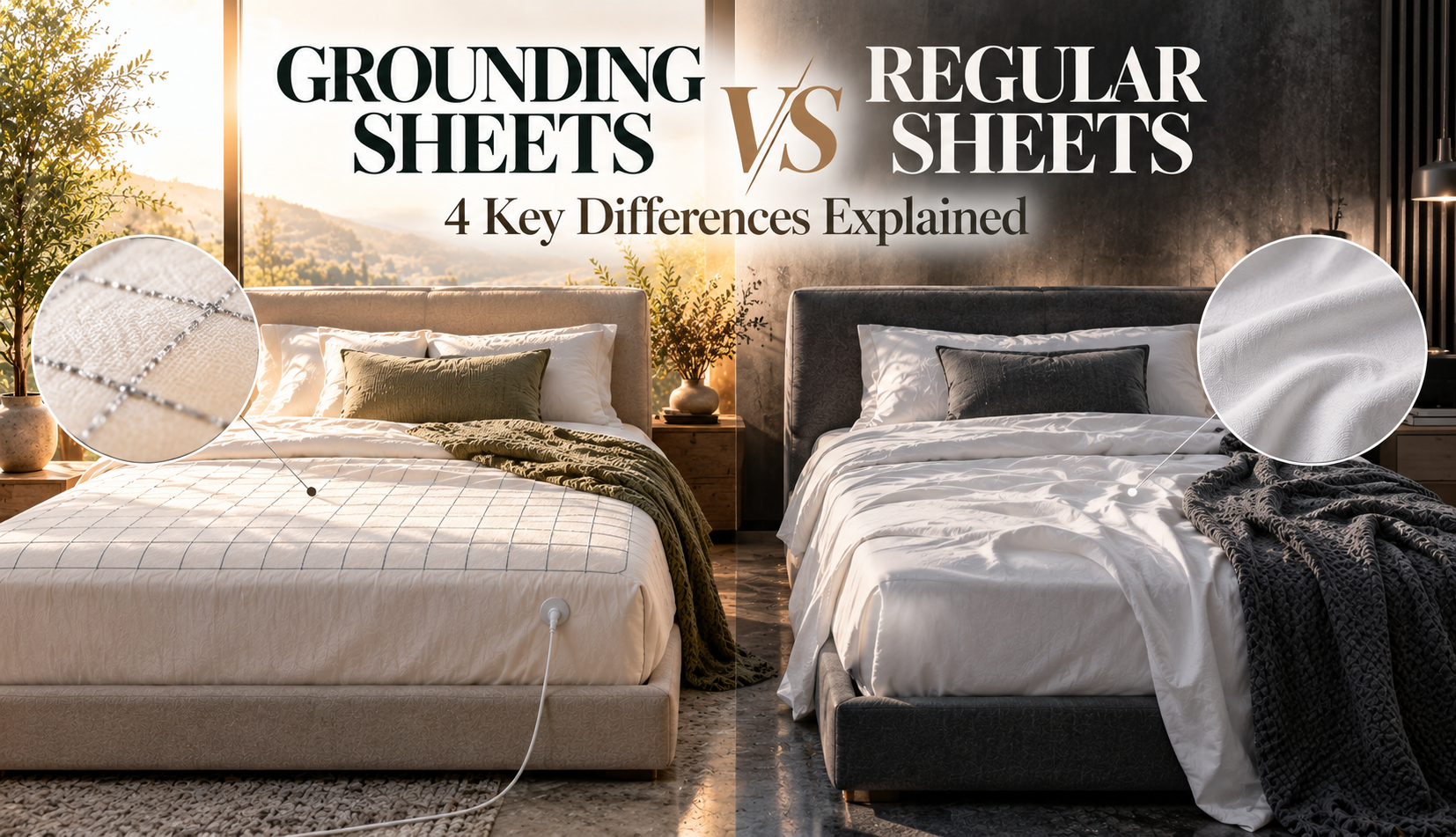
A grounding sheet changes one thing: it makes the surface you sleep on electrically conductive. Silver fiber — woven into the cotton at 5% to 10% of the total thread count — creates a continuous conductive grid across the fabric. A cord connects the sheet to the ground port of a standard three-prong outlet (the round hole at the bottom). No electricity flows through the sheet. Instead, it gives electrons from the Earth's surface a pathway to reach your body through skin contact.
This is the same principle as walking barefoot on grass or sand — but delivered through your bedding, for 7–8 hours every night, without changing your routine.
The question isn't whether the sheet conducts — a multimeter proves that in seconds. The question is whether that conductivity does anything meaningful to your body while you sleep. That's where the research comes in.
🌿 The Grounding Sheet I Use: GroundingWell™ Bedsheet
🌿 Ready to Feel the Difference?
GroundingWell™ Bedsheet: $99.90 (50% off). 95% organic cotton + 5% silver. Free shipping. 90-day money-back guarantee. Try it risk-free for 90 nights.
4 Science-Backed Differences Worth Knowing
① Conductivity: One Connects You to the Earth, the Other Blocks It
This is the foundational difference — and it's the one you can verify at home with a $15 multimeter.
A regular sheet — cotton, polyester, bamboo, microfiber — is an electrical insulator. Place a multimeter probe on one side and the other on your skin: zero conductivity. The sheet creates a barrier between your body and anything electrically conductive beneath it. You could sleep on a copper plate, and a cotton sheet between you and the plate would block the connection completely.
A grounding sheet is electrically conductive. Silver fibers woven into the cotton create pathways for electrons to travel between the sheet's surface and its grounding cord. Touch the sheet with one multimeter probe and the ground port with the other: continuous conductivity, typically reading 0.5–2.0 volts of body voltage reduction.
Why this matters: the Earth's surface carries a natural negative electrical charge — a reservoir of free electrons. When your body is in conductive contact with the ground (barefoot on grass, or sleeping on a conductive sheet plugged into ground), those electrons flow into your body. When you're insulated from the ground (wearing rubber-soled shoes, sleeping on cotton sheets on an elevated bed), that electron transfer doesn't happen.
This isn't theory — it's basic physics. The question is what those electrons do once they reach your body. That's where the next three differences come in.
② Cortisol Regulation: One Helps Normalize Your Stress Hormone Rhythm
Cortisol is the body's primary stress hormone. In a healthy circadian rhythm, cortisol peaks in the morning (helping you wake up alert) and drops to its lowest point around midnight (helping you sleep deeply). When this rhythm is disrupted — by chronic stress, blue light exposure, irregular schedules — cortisol stays elevated at night, making it harder to fall asleep, harder to reach deep sleep stages, and harder to wake up feeling rested.
What the research found: A 2004 study published in the Journal of Alternative and Complementary Medicine (Ghaly & Teplitz) measured cortisol levels in 12 participants who slept grounded for 8 weeks. The results: grounding during sleep resynchronized cortisol secretion toward a more normal circadian profile. Peak cortisol shifted closer to the expected morning high. Nighttime cortisol levels dropped. Participants reported improvements in sleep quality, pain, and stress.
The limitation: 12 participants is a small sample. The study relied partly on self-reported outcomes. But the cortisol measurements were objective, and the pattern — normalized circadian cortisol — is consistent with the mechanism of electron transfer reducing physiological stress.
Regular sheets: No mechanism to influence cortisol. Cotton and polyester are electrically inert — they don't interact with your body's electrical or hormonal systems. A regular sheet's contribution to sleep quality is limited to temperature regulation and tactile comfort. Both important — but neither addresses the hormonal patterns that determine how deeply you actually sleep.
③ Inflammation Response: One Gives Your Body Access to Free Electrons
Chronic low-grade inflammation is linked to nearly every modern health concern: poor sleep, slow recovery, joint stiffness, brain fog, accelerated aging. The body produces inflammation through reactive oxygen species (free radicals) — positively charged molecules that damage cells when unchecked.
The electron transfer theory proposes that free electrons from the Earth — delivered through conductive contact — can neutralize these free radicals, acting as a natural antioxidant at the cellular level. When your body is electrically grounded, it has access to an essentially unlimited supply of negatively charged electrons. When it's insulated (sleeping on regular sheets, wearing rubber-soled shoes), it doesn't.
What the research found: A 2015 review published in the Journal of Inflammation Research (Oschman, Chevalier & Brown) examined multiple grounding studies using thermal imaging, blood markers, white blood cell counts, and pain assessments. The review found evidence of reduced inflammation markers in grounded subjects compared to ungrounded controls. The authors described grounding as potentially “the most natural and accessible anti-inflammatory available.” Specific findings included reduced delayed-onset muscle soreness (DOMS) after exercise and improved white blood cell profiles.
The limitation: The review compiled smaller studies, none individually large enough to be definitive. The thermal imaging results were compelling but limited in participant count.
Regular sheets: No electron transfer. No mechanism to interact with free radicals, inflammation markers, or immune response. A regular sheet's physical contact with your skin is pure insulation — comfortable insulation, but insulation nonetheless. A high-quality regular sheet and a grounding sheet may feel similar against your skin, but electrically and biologically, they're doing completely different things during those 7–8 hours you spend sleeping.
④ Measurable Sleep Outcomes: One Has Clinical Trial Data
The strongest evidence against the “it's just placebo” argument came in 2025: a randomized, double-blind, placebo-controlled trial — the gold standard of clinical research design.
Study design: 60 participants were randomly assigned to either a grounding mat or a sham (non-grounding) mat that looked and felt identical. Neither participants nor researchers knew which group had the active device. This eliminates placebo bias — if grounding were pure placebo, both groups would show similar improvement.
Results: The grounded group showed statistically significant improvements in insomnia severity (measured by the Insomnia Severity Index), daytime sleepiness (Epworth Sleepiness Scale), perceived stress, and total sleep time — compared to the sham group. These are validated clinical instruments, not subjective reports. The sham group showed some improvement too (as expected in any sleep study), but the grounded group improved significantly more.
The limitation: 60 participants. Larger replication studies are needed. The study used grounding mats rather than grounding sheets specifically (same mechanism, different form factor).
Regular sheets: No clinical trial has ever tested whether a regular sheet — at any thread count, any material, at any price — improves insomnia severity, daytime sleepiness, or total sleep time beyond comfort-related effects. Because there's no mechanism to test. A regular sheet's job is to be soft, breathable, and temperature-appropriate. A grounding sheet does all of that, plus provides a conductive connection with published clinical data behind it.
What I Actually Noticed Switching From Regular Sheets
I want to be honest about this: I didn't expect much. I'd been sleeping on a solid set of 400-thread-count organic cotton sheets from a well-reviewed brand. They were comfortable, breathable, and I had no complaints about the fabric itself. The GroundingWell Bedsheet strip sits underneath my regular top sheet, so the tactile experience of going to bed didn't change at all.
Week 1: The only thing I could confirm was conductivity — my body voltage dropped from ~2.5V to ~0.05V when measured with a multimeter while lying on the grounding strip. That's not a feeling; it's a reading. But it confirmed the sheet was functioning. I didn't notice any subjective difference in sleep quality that first week.
Weeks 2–3: This is when things shifted. I started waking up before my alarm — not groggy, but actually alert. My wearable showed a small but consistent increase in deep sleep percentage (from ~17% to ~22%). Morning stiffness in my lower back, which I'd been attributing to my mattress, reduced noticeably. I hadn't changed anything else — same mattress, same pillow, same routine.
Week 4+: The deep sleep improvement plateaued (which I'd expect — the body adapts), but the morning alertness and reduced stiffness persisted. What convinced me it wasn't placebo: I had my partner — who didn't know which sheet position was grounded — sleep with feet on the strip for two weeks, then off it for two weeks. He reported sleeping “heavier” during the grounded weeks, unprompted. He hadn't been told what to look for.
Would a different brand of $50 regular sheets have done this? I don't think so. The regular sheets I was already using were quality. What changed was the electrical connection — the one thing regular sheets can't provide, regardless of thread count or material.
✅ What Grounding Sheets Do That Regular Sheets Can't
Electrical conductivity: Silver fiber creates a measurable conductive pathway between your body and the Earth's grounding system. Verified with a multimeter. Regular sheets are insulators — zero conductivity.
Published cortisol data: Peer-reviewed research (Ghaly & Teplitz, 2004) shows grounding during sleep normalizes cortisol circadian rhythm. No regular sheet has any mechanism to influence hormone patterns.
Inflammation research: Multiple studies reviewed in the Journal of Inflammation Research (2015) found reduced inflammation markers in grounded subjects. Regular sheets don't interact with free radicals or immune markers.
Clinical trial support: A 2025 randomized, double-blind, placebo-controlled trial found grounding improved insomnia severity, sleepiness, and total sleep time vs. sham. No comparable trial exists for regular sheets.
Passive, 7–8 hours nightly: The grounding connection works while you sleep — no active effort, no supplements, no devices to charge. Regular sheets provide comfort. Grounding sheets provide comfort plus a biological interface.
⚠️ Where Regular Sheets Still Win
Fabric variety: Regular sheets come in cotton, linen, bamboo, silk, Tencel, flannel, jersey, and dozens of blends. Each has a distinct feel, breathability, and temperature profile. Grounding sheets are currently limited to cotton-silver blends.
Longevity: Quality regular sheets last 2–3 years with no performance degradation. Grounding sheets maintain conductivity for 12–18 months with proper care — the silver fibers oxidize gradually with washing and body contact. You'll replace a grounding sheet sooner.
Price range: Regular sheets span $20 to $500+, fitting any budget. Grounding sheets start around $80 and go up. If your only concern is a comfortable sleeping surface, regular sheets offer more options at every price point.
No care restrictions: Most regular sheets tolerate hot water, bleach, and high-heat drying. Grounding sheets require cold or warm water, no bleach, no fabric softener, and low-heat or air drying to preserve the silver fibers. If you want zero-maintenance bedding, regular sheets are simpler.
Full Comparison Table
| Criteria | ⭐ Grounding Sheet (GroundingWell) | Regular Sheet (Any Brand) |
|---|---|---|
| Material | 95% organic cotton + 5% silver | Cotton, polyester, bamboo, etc. |
| Conductivity | ✅ Measurable (multimeter-verified) | ❌ Zero — electrical insulator |
| Cortisol Effect | Published study: normalized rhythm | No mechanism |
| Inflammation Data | Peer-reviewed review: reduced markers | No mechanism |
| Clinical Trial | 2025 RCT: improved sleep metrics | No trial data |
| Price | $99.90 (GroundingWell) | $20–$500+ |
| Lifespan | 12–18 months (conductivity) | 2–3 years |
| Cost Per Night (12 mo) | $0.27/night | $0.05–$0.45/night |
| Care Requirements | Cold/warm wash, no bleach, no softener | Most tolerate hot water & bleach |
| Fabric Variety | Cotton-silver only | Cotton, linen, bamboo, silk, blends |
| Overall | 🏆 Comfort + biological function | Comfort only |
Who Should Try a Grounding Sheet
People who sleep fine on comfortable sheets but still wake up tired — if your mattress and bedding are already good but you're still not getting restorative sleep, the issue may not be comfort. A grounding sheet addresses the electrical connection that premium sheets at any price point cannot provide.
Anyone interested in recovery optimization — athletes, weekend warriors, or anyone dealing with post-workout soreness or stiffness. The inflammation research is specifically relevant here: reduced DOMS and improved recovery markers were among the findings in grounding studies.
High-stress professionals — if cortisol dysregulation is a likely factor in your sleep quality (high-pressure work, irregular hours, chronic stress), the cortisol normalization data is directly relevant. A grounding sheet works passively during the 7–8 hours you're already sleeping — no meditation app, no supplement, no additional routine.
Anyone who wants to test grounding without changing their routine — a grounding sheet strip goes underneath your existing bedding. You don't have to walk barefoot, buy a separate device, or block out time. It integrates into what you already do every night.
Who Should Stick With Regular Sheets
People who need maximum fabric variety — if you specifically want silk, linen, flannel, or bamboo sheets for their unique texture and temperature properties, the grounding sheet market doesn't offer those fabrics yet. If fabric feel is your top priority, a grounding sheet won't match a luxury silk set.
People with diagnosed sleep disorders requiring medical treatment — as Dr. John Saito notes, if you have untreated sleep apnea or another structural sleep disorder, a grounding sheet won't address the root cause. Get the medical issue treated first. Grounding sheets are a complement to good sleep hygiene, not a substitute for clinical treatment.
Anyone on a very tight budget who needs new bedding now — if you're choosing between a $30 regular sheet you need and a $100 grounding sheet you want, get the regular sheet. A grounding sheet is an optimization layer, not a necessity. Come back to it when the budget allows.
🏆 Final Verdict
Regular sheets do one thing: provide a comfortable sleeping surface. Grounding sheets do that, plus create a measurable electrical connection to the Earth's surface — one backed by a 2004 cortisol study, a 2015 inflammation review, and a 2025 randomized controlled trial showing improved sleep metrics vs. sham.
The research isn't definitive yet — sample sizes are small and the field needs larger independent trials. But the direction is consistent, the mechanism is physically sound, and the 2025 double-blind trial addresses the placebo concern directly.
At $0.27 per night with a 90-day money-back guarantee, a GroundingWell Bedsheet is one of the lowest-risk ways to test whether grounding makes a noticeable difference in your sleep. If it doesn't — you're covered. If it does — you've added something to your sleep environment that no regular sheet, at any price, can replicate.
🌿 $0.27/Night. 90-Day Guarantee. The Science Is Pointing Somewhere.
GroundingWell™ Bedsheet: $99.90 (50% off). 95% organic cotton + 5% silver.
Try it risk-free — if you don't feel a difference in 90 nights, full refund.
Frequently Asked Questions
Do grounding sheets actually work differently than regular sheets?
Yes — the difference is measurable. Grounding sheets contain conductive silver fibers connected to your home's grounding system. A multimeter confirms the conductivity. Whether that translates to health benefits is supported by early clinical research (2004 cortisol study, 2015 inflammation review, 2025 RCT), though larger studies are needed.
What makes grounding sheets conductive?
Silver fiber woven into the fabric — typically 5% to 10%. Silver is highly conductive and creates a continuous grid. A cord connects the sheet to the ground port of a standard outlet. No electricity flows through the sheet — it simply gives Earth's electrons a path to reach your body through skin contact.
Is there real science behind grounding sheets?
Yes — published, peer-reviewed research exists. Key studies: Ghaly & Teplitz (2004) on cortisol normalization, Oschman et al. (2015) on inflammation reduction, and a 2025 double-blind RCT showing improved insomnia severity and total sleep time vs. sham. The research direction is consistent, though sample sizes are small.
Can grounding sheets help with inflammation?
The mechanism is electron transfer — free electrons from the Earth neutralize positively charged free radicals associated with inflammation. The 2015 Journal of Inflammation Research review found reduced inflammation markers in grounded subjects, including reduced delayed-onset muscle soreness. Regular sheets block this pathway entirely.
Do grounding sheets affect cortisol levels?
A 2004 study found grounding during sleep resynchronized cortisol toward a normal circadian profile — morning peaks and lower nighttime levels. Participants reported improved sleep, reduced pain, and less stress. Regular sheets have no mechanism to influence cortisol patterns.
How long do grounding sheets last compared to regular sheets?
Grounding sheets maintain conductivity for 12–18 months with proper care. Regular sheets last 2–3 years. The per-night cost: GroundingWell at $99.90 over 12 months = $0.27/night — less than a daily supplement, with measurable sleep and recovery benefits regular sheets can't provide.
Are expensive regular sheets better for sleep than grounding sheets?
They solve different problems. A $300 Egyptian cotton sheet improves comfort (softness, breathability, temperature). A $99.90 grounding sheet adds a conductive connection with published data on cortisol, inflammation, and sleep metrics. If your issue is comfort, upgrade your regular sheets. If it's systemic (poor recovery, disrupted sleep patterns), a grounding sheet addresses what no regular sheet can.
Which grounding sheet should I try first?
I recommend GroundingWell — 95% organic cotton + 5% silver, universal fit (any bed size), $99.90 (50% off), 90-day money-back guarantee, 4.0/5 Trustpilot with 4,016 verified reviews. The 2-pack deal ($159.90 + free mat) is the best value if buying for a household.




 Top Picks