
By Kate Morrison, Beauty & Wellness Product Editor · Rating: 4.6/5 ⭐⭐⭐⭐⭐ · 9 min read
“In consumer product testing, the budget-vs-premium question in the shower filter category is one of the most misunderstood by shoppers because the price difference is dramatic but the spec difference is often understated in marketing. Here is the honest way to think about it. A budget shower filter in the $35–$60 range typically uses activated carbon as the primary filtration medium, with a small amount of KDF mixed in. Carbon filters are effective — genuinely effective — at removing chlorine at the temperatures used in water treatment testing, which is typically room temperature or below. But shower water is not room temperature. It's 100 to 110 degrees Fahrenheit for most people, and at those temperatures, carbon adsorption efficiency drops significantly — in some studies by 40 to 60 percent. This doesn't mean the budget filter does nothing. It does something. But it's doing something closer to 40 to 60 percent of what the lab tests that support its marketing claims demonstrate. A KDF-primary filter like the Jolie avoids this problem because the redox chemistry that removes chlorine doesn't depend on adsorption surface area in the same way. The upfront cost difference between a budget filter and a KDF-primary filter is real. So is the performance gap at shower temperatures. The question every buyer should ask themselves is not ‘is the expensive one better' but ‘at the temperatures I actually shower at, how much of the budget filter's rated performance am I actually getting?'”
— Marcus Webb, independent consumer product researcher and former senior product analyst at a major US consumer testing organization, with 11 years evaluating home water treatment products
The Real Question: Is the Price Gap Worth It?
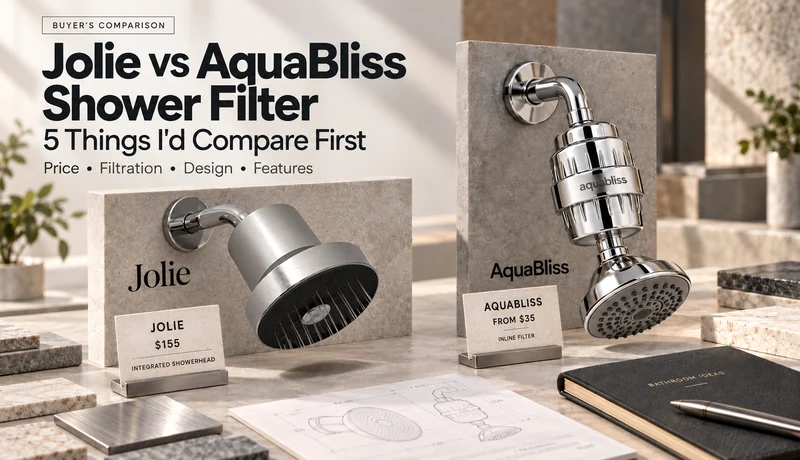
The price difference between AquaBliss and Jolie is not subtle. AquaBliss starts at $35 and tops out around $60. Jolie is $155 at jolieskinco.com — a gap of $95 to $120 upfront depending on which AquaBliss model you compare. That's a real difference, and it deserves a real answer rather than a vague “you get what you pay for.”
I've used both products for extended periods in my own bathroom. The five comparisons below are what I'd want to know before making the choice — not the marketing claims, but the actual differences that show up in everyday use. The answer isn't always “buy the expensive one.” There are real situations where AquaBliss is the right call.
Brand Overview: Jolie vs AquaBliss
💧 Jolie — Premium DTC
New York. Single product: fixed filtered showerhead. KDF-55 + calcium sulfite — hot-water effective filtration. $155 showerhead at jolieskinco.com. $25 replacement cartridge / 3 months. ~$100/year filters. 4 premium finishes. No handheld, no multi-spray. DTC only.
Position: premium, aesthetics-forward, hot-shower optimized.
💧 AquaBliss — Budget Accessible
Amazon-native brand. Multiple models: fixed, handheld, combo, high-output. Multi-stage carbon/KDF/ceramic/vitamin C blend. $35–$60 showerhead. $15–$20 replacement filter / 2–3 months. Up to $90–$120/year filters. Chrome and white finishes. Available on Amazon, broad retail. Multiple spray settings standard.
Position: accessible, versatile, budget-first, broad availability.
5 Things I'd Compare First
① What the Filter Actually Does at Your Shower Temperature
This is the comparison I'd make first because it most directly determines results on your hair and skin — and it's the one most buyer comparisons skip entirely in favor of listing filter “stages” and contaminant lists.
AquaBliss uses a multi-stage blend of activated carbon, KDF, ceramic, and in some models vitamin C. Carbon is the primary workhorse for chlorine removal in this blend. The problem, as Marcus Webb described above, is that carbon's chlorine adsorption efficiency drops significantly at the temperatures of a typical hot shower. The rating on the box — usually something like “removes 91% of chlorine” — is typically measured at room temperature, not at 105°F. At actual shower temperature, the real-world chlorine removal rate is meaningfully lower.
Jolie uses KDF-55 and calcium sulfite exclusively. Both work through redox chemistry rather than adsorption — the filtration mechanism is not meaningfully affected by water temperature in the residential shower range. If you shower warm (below 90°F), the performance gap between AquaBliss and Jolie is smaller. If you shower hot — which is most people — Jolie is doing substantially more work per gallon.
⚖️ Edge: Jolie — for hot showers specifically, the performance gap is real and the mechanism is documented.
② The Real Price — Upfront and Over Two Years
The $35 AquaBliss versus $155 Jolie comparison is the headline, and it's real — $120 upfront is a significant gap. But filter replacement costs change the picture over time.
AquaBliss filter cartridges cost approximately $15–$20 each, with a recommended replacement cycle of 2–3 months. At a 2-month cycle (common in high-chlorine cities or high-use households), that's 6 cartridges per year at $15–$20 each — $90–$120/year in filter costs. At 3 months, it's $60–$80/year. Add the $35–$60 showerhead, and AquaBliss year one ranges from $95 (best case) to $180 (worst case).
Jolie: $155 showerhead plus $100/year in filters = approximately $255 year one. Year two onwards: $100/year for Jolie versus $60–$120/year for AquaBliss. By year two, the total cost of ownership gap has narrowed considerably — sometimes to under $50 — and by year three, some AquaBliss configurations will have cost more in total than the Jolie.
⚖️ Edge: AquaBliss upfront. Narrows significantly by year 2. See the cost table below for the full math.
③ Design — Whether It Matters for Your Bathroom
AquaBliss comes in chrome and white, with a showerhead form factor that reads as generic — functional, inoffensive, looks like a hardware store showerhead with a filter chamber attached. Nothing wrong with this, but it doesn't add to the room.
Jolie comes in Brushed Steel, Chrome, Matte Black, and Brushed Gold. The weight and finish quality is that of a premium fixture, not a filter product. Whether this matters depends entirely on your bathroom and your priorities. In a bathroom with consistent hardware finishes or any aesthetic consideration at all, the Jolie fits. The AquaBliss in chrome is fine anywhere but distinctive nowhere.
⚖️ Edge: Jolie — not a filtration factor, but a real everyday-use factor.
④ Versatility — Handheld, Multi-Spray, and Availability
AquaBliss wins this category cleanly and without contest. Their product line includes fixed showerheads, handheld units, high-output models, and combo fixed+handheld sets with a diverter valve. Multiple spray modes — typically rain, massage, and mist — are standard across the line. AquaBliss is available on Amazon with Prime shipping and at many physical retailers.
Jolie is a single fixed showerhead in four finish options, with one spray pattern, sold exclusively at jolieskinco.com. No handheld. No combo. No multi-spray. If any of those things matter to your setup — children, pets, accessibility needs, a preference for a massage setting after workouts — AquaBliss is simply the right answer regardless of the filtration comparison.
⚖️ Edge: AquaBliss — comprehensively, and not close. For handheld or multi-spray needs, AquaBliss is the only answer.
⑤ What Happens If You've Already Tried AquaBliss and Were Underwhelmed
This is the comparison that brings a lot of people to this article in the first place. They bought the AquaBliss — usually from Amazon after seeing positive reviews — and the results were: some improvement in chlorine smell, possibly some reduction in skin tightness, but persistent frizz, ongoing brassiness in color-treated hair, or the feeling that the filter helped a little but not as much as the reviews implied.
In most cases, the answer is yes — Jolie would do more. The AquaBliss likely was helping, but at the temperatures of a hot shower, it was delivering something closer to half its rated chlorine removal. The partial results were real — just not the full results the filter is rated for at lower temperatures. Switching to a KDF-primary filter like Jolie in those cases typically produces a noticeable further improvement: less frizz, better color hold, more complete post-shower skin feel, and the complete absence of the residual chlorine smell that often persists with carbon-based filters in hot water.
⚖️ Edge: Jolie — specifically for buyers upgrading from AquaBliss who saw partial but not complete results.
Tried a budget filter and got partial results? The medium is the reason.
Jolie filtered showerhead — KDF-55 filtration, effective at hot shower temperatures. 4 premium finishes. jolieskinco.com.
Full Head-to-Head Comparison
| Feature | Jolie | AquaBliss | Edge |
|---|---|---|---|
| Showerhead price | $155 | $35–$60 | AquaBliss |
| Filtration medium | KDF-55 + calcium sulfite | Carbon + KDF + ceramic + vit C | Jolie (hot water) |
| Hot water effectiveness | ✅ Full (redox) | ⚠️ Reduced (carbon-heavy) | Jolie |
| Removes chloramines | ✅ Yes (fully, hot water) | Partial (KDF portion only) | Jolie |
| Filter life | ~3 months | ~2–3 months | Tie |
| Cartridge cost | ~$25 | ~$15–$20 | AquaBliss |
| Annual filter cost | ~$100 | ~$60–$120 | Varies by cycle |
| Year 1 total cost | ~$255 | ~$95–$180 | AquaBliss |
| Year 2 total cost | ~$100 | ~$60–$120 | AquaBliss (best case tie) |
| 2-year cumulative | ~$355 | ~$155–$300 | AquaBliss ($55–$200 cheaper) |
| Design quality | Premium (4 finishes) | Basic (chrome/white) | Jolie |
| Handheld option | ❌ No | ✅ Yes | AquaBliss |
| Multi-spray settings | ❌ Single mode | ✅ Multiple modes | AquaBliss |
| Retail availability | DTC only (jolieskinco.com) | Amazon, broad retail | AquaBliss |
| Visual filter indicator | ✅ Color change | ❌ Calendar only | Jolie |
| Hair results (hot showers) | More consistent | Partial at hot temps | Jolie |
What I Actually Noticed Switching Between Them
📅 Months 1–3: AquaBliss SF220
I started with the AquaBliss SF220 — one of their most popular models, five spray settings, chrome finish, $45 on Amazon. The first noticeable difference was a mild reduction in the chlorine smell during warm showers. My skin felt slightly less tight after moderate-temperature showers. Hair texture improved somewhat on days when I washed at lower temperatures. On the days I showered hot, the improvement was noticeably less pronounced. I attributed it to seasonal dry air. I was partly right — but the shower temperature was the more significant variable I wasn't accounting for.
📅 Week 1 After Switching to Jolie
The first thing I noticed was the complete elimination of the chlorine smell even at maximum hot water temperature — something the AquaBliss had never fully achieved. Water texture felt softer and less sharp. Shampoo lather was noticeably richer with the same product volume. My skin after showering felt different — not stripped, not urgently needing moisturizer. The difference was most dramatic on hot shower days — exactly the days the AquaBliss had been least effective.
📅 Weeks 2–4: Incremental and Consistent Improvement
By week two, hair frizz had reduced beyond the AquaBliss baseline — specifically the surface frizz that had improved slightly with AquaBliss but hadn't resolved. My color — balayage highlights — looked noticeably less brassy at the four-week mark than it typically did at the same point with the AquaBliss. By week four, the skin tightness that had partially improved with AquaBliss was almost entirely gone. Every metric that had improved somewhat with AquaBliss improved further and more reliably with Jolie.
📅 What I Miss From AquaBliss
The massage spray setting — I used it after particularly intense workouts and it's not available on the Jolie. Also the lower ongoing cost. What I don't miss: the partial results at hot temperatures, the functional-but-generic look in my bathroom, and the residual chlorine smell that was always present when the water ran hot.
The 2-Year Cost Math: Closer Than You Think
| Scenario | Jolie 2-yr Total | AquaBliss 2-yr Total | 2-yr Gap |
|---|---|---|---|
| Best case AquaBliss (3-mo cycle, $15 filter) | $355 | $155 | AquaBliss $200 cheaper |
| Mid case (3-mo cycle, $20 filter) | $355 | $220 | AquaBliss $135 cheaper |
| Heavy use (2-mo cycle, $20 filter) | $355 | $300 | AquaBliss $55 cheaper |
The two-year cost gap ranges from $55 to $200 depending on your usage and filter cycle. In the heavy-use AquaBliss scenario, the gap narrows to $55 over two years — about $2.30 per month. At that point, the decision is almost entirely about filtration performance and design rather than cost.
Choose Jolie If…
- You shower hot and hair/skin results matter most — the KDF-only medium is the only shower filter approach that maintains full effectiveness at the temperatures most hot-shower users actually use.
- You have color-treated, highlighted, or bleached hair — chlorine oxidizes pigment, and consistent removal in hot water is what protects color.
- You've already tried AquaBliss or a similar budget filter and got partial results — the partial results you saw are consistent with a carbon-heavy filter in hot water. Jolie is the logical upgrade. Available at jolieskinco.com.
- Your bathroom has a design standard you want to maintain — Brushed Steel, Matte Black, Brushed Gold, and Chrome all look like fixtures rather than filter attachments.
- The 2-year cost math works for you — at worst, Jolie costs $55 more over two years than the heaviest AquaBliss usage scenario.
Choose AquaBliss If…
- Budget is the primary constraint — $35–$60 upfront vs $155 is a real difference that the 2-year math doesn't fully close for at least 18 months.
- You need a handheld option — AquaBliss makes handheld and combo units; Jolie does not exist in that form factor.
- You shower warm rather than hot — below 90°F, the carbon performance gap between AquaBliss and Jolie narrows significantly.
- You want to try a filtered showerhead before committing to a premium product — AquaBliss is a genuinely decent entry point. If you see meaningful results at warm temperatures, upgrading to Jolie later is a logical progression.
- Multi-spray settings matter to you — rain, massage, mist options are standard on AquaBliss and unavailable on Jolie.
- You want Amazon convenience and easy returns — Prime shipping and broad retail access make AquaBliss lower commitment to try.
⭐ Final Verdict: Jolie vs AquaBliss Shower Filter
Five things to compare first, and the decision comes down to this: AquaBliss is a good filter that delivers real results at warm temperatures and a lower upfront cost. Jolie is a better filter for hot showers, better-designed, and more consistent across the full range of shower temperatures — at a price premium that narrows considerably over 2 years but never fully disappears.
If you shower hot, have color-treated or damaged hair, or have already tried AquaBliss and seen partial results — Jolie is the logical choice. The temperature-performance gap is real, documented, and consistent with what I observed switching between the two products.
If you're budget-constrained, need a handheld, prefer multi-spray, or want to try filtered shower water before committing to a premium product — AquaBliss is a solid starting point, not a consolation prize.
Hot shower + hair and skin priority → Jolie at jolieskinco.com. Budget + versatility → AquaBliss.
The filter that works at your actual shower temperature.
Jolie — KDF-55 + calcium sulfite, hot-water effective. 4 premium finishes. Tool-free install. jolieskinco.com.
Frequently Asked Questions
Is Jolie or AquaBliss better for hair and skin?
Jolie for hot showers — KDF-55 maintains full chlorine removal effectiveness at 100–110°F where AquaBliss's carbon component degrades. For warm showers the gap narrows; for hot showers the gap is real and consistent.
Is AquaBliss a good shower filter?
Yes — genuinely good at warm temperatures with a large satisfied user base. Best for budget-conscious buyers, handheld requirements, multi-spray preference, or warm shower users. Partial results at hot temperatures is the main limitation.
How much does AquaBliss cost compared to Jolie?
AquaBliss: $35–$60 showerhead + $60–$120/year filters = $95–$180 year one. Jolie: $155 + $100/year filters = ~$255 year one. The 2-year gap ranges from $55 to $200 depending on your AquaBliss usage cycle.
Does AquaBliss remove chloramines?
Partially — through the KDF component only. Carbon doesn't remove chloramines and degrades in hot water. Jolie's KDF-55 removes chloramines effectively in hot water.
How long does the AquaBliss filter last?
~2–3 months at $15–$20 per cartridge. At 2-month cycle: $90–$120/year. At 3-month cycle: $60–$80/year. Jolie: ~3 months at $25, ~$100/year.
Which shower filter is easier to install?
Both are tool-free, ~2–5 minutes, standard 1/2-inch connection. Neither requires a plumber or permanent modifications. Both are renter-friendly. Installation is effectively a tie.
Is Jolie worth upgrading to if I already tried AquaBliss?
Yes — if you saw partial results with AquaBliss (some improvement but persistent frizz, brassiness, or skin issues), the most likely cause is the carbon medium's hot-water limitation. Jolie's KDF-only approach delivers more complete chlorine removal at hot shower temperatures.
Where can I buy Jolie?
Exclusively at jolieskinco.com → DTC only — not available at Amazon, Target, or other retailers.



 Top Picks