

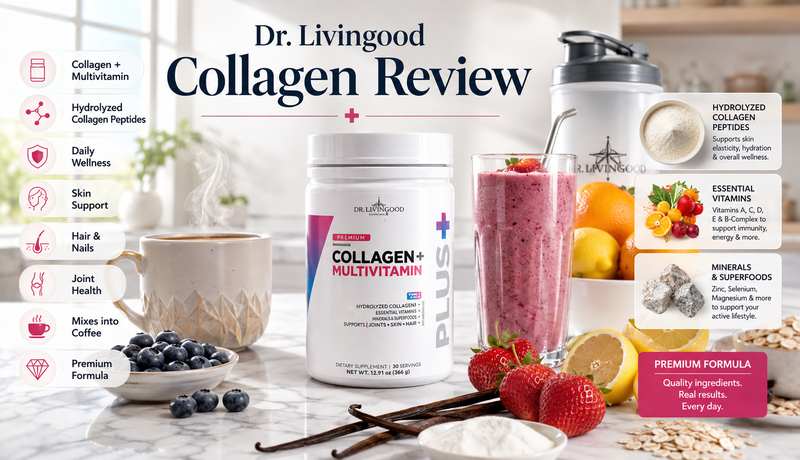
By Rachel Kim · 11 min read · Rating: 4.5/5 ⭐⭐⭐⭐⭐ · Keyword: dr livingood collagen
Rachel Kim
Health & Wellness Writer · Tested Livingood Daily Vanilla Collagen daily for 4 weeks · Reviewed for accuracy by our editorial wellness research team
Disclaimer: This article is for informational purposes only and does not constitute medical advice. Consult a healthcare professional before starting any new supplement.
Table of Contents
“We didn't want to just throw collagen in a tub and call it a day. That's why our Collagen has Vitamin C and organic pea protein built in — your body actually needs that Vitamin C to make use of the amino acids you're giving it, and most collagen powders skip that step entirely.”
— Dr. Blake Livingood, D.C., Founder of Livingood Daily
For independent context: the Academy of Nutrition and Dietetics notes that collagen supplements don't deliver intact collagen to skin or joints — they provide building blocks the body may use for its own collagen production, with benefits typically showing after 8–12 weeks of consistent use (source: eatright.org).
What Is Livingood Daily Collagen?
I've tried enough collagen powders at this point to have a drawer full of half-finished tubs — mostly because they either tasted chalky, clumped up in my coffee, or just didn't feel worth the price once I did the math per scoop. When Livingood Daily's collagen kept showing up in my research for the brand's broader supplement line, I wanted to know if it was actually formulated differently or just another private-label collagen with a founder's name on the tub.
It's part of the “nutrition” pillar in Dr. Blake Livingood's 5 Essentials framework, and it comes in Vanilla and Chocolate, sold both as a standalone Collagen powder and as a Collagen + Multivitamin combo. Each scoop (9.9g) delivers 9g of grass-fed, hydrolyzed bovine collagen peptides — Type I and Type III, the two types most associated with skin, hair, nails, and connective tissue — for $60.95 per 30-serving container.
The 5 Ingredients Worth Knowing About
1. Grass-Fed Hydrolyzed Bovine Collagen (Type I & III) — 9g
This is the core ingredient, sourced from grass-fed cattle and hydrolyzed so your body can absorb the amino acid chains more easily. Type I and III are the same collagen types most abundant in human skin and connective tissue, which is why they're the standard for beauty- and joint-focused collagen products.
2. Vitamin C (as Ascorbic Acid) — 75mg
Vitamin C is a required cofactor in your body's own collagen synthesis — without it, the collagen-building process stalls. A lot of collagen powders leave this out entirely and expect you to get it elsewhere. Building it into the formula is a legitimately smart formulation choice, not just a marketing add-on.
3. Organic Whole Pea Protein
Collagen protein is “incomplete” on its own — it's missing tryptophan, an amino acid your body can't produce. Adding organic pea protein rounds out the amino acid profile, which is a detail most competing collagen powders skip.
4. Himalayan Pink Salt
A small amount used to round out flavor and provide trace minerals. It's not a headline ingredient, but it's a clean-label choice over the processed sodium fillers you'll find in some cheaper powders.
5. Organic Stevia Leaf Extract
The sweetener of choice here, instead of sugar, sucralose, or sugar alcohols. It keeps the product keto- and paleo-friendly, though stevia's aftertaste is polarizing — more on that in the weaknesses section below.
Want to try the collagen formula for yourself?
My Real Experience: 4 Weeks Testing It
Week 1: I mixed one scoop of the Vanilla into my morning coffee, which is the real test for any collagen powder — a lot of them leave a grainy film on top. This one dissolved fully within about 10 seconds of stirring, no clumping. The stevia aftertaste was noticeable but not overwhelming, more like a mild sweetness that faded fast.
Week 2–3: This is where I started actually tracking something measurable: my nails. I'd had noticeably brittle, splitting nails for months (a side effect of a restrictive diet phase earlier in the year). By day 16, I'd gone two full weeks without a new split or break — the longest stretch I'd had since spring. I also noticed my skin felt less tight and dry by the end of week 3, though that's a much harder thing to quantify than a nail break.
Week 4 — the real test: I stopped for five days mid-week to see if I'd notice a difference. Nothing dramatic happened in that short window, which tracks with the research — collagen benefits build up over 8–12 weeks, not days. I went back on it and I'm continuing past the 4-week mark specifically to see if the nail improvement holds.
What I didn't experience: any noticeable change in fine lines or wrinkles at 4 weeks. That's expected — skin-elasticity benefits in the research take closer to 8–12 weeks, so I'm not going to claim a result I didn't actually see in this window.
What This Collagen Does Well
Vitamin C built into the formula. This is the detail that actually separates it from most competitors — your body needs Vitamin C to synthesize collagen, and a lot of powders make you source that separately.
A more complete amino acid profile. Adding organic pea protein to fill collagen's missing tryptophan is a thoughtful formulation choice, not just filler.
Genuinely good mixability. No grit, no film, dissolves in both hot and cold liquids.
Clean label. Grass-fed sourcing, no artificial sweeteners, gluten-free, keto- and paleo-friendly.
What to Know Before You Order
Less collagen per scoop than some competitors. At 9g per serving, this delivers less raw collagen than Vital Proteins' 20g scoop — you're trading collagen quantity for the added Vitamin C and protein.
Stevia isn't for everyone. If you're sensitive to stevia's aftertaste, it's worth trying a single-serving size before committing to the full 30-serving tub.
Price per serving runs mid-to-high. At roughly $2.03 per scoop, it's priced closer to premium collagen brands than budget options.
How It Compares to Other Collagen Brands
| Feature | Livingood Daily | Vital Proteins | Ancient Nutrition | Sports Research |
|---|---|---|---|---|
| Collagen per serving | 9g (Type I & III) | 20g (Type I & III) | 9g protein (5 collagen types) | 11g (Type I & III) |
| Vitamin C included | Yes, 75mg | Not in base formula | Yes, 200% DV (2 scoops) | Only in “Beauty” variant |
| Added protein source | Organic pea protein | None | Probiotics, no added protein | None |
| Sweetener | Organic stevia | Unflavored, none | Varies by SKU | Unflavored, none |
| Servings per container | 30 | 14–20 (varies by size) | 45 (unflavored) | 28–41 (varies by size) |
| Approx. price per serving | ~$2.03 | ~$1.93–$2.00 | ~$1.00–$1.50 | ~$1.00–$1.30 |
| Third-party tested | Yes | Yes | Yes | Yes |
If raw collagen grams per scoop is all that matters to you, Vital Proteins wins on volume. But gram-for-gram isn't the whole story — Livingood Daily's Vitamin C and pea protein additions mean you're getting a formula built around how collagen actually gets used by your body, not just a bigger number on the label. Ancient Nutrition and Sports Research are cheaper per serving, but neither pairs Vitamin C with collagen in their standard formula the way Livingood Daily does.
Who Should Buy This Collagen
This is a strong fit if you want a collagen powder that's already formulated with Vitamin C and complete protein rather than one you have to build a stack around yourself, you like a flavored powder over unflavored, and you're comfortable with stevia as a sweetener. It's also a good match if you're already using other Livingood Daily products and want your supplements to work as one system.
Maybe Wait If…
If maximizing raw collagen grams per dollar is your top priority, an unflavored option like Vital Proteins or Sports Research will get you more collagen per scoop for a similar or lower price. And if you've had a bad reaction to stevia before, it's worth sampling a single serving before buying the full container.
Final Verdict: 4.5/5
Livingood Daily's Collagen isn't the biggest scoop on the market, but it's one of the more thoughtfully formulated ones — pairing hydrolyzed Type I & III collagen with the Vitamin C and protein your body actually needs to make use of it. It mixes cleanly, tastes better than most stevia-sweetened powders, and fits neatly into a broader daily routine if you're already bought into the brand's approach. If you want maximum collagen grams at the lowest price, look elsewhere — but if you want a formula built with the full picture in mind, this earns its spot.
Ready to add a smarter collagen to your routine?
FAQ
What is in Dr. Livingood collagen protein powder?
Each scoop has 9g of grass-fed hydrolyzed bovine collagen peptides (Type I & III), 75mg of Vitamin C, organic whole pea protein, Himalayan pink salt, and organic stevia leaf extract as the sweetener.
How much collagen is in a serving of Livingood Daily Collagen?
One scoop (9.9g) provides 9g of hydrolyzed collagen peptides, delivering 20 amino acids, with 30 servings per container.
Is Dr. Livingood collagen grass-fed and gluten-free?
Yes. The collagen is sourced from grass-fed, hydrolyzed bovine collagen and the product is labeled gluten-free, keto- and paleo-friendly.
Why does Dr. Livingood collagen include Vitamin C?
Vitamin C is a required cofactor for the body's own collagen synthesis. Pairing 75mg of Vitamin C with collagen peptides is a formulation choice meant to support the body's ability to actually use the amino acids provided.
How does Dr. Livingood collagen compare to Vital Proteins?
Vital Proteins delivers more collagen per scoop (20g vs. 9g) but costs more per serving and doesn't include Vitamin C or added protein in its base formula. Livingood Daily's version includes Vitamin C and pea protein, giving it a more complete amino acid profile per scoop, though with less total collagen.
What flavors does Dr. Livingood collagen come in?
It's available in Vanilla and Chocolate, both sweetened with organic stevia rather than sugar or artificial sweeteners.
Is Dr. Livingood collagen third-party tested?
Livingood Daily says its products are manufactured in a GMP-certified U.S. facility and undergo regular third-party testing.
Can I mix Dr. Livingood collagen into coffee?
Yes. The powder is designed to dissolve in both hot and cold liquids, including coffee, and the recommended use is 1–2 scoops daily in 8–12oz of your beverage of choice.





 Top Picks