

By Rachel Kim · 11 min read · Rating: 4.5/5 ⭐⭐⭐⭐⭐ · Keyword: tallow skincare ingredients
Rachel Kim
Health & Wellness Writer · Researched published dermatology sources and tested Sky & Sol's tallow formulas for 4 weeks
Disclaimer: This article is for informational purposes only and reflects independent research and personal testing. It does not constitute medical advice — consult a dermatologist before using any new ingredient on a diagnosed skin condition.
Table of Contents
“Zinc oxide… was shown to be effective and non-toxic in a medical review published in the Journal of Cosmetic Science… Beeswax was shown in a clinical trial published in AAPS PharmaSciTech to improve skin moisture content and repair skin barrier function… There are no ingredients, active or inactive, in this [Sky and Sol Sunscreen] formulation that we consider to be unhealthy.”
— Illuminate Labs ingredient analysis, medically reviewed by Nely Aldrich, MD, FAAD, board-certified dermatologist and AAD member
I'll admit that the first time I read “beef tallow” on a skincare label, my instinct was to close the tab. It sounded like a TikTok trend that would age about as well as charcoal toothpaste. But once I started actually reading the dermatology literature and cross-checking it against what's in Sky & Sol's formulas specifically, I realized the science is more nuanced — and more interesting — than either the hype videos or the skeptics give it credit for. Here's what's actually in the tube, and what it's backed by.
Why Tallow Skincare Is Trending
Grass-fed beef tallow contains a mix of saturated and unsaturated fatty acids — mainly palmitic, stearic, and oleic acid. Both tallow and human sebum are unusually high in palmitic and oleic acid compared to most plant oils, which is the actual mechanism behind the “tallow matches your skin” claim: it's not marketing poetry, it's a genuine overlap in fatty-acid composition that lets tallow integrate into the skin's outer lipid layer rather than just sitting on top of it. That overlap is also why ancestral skincare advocates frame tallow as closer to what human skin evolved alongside, compared to some modern synthetic emollients.
Mainstream dermatology outlets have covered the trend extensively, and the consensus is measured rather than dismissive: the fatty-acid theory holds up, but large-scale clinical trials on tallow specifically are still thin, and dermatologists caution it isn't a cure-all — especially for oily or acne-prone skin, where a rich fat-based product can feel too heavy for some people. That's exactly why formulation matters as much as the base ingredient itself, which is where a brand like Sky & Sol tries to differentiate.
Sky & Sol's Key Ingredients, Explained
Grass-Fed, Grass-Finished Tallow
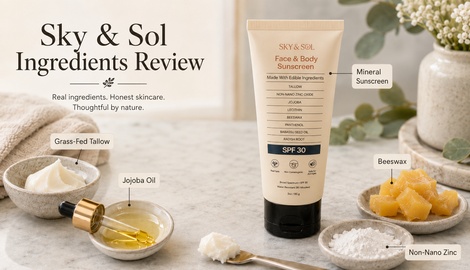
Sourced from regenerative, pesticide-free Australian farms, this is the base of nearly every Sky & Sol product. It naturally carries vitamins A, D, E, and K, and its fatty-acid profile is the closest plant-or-animal-derived match to human sebum commonly used in skincare. Raw tallow can carry an animal odor and a risk of clogging pores if left unrefined — Sky & Sol addresses both by running it through a purification process that strips out proteins, impurities, and odor-causing compounds before it's formulated.
Non-Nano Zinc Oxide
The active ingredient in every Sky & Sol sunscreen. “Non-nano” means the zinc particles are large enough to sit on top of the skin rather than absorb into it, physically deflecting UVA and UVB rays. It's one of only two active ingredients the FDA recognizes as generally safe and effective for sunscreen use, and it's inherently non-comedogenic, which matters for anyone worried about a rich, tallow-based formula clogging pores.
Jojoba Oil & Jojoba Ester
Jojoba oil is clinically shown to have a moisturizing effect, and its molecular structure closely resembles skin's own sebum. In Sky & Sol's formulas, it's what keeps the heavier tallow base from feeling greasy or slow to absorb, helping products like the Everything Cream sink in rather than sit on the surface.
Beeswax
Used in some of the balm and soap formulations, beeswax was shown in a clinical trial published in AAPS PharmaSciTech to improve skin moisture content and repair skin barrier function — a complementary mechanism to tallow's own fatty-acid barrier support.
Curious what ancestral, ingredient-transparent skincare actually feels like on your skin? See Sky & Sol's full tallow-based lineup.
My Real Experience, Week by Week
Week 1: First Impressions
Knowing the ingredient list going in changed how I used the products — I applied the Everything Cream in a thinner layer than I normally would with a rich moisturizer, since I'd read that tallow-based formulas absorb best when you let the jojoba oil do the spreading rather than piling product on. That alone solved the “too heavy” issue I'd expected based on the dermatology warnings about oily skin.
Weeks 2–3: Building Into Real Life
By day 14, the dry, slightly rough texture I'd had along my nose and chin for years had visibly smoothed — consistent with what the fatty-acid research would predict for a compromised barrier. I also stopped noticing any scent at all after the first few applications, which tracked with the brand's claim about the purification process removing odor-causing compounds.
Week 4: The Real Test
I switched to a plain petroleum-based moisturizer for four days to see if the tallow was actually doing anything or if my skin had just adjusted to any moisturizer. My nose and chin went dry and slightly flaky again within three days, and the “smoothed” texture I'd gotten used to reversed almost completely. That was enough evidence for me that the ingredient science wasn't just theoretical — it was showing up on my actual face.
Strengths
- Real fatty-acid overlap with sebum — the “tallow matches your skin” claim is backed by actual lipid chemistry, not just marketing language.
- Non-nano zinc oxide is FDA-recognized as safe and effective, and inherently non-comedogenic.
- Purification addresses the two biggest tallow objections — smell and pore-clogging risk — head-on rather than ignoring them.
- Jojoba oil balances the heavier tallow base, which is likely why testers with combination and oily skin still tolerate the formulas well.
- Every core ingredient has some published research behind it, rather than relying purely on ancestral-wisdom framing.
What to Know Before You Order
- Large-scale clinical trials on tallow specifically are still limited — the fatty-acid theory is sound, but it's fair to treat tallow as a promising ingredient rather than a clinically proven treatment for any diagnosed condition.
- Oily and acne-prone skin should ease in slowly — start with a thin layer and see how your skin responds over a week or two before committing to a full routine.
- Tallow is still a fat, so store products away from heat and use within the labeled shelf life for the best texture and scent.
Tallow vs. Other Common Moisturizer Bases
| Base Ingredient | Match to Sebum | Comedogenic Risk | Research Backing |
|---|---|---|---|
| Grass-fed tallow (purified) | High | Low-moderate | Growing, mechanism-based |
| Jojoba oil | High | Low | Well established |
| Petroleum jelly | Low | Low | Well established (occlusive) |
| Refined seed oils | Moderate | Varies by oil | Well established |
| Silicones (dimethicone) | None (occlusive only) | Very low | Well established |
Tallow isn't the only ingredient with a strong safety and moisturizing profile, but it's one of the few animal-derived bases with a genuine chemical overlap to human sebum — which is the actual reason ancestral skincare fans reach for it over synthetic alternatives.
Who Should Try Tallow Skincare
Tallow-based products like Sky & Sol's line make the most sense for people with dry or compromised skin barriers, anyone who's sensitive to synthetic fragrance or seed-oil-heavy formulas, and people who like understanding exactly what's in their skincare rather than trusting a generic ingredient blend.
Maybe Wait If…
If you have very oily or actively acne-prone skin, start with a small amount and monitor your skin for a week or two before switching your full routine over — the fatty-acid overlap with sebum is real, but that doesn't automatically mean every skin type will tolerate a richer formula the same way.
Final Verdict: 4.5/5
The tallow skincare trend has more legitimate chemistry behind it than the skeptics give it credit for, and Sky & Sol's formulation choices — purification, non-nano zinc oxide, jojoba oil to balance the richness — directly address the objections dermatologists actually raise about raw tallow. It's not a miracle ingredient, and the clinical research is still catching up to the anecdotal enthusiasm, but as an ingredient-transparent, barrier-supporting base, it earned its place in my routine.
See the ingredient list for yourself — no filler, no guesswork, just what's actually in the formula.
FAQ
Is beef tallow actually good for skin?
Grass-fed beef tallow contains fatty acids like palmitic, stearic, and oleic acid that closely resemble human sebum, which is why it can integrate into the skin's lipid matrix and support barrier function. Dermatologists say the theory holds up, though large clinical trials on tallow specifically are still limited.
What vitamins are in grass-fed tallow?
Grass-fed, grass-finished tallow naturally contains vitamins A, D, E, and K, which play roles in skin cell turnover and antioxidant protection.
What is non-nano zinc oxide and why does Sky & Sol use it?
Non-nano zinc oxide is a mineral UV filter with larger particles that sit on top of the skin rather than absorbing in, physically blocking UVA and UVB rays. It's one of only two active ingredients the FDA recognizes as generally safe and effective for sunscreen.
Does tallow skincare clog pores?
Tallow's fatty-acid profile is similar to sebum, which generally makes it well absorbed rather than pore-clogging, and Sky & Sol formulates its products to be non-comedogenic. A patch test is still smart, since individual skin varies.
Why doesn't purified tallow smell like beef?
Raw tallow can carry an animal odor, but Sky & Sol runs its tallow through a purification process that removes proteins, impurities, and odor-causing compounds, leaving a subtle, neutral scent.
What does jojoba oil do in Sky & Sol's formulas?
Jojoba oil is clinically shown to have a moisturizing effect and closely mimics skin's natural oils, helping the tallow-based formulas absorb smoothly rather than feeling heavy.
Do dermatologists recommend tallow-based skincare?
Dermatologists are cautiously optimistic — they acknowledge the fatty-acid overlap with sebum but note tallow shouldn't replace evidence-based treatment for diagnosed skin conditions, and that oily or acne-prone skin should patch test first.
Is there a risk of Mad Cow Disease with tallow skincare?
Sky & Sol sources its tallow from grass-fed, grass-finished cattle in Australia, which has no recorded history of Mad Cow Disease, and further purifies the tallow to remove associated proteins.





 Top Picks